London: The man who wants to lead Great Britain followed in the footsteps of his Australian idol when he quit as a cabinet minister and prepared for a challenge.
Wes Streeting, touted for months as a potential leader, issued a caustic letter to Prime Minister Keir Starmer on Thursday (London time) declaring the government was drifting in a vacuum.
Streeting is a known admirer of Paul Keating and repeated a pivotal move by the Australian leader in 1991, when he quit on then prime minister Bob Hawke and took the first step of a long contest to win the leadership of the Labor Party. Streeting, who is on the Labour right in Westminster, is positioning himself as the reformer Britain has to have.
But the Labour left has a champion who could trounce the right. Andy Burnham, the mayor of Greater Manchester and a former minister in the national parliament, is on the march. Hours after Streeting resigned, Burnham went public with his plan to return to Westminster and set a new direction for the government.
The leadership fight is now out in the open. And the British government is in turmoil. Starmer says he will fight a contest if he must, which means Labour has at least three contenders for the top job while it is supposed to be running the country.
For all the media excitement about the ballot, the result is the implosion of a government that swept to power less than two years ago with the promise of better times ahead. Those who worry that Britain is broken now have even more proof of decline. They see not only the anger in the community, and the rise of the populist right, but the civil war within the government itself.
The media spin presents the leadership contenders as the solutions to this crisis. In fact, they are part of the problem. Labour is shockingly divided on how to run the country, and it has been weakened by the anonymous briefings and backbiting from the Streeting and Burnham camps for months.
Starmer, a bland leader who has struggled to display energy and conviction, has taken the government into this spiral. But he has not done it alone. Labour has 403 members in the House of Commons. Astonishingly, 243 were new to parliament when they won the 2024 election. They were unready for government. As a group, they were unsure of what to stand for – and unable to hold their nerve.
The fact that Streeting admires Keating may offer a glimmer of hope for Labour when it is in desperate need of a leader who can reform its economy. This could be a contest between the bland and the brave – or just the brazen.
Streeting visited Australia in 2023 and met Keating during his travels. This was before Labour won power in Westminster, so Streeting was a shadow minister and was following in the footsteps of Tony Blair, the British prime minister who famously came to Australia and learned from Keating in the 1990s. Because Streeting is seen as a “Blairite” within his party, there is a philosophical lineage back to Keating. The pair spoke in Sydney about Medicare, superannuation, enterprise bargaining and the minimum wage “safety net” for workers.
“I found Streeting sharp with a mind open to ideas,” Keating tells this masthead. “A thinker.”
Could he do better than Starmer? “It would not be hard for anyone with some imagination and courage to do better than Starmer,” says Keating.
But there is a difference in Streeting’s game plan compared with Keating’s rise to power three decades ago, and it highlights the doubts about what comes next.
When Keating moved on Hawke in May 1991, he saw the prime minister at 5pm on a Thursday and brought on a caucus meeting for 8am the next day. He lost the first contest and went to the backbench, but claimed the leadership at a second ballot six months later.
Streeting is moving more cautiously. He lacks the experience and daring that Keating displayed in that momentous contest decades ago. Streeting resigned on Thursday, but did not take the logical next step to test his claim about a new direction. He has not triggered an actual vote.
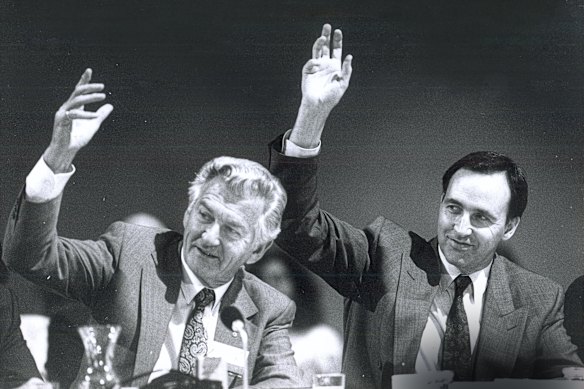
This guarantees more drift while the government debates its leadership. Streeting may be able to repeat Keating’s success in waging a campaign over six months to convince MPs to vote for change. For now, however, there is general confusion about how to resolve the breakdown within the government.
“Wes is just trying to seize an opportunity, it’s as simple as that,” said one Labour backbencher, John McDonnell, in an interview with LBC News in the hours after the resignation. “Ambition is overriding principle and real political commitment.”
The Streeting supporters, however, praised him for bringing on a contest of ideas.
“We have had a principled decision by Wes to resign from the government having lost confidence in the prime minister,” said another backbencher, Alan Gemmell, on the BBC.
Starmer appears intent on governing despite the upheaval. He appointed a new minister, James Murray, to replace Streeting, who was in the health portfolio. This follows the approach earlier in the week, when the prime minister replaced four junior ministers who resigned because they had lost confidence in his leadership.
Who really has the numbers?
Starmer wants to put the onus on his challengers. Under the Labour rules, Streeting has to show he has the numbers to trigger a ballot. That means finding 81 MPs to launch the formal request for a contest, which would then go to thousands of party members. This would take months.
Time and again, Streeting’s agitators have briefed the media with claims that he already has the 81 votes he needs. The man himself has been reluctant to test this claim. On May 2, The Telegraph of London reported on its front page that Streeting was “primed to challenge” the prime minister and had the backing of enough MPs to make it happen.
If those MPs exist, they are being very coy about their loyalties.
Burnham, the hero of the left, has been desperately searching for an MP who will give up his or her seat so he can run for the House of Commons and enter the leadership race. Finally, on Thursday afternoon, a volunteer stepped forward. An MP from England’s north-west, Josh Simons, said he would resign from parliament so Burnham could run for his seat at a byelection.
Burnham did not need to say a word about challenging Starmer for everyone to know that it was on.
“We will change Labour for the better and make it a party you can believe in again,” he said in a post on social media.
Does that sound familiar? It echoes the line that helped take Barack Obama to the White House in 2008: change you can believe in.
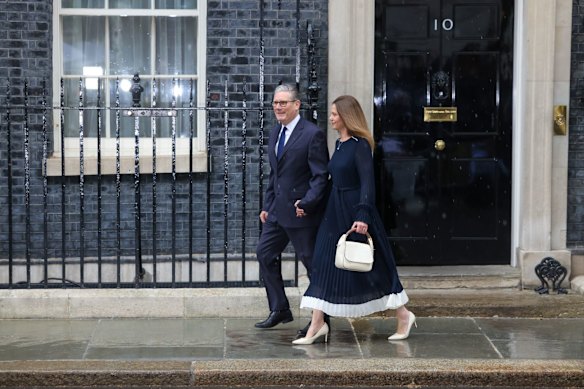
Another contender may be in the mix. Angela Rayner, a former deputy leader, stepped down from cabinet last year when the media revealed she had not paid stamp duty properly on a second home. She claimed on Thursday she had been exonerated.
Rayner was vague when The Guardian asked her on Thursday if she would run or whether Starmer should resign. Instead, she said she wanted change. What change, exactly? She was not pressed on this question.
How Starmer benefits from an open race
Starmer is being rubbished in the media, attacked by his colleagues and rejected by voters. He is disliked by 61 per cent of voters, according to YouGov. Even so, it is in interest to fight on. Why offer to resign merely to please Streeting, Burnham, or the opinion writers in the media?
The Labour rules set out a voting process that guarantees one vote, one value for all party members. In the Australian Labor Party, the elected MPs in federal parliament have enormous voting power: their ballots, combined, are worth the same as the ballots from the entire membership. In the UK, by contrast, ministers and MPs have one vote each – just like everyone else.

Crucially, the outcome is decided by preferential voting if there are more than two candidates. This sets up a scenario that might benefit Starmer if members on the right favour Streeting and those on the left want Burnham. It is possible for Starmer to be the second preference for large numbers on each side.
A poll of Labour members by research firm Survation, released on Thursday, found that Starmer would win a vote against Streeting by 53 per cent to 23 per cent. However, it found that Starmer would lose to Burnham by 28 per cent to 61 per cent. He would lose to Rayner more narrowly, by 41 per cent to 45 per cent.
The rise of the populist left
Burnham’s popularity defies conventional wisdom given he left parliament a decade ago after serving in the ministry in the Labour government that lost office in 2010. But he is admired for leaving Westminster to fight local battles for the Manchester community, so his brand is all about being a champion for the left and for working people.
Labour, in a fight for survival against populist right-wing leader Nigel Farage and Reform UK party, is desperate to fight fire with fire by finding a populist left-wing leader. Many in the party see Burnham as their saviour.
This is not just about personalities. It is about maths. Labour lost votes to the Greens at the council elections last week, and this spells doom at the general election under Britain’s “first past the post” electoral system, because there are no preference flows as there are in Australia.
When Labour loses votes to the Greens, it ends up with a lower total and no preferences. Meanwhile, some Labour and Conservative voters peel away to the right on issues like migration, helping Farage and Reform. The combined impact makes Reform the single biggest party, even if no party has a majority. In the “first past the post” system, it wins.
The danger for Burnham is that he loses his attempt to return to Westminster through a byelection. The seat in his sights, Makerfield, is west of Manchester and close to Wigan, which places it in an area that swung hard to Reform at the council elections. In the council election in Central Wigan, for instance, Reform gained 44 per cent of the vote. Labour gained only 30 per cent in a district that has been a working class stronghold for generations.
If Burnham wants to save Labour, he must first work miracles in Makerfield.
Only then will Labour move to the next step: a choice between Burnham, Streeting and Starmer. One intriguing scenario is a decision by Streeting to accept that Burnham has the numbers, as the polls suggest. In that case, the man who admires Keating could opt for running the treasury as Chancellor of the Exchequer.

And what of the government, and the country, while the Labour chieftains fight among themselves? There will be a long drift towards a ballot among party members at some point in the months ahead, weakening the government when there is war in Europe, war in the Middle East and an energy price shock.
The Burnham and Streeting camps have done superb jobs at briefing the British press to position their candidates, but they have not bothered to outline any substantial agenda for higher office. Burnham runs a council, Streeting managed the health portfolio. What the two candidates offer the country as prime minister is the subject of media spin rather than anything more compelling.
Streeting’s admiration for Keating suggests he has some zeal for reform. It is too early to tell if he can put this to good purpose.
One of the sharpest observations about Britain’s malaise came from left-leaning writer Nick Cohen, who argued on Thursday that the country would miss Starmer when he was gone. The prime minister, he said, was a scapegoat for a country that could not agree on how to save itself because all the options were so difficult.
“At some level most people in the UK know that we are in a land of make-believe,” he wrote. “But because we lack the courage to face our problems, we distract ourselves by torturing our leaders instead. Better to blame Starmer for his timidity than accept that British society in the 2020s forces timidity on its prime ministers – and then hates them for doing what we tell them to do.”
The contenders for Britain’s leadership have emerged. The candidates will spend months arguing eloquently about the nation’s problems.
If only they could fix them.
Get a note directly from our foreign correspondents on what’s making headlines around the world. Sign up for our weekly What in the World newsletter.
Disclaimer : This story is auto aggregated by a computer programme and has not been created or edited by DOWNTHENEWS. Publisher: www.smh.com.au