It is often said that pain shapes us, that the most difficult chapters of our lives leave lessons etched deep within us. But for some, pain transcends survival. It transforms into a quiet, formidable force — one that not only redefines their own journey but also ripples outward to change the lives of countless others.
For Devendra Kumar, that transformation began in a place most would struggle to even endure — a crime-ridden slum in Delhi where survival was uncertain, and safety was a privilege. Today, he is the founder of the Ladli Foundation, a grassroots movement that has impacted millions of lives across India and beyond.
But long before the recognition, the awards, or the scale, there was simply a child trying to survive.
“What I went through was not just struggle; it was my training. It made me sensitive, turning my pain into passion and passion into purpose,” Devendra tells The Better India.
A childhood shaped by survival
Devendra’s story does not begin with opportunity, it begins in the quiet shadow of abandonment, where certainty was scarce and survival came long before hope.
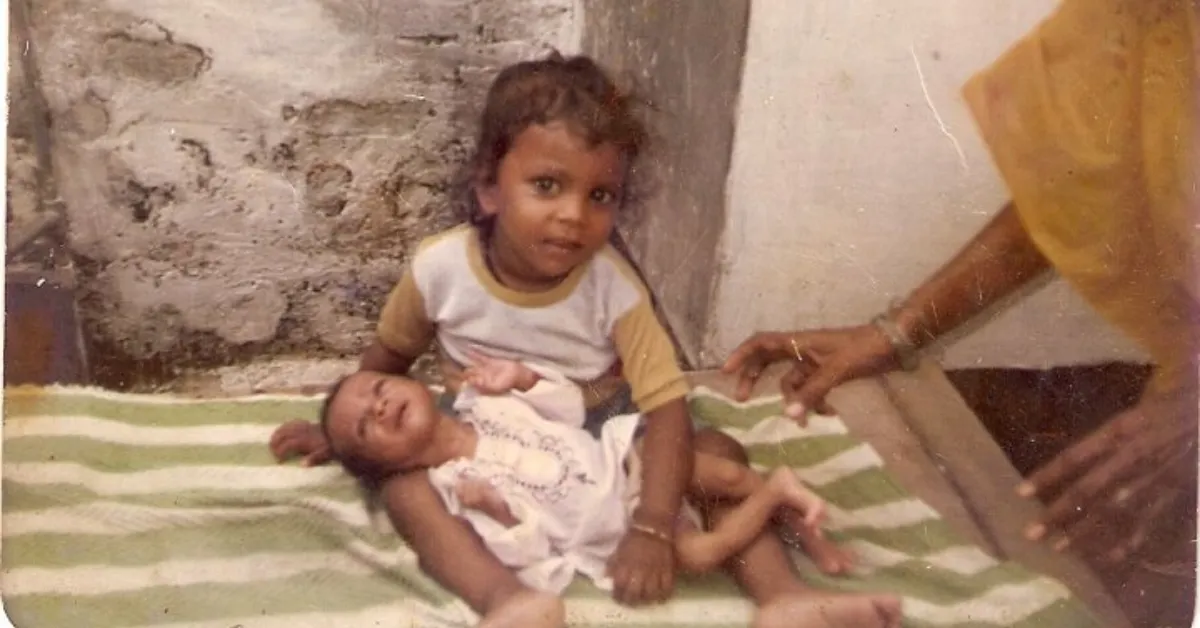
In 1988, when he was just two years old, he was left behind by his parents in a Delhi slum, with his three-day-old sister in his arms. What followed was not a childhood in any conventional sense but a fight for survival shaped by poverty, violence, and neglect.
Raised by extended family members who themselves had limited means, Devendra was pushed into child labour at the age of eight. He sold balloons on the streets, navigating a world where exploitation was common and protection was rare.
Without parental support, he found himself vulnerable to street violence and organised criminal networks that often targeted children like him.
“I used to get beaten up a lot. There was no protection, no control,” he recalls. “Children in such conditions are easy targets.”
In search of safety, he began volunteering informally with local community policing initiatives. What started as an attempt to find refuge, helping clean grounds or assisting in small activities, slowly became something deeper.
That space gave him something he had never experienced before: a sense of belonging and safety.
It was here that the seed of volunteering was planted, a seed that would eventually grow into a life’s mission.
Turning personal struggle into collective change
The turning point in Devendra’s journey came years later, not for himself, but for his sister.
Growing up in a vulnerable environment, he witnessed firsthand the pressures that young girls face — early marriage, dowry expectations, and the looming threat of exploitation. In 2007, when his sister faced similar risks, Devendra fought against the odds to ensure she was not pushed into child marriage. That experience stayed with him.
/filters:format(webp)/english-betterindia/media/media_files/2026/05/06/ladli-foundation-2026-05-06-18-19-14.png)
“I realised this was not just my story but the reality for so many girls around me,” he adds.
In 2010, driven by that realisation, he founded Ladli Foundation, an organisation dedicated to protecting and empowering vulnerable girls and women from underserved communities.
What began as a small, volunteer-led effort has today grown into an internationally recognised grassroots organisation working across sectors such as education, healthcare, sanitation, and livelihood development.
At its core, Ladli Foundation focuses on bridging critical gaps – from digital access in schools to menstrual hygiene infrastructure and from preventing child marriage to supporting girls’ education.
One of its most significant contributions has been addressing the digital divide. In government schools where children had never used a computer, Ladli foundation, set up computer labs and enabled access to digital education for over a lakh students.
/filters:format(webp)/english-betterindia/media/media_files/2026/05/06/ladli-foundation-2026-05-06-18-20-01.png)
“Children didn’t even know where letters were on the keyboard,” Devendra says. “How could they compete in a system that requires digital literacy?”
Over the years, the foundation has also introduced AI-enabled smart washrooms for girls in schools — tackling a deeply overlooked issue of hygiene and dignity that often leads to absenteeism.
Today, Ladli Foundation has directly impacted over 2.7 million people, with initiatives spanning across India and expanding internationally.
Despite the scale, Devendra insists the organisation remains rooted in its original philosophy — community-driven, volunteer-led, and grounded in real needs.
“We are not a business organisation,” he says. “We are a blessed organisation, with so many volunteers coming together to support this work.”
Building a movement with purpose and partnership
Behind Devendra’s journey is not just resilience, but also a support system that has stood by him through uncertainty.
His wife, Pankhuri Singhal, who became part of his life years after the foundation was established, recalls being deeply moved when she first learned about his journey.
/filters:format(webp)/english-betterindia/media/media_files/2026/05/06/ladli-foundation-2026-05-06-18-21-07.png)
“When I truly understood his story — his struggles and his vision, I was inspired,” Pankhuri says. “What impressed me most was his honesty and dedication. This is not just social work for him. It is his life’s purpose.”
At home, she describes him as simple, grounded, and deeply connected to his roots — qualities that remain unchanged despite his achievements.
But the journey has not been without challenges. From financial instability to long working hours and the emotional demands of sustaining a social mission, the early years and even the present have required constant perseverance.
“There were moments of concern,” Pankhuri admits. “Social work does not offer stability in the conventional sense. But his clarity of purpose gave me confidence.”
Over time, that uncertainty transformed into unwavering support.
Today, she has witnessed firsthand the impact of Ladli Foundation – meeting girls whose lives have been transformed through education, healthcare, and opportunity.
“Their confidence and happiness reflect the true value of his work,” she says. “More than awards, it is these stories that make me proud.”
From seeking support to leading change
Among the many lives Ladli Foundation has touched, Kamini’s story stands as a powerful example of what sustained support can achieve.
/filters:format(webp)/english-betterindia/media/media_files/2026/05/06/ladli-foundation-2026-05-06-18-22-34.png)
Raised in a slum community where girls’ education was often discouraged, Kamini’s journey was nearly cut short after she completed her Class 12 education. Financial constraints and societal pressures meant her family was ready to stop her studies and possibly marry her off.
“I don’t think I would have continued my education if Ladli had not come into my life,” she says.
In 2015, she became part of the Ladli Foundation — initially as a beneficiary and soon after, as a volunteer teacher at one of its centres. Supporting children from similar backgrounds, she began earning a small stipend, which she used to fund her own education.
/filters:format(webp)/english-betterindia/media/media_files/2026/05/06/laldli-foundation-2026-05-06-18-23-31.png)
What followed was a remarkable transformation.
With mentorship and support from the foundation, Kamini completed her higher education, gradually taking on larger roles within the organisation — from field coordinator to senior leadership.
Today, at just 26, she serves as a trustee of Ladli Foundation.
“It has been a full-circle journey,” she says. “From being a beneficiary to now helping lead the organisation, it has changed my life completely.”
Her impact has extended beyond her own story. Inspired by her journey, her family, who had earlier discontinued education for other girls, began supporting their studies again.
Kamini also went on to receive the prestigious Diana Award, an international recognition for young changemakers.
But for her, the real achievement lies elsewhere.
“I just want to provide the same opportunities I received to other girls,” she says. “Health, education, respect, and equal opportunity — every girl deserves that.”
A message rooted in action
Despite the scale Ladli Foundation has achieved — from national awards to global recognition — Devendra remains focused on a simple but powerful idea: that real change does not come from charity alone but from responsibility.
One of the biggest challenges he identifies is not funding, but the lack of skilled volunteers.
“People think donating money is enough,” he says. “But without understanding where it goes and how it is used, impact is lost.”
His vision is clear: a society where individuals take ownership of change at a grassroots level.
/filters:format(webp)/english-betterindia/media/media_files/2026/05/06/ladli-foundation-2026-05-06-18-25-59.png)
“If every home takes responsibility for one marginalised girl, a revolution can happen,” he says.
He encourages people to move beyond passive support and become active participants — to understand problems, build skills, and contribute meaningfully.
“What we need are skilled volunteers,” he adds. “People who know what to do, why to do it, and for whom.”
Looking ahead, Devendra envisions Ladli Foundation growing into a global grassroots movement, one that continues to amplify the voices of marginalised women and communities.
But at its heart, the mission remains unchanged. To ensure that no child has to endure the kind of childhood he did and no girl’s future is decided by circumstance alone.
Along with this, it acts as a reminder for us to understand that even from the most difficult beginnings, it is possible to build something that changes the world — one life at a time.
All images courtesy Ladli Foundation team
Disclaimer : This story is auto aggregated by a computer programme and has not been created or edited by DOWNTHENEWS. Publisher: thebetterindia.com