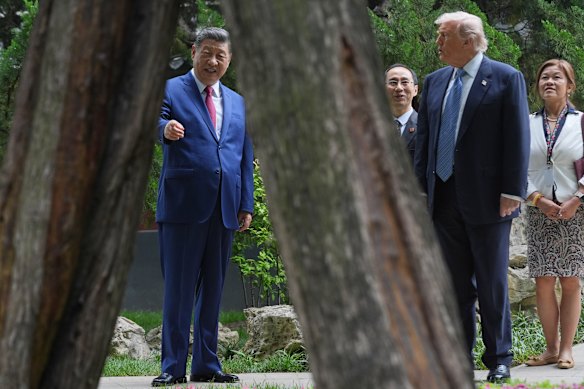
Beijing: As Chinese leader Xi Jinping took his US rival on a stroll through the secretive compound of the Communist Party, he pointed out the historic trees that have flourished since imperial times.
“Let me tell you, all the trees here are over two or three hundred years old, and there’s another tree over 400 years old over there,” Xi told US President Donald Trump through an interpreter as they wandered the gardens of Zhongnanhai.
“There are also 1000-year-old trees in other places.”
It was one of several highly choreographed glimpses of the Xi-Trump dynamic that the press was invited to record across the two-day summit, which featured hours of closed-door negotiations over the thorny issues of trade, Taiwan, the Iran war and artificial intelligence.
The symbolism of the old trees taps the cornerstone theme Beijing likes to project. China has endured for thousands of years – a measure by which the American empire is a recent phenomenon, and one Xi believes is in decline.
If Trump picked up on the messaging, he gave little away, keeping himself on an uncharacteristically tight leash with his public remarks throughout the summit.
“Nice, nice place. I like it. I like this place. I can get used to staying here, and I probably don’t want to leave,” he told Xi, as they lingered in the gardens.
For a summit low on expectations but high on optics, Xi delivered a carefully crafted spectacle designed to project China’s status as the foremost peer to the US, occupying the rarefied air of two superpower nations capable of reshaping international relations for better or worse.
The “China-US relationship is the most important bilateral relationship in the world. We must make it work and never mess it up”, Xi said in a toast, as the Chinese side hosted Trump at a banquet at The Great Hall of the People on Thursday evening.
These kinds of highly billed proceedings rarely land consequential outcomes themselves or change the fundamentals of bilateral relationships, and they are designed as much to send messages to their domestic audiences as they are to the world.
“This is a boxing match between two very good heavyweights,” says Dennis Wilder, a former White House intelligence official who helped arrange then-president George W. Bush’s trips to China.
“They’re both great at this game. Both leaders are quite confident that they own the high ground.”
As the two men strolled through Zhongnanhai, a travelling US reporter was cut off by Chinese minders for trying to lob a question.
“No questions,” the reporter was told when he asked Trump if he was enjoying his visit. Trump responded with a thumbs-up. Xi has not taken a question from the press since 2017.
The incident serves as a reminder of the fundamental ideological differences between the two nations – one obsessed with individual freedom and the other with control; one run by a president whose volubility knows few constraints and the other by a leader who never goes off script.
After a turbulent year in which Trump kicked off his second-term presidency with a tariff war, from which Xi refused to back down, the US-China relationship found a fragile truce in October when the pair met on the sidelines of the APEC summit in South Korea.
Since then, China experts have debated whether the leverage has shifted in Xi’s favour as Trump arrived in Beijing this week with the economic damage of the Iran war hammering his popularity at home, and his tariff regime crippled by the US courts.
For his part, Xi unveiled a new framing for the China-US relationship as one based on “constructive strategic stability”, which state media said was meant to “provide strategic guidance for the next three years and beyond”.
In the tepid language of Communist Party speak, it may sound underwhelming, but China analysts will spend considerable time unpacking it as Beijing rarely throws out new declarative statements. Xi also packaged it with a well-worn warning on Taiwan – that this stability hinged on the US not “mishandling” the reddest of all red lines for China.
“This tells us two things: that US-China relations are stable, but also they are not partners, because they still do not align on matters of fundamental strategic interest,” says Wen-Ti Sung, a Taipei-based specialist on China-Taiwan relations at the Australian National University.
To Americans, China came across in this summit as economically permissive but politically hardball. George Chen, a partner at The Asia Group consultancy, said Xi’s remarks drew clear boundaries for the US while offering reassurance to American businesses.
“Politically, the message was unequivocal: everything begins with Taiwan,” he said. “Xi expressed zero tolerance for any moves toward Taiwan independence, and he placed this ‘red line’ at the very start of his meeting with Trump. There was no ambiguity, no softening – just a direct restatement of China’s core position.”
Trump signed off on a $US11 billion ($15 billion) arms package to Taiwan last year, infuriating China, which regards the island democracy as its own territory. A further $US14 billion in weapon sales is awaiting Trump’s approval, and Xi was expected to press him to delay or withhold it during their summit talks.
US Secretary of State Marco Rubio said America’s Taiwan policy remained “unchanged” in an interview with NBC from the sidelines of the summit.
“They always raise it on their side. We always make clear our position, and we move on to the other topics,” said Rubio, who was among senior aides to join Trump for the talks.
Xi’s directive of “constructive strategic stability” will now filter down through the byzantine network of the Communist Party system.
“Once the signal from Xi himself comes out, that’s actually the directive to the working level officials on how they need to proceed with their relationship with the US counterparts,” says Dylan Loh, an expert on Chinese foreign policy at Nanyang Technological University in Singapore.
“It’s a signal to the entire ecosystem that we are looking for stability … not confrontation.”
Trump, eager to announce “wins”, said the two men had made “some fantastic trade deals”, as he touted his strong relationship with Xi in a message also aimed at shoring up stability.
“We’ve settled a lot of different problems that other people wouldn’t have been able to settle. And the relationship is a very strong one. We’ve really done wonderful things, I believe,” he said in brief remarks before the press at Zhongnanhai.
With the details of the summit still yet to filter into the public domain, some of the more concrete substance about the leaders’ apparent discussions has come through Trump’s interviews with Fox News while in Beijing. He said China had agreed to buy 200 Boeing jets and that Xi had offered to help reopen the Strait of Hormuz, claims the Chinese side has not commented on.
“He did offer. He said, ‘If I can be of any help at all, I would like to be of help’,” Trump told Fox’s Sean Hannity, recounting his conversation with Xi.
The Iran war has added a fresh source of tension to the US-China relationship due to the fact that Beijing is Tehran’s chief financial backer as the major buyer of its oil. But experts have been sceptical that Beijing has any meaningful influence over Tehran, or that it would be willing to leverage it to help the US resolve a war of its own making.
By the time the wheels were up on Air Force One out of Beijing, it was not clear if Trump had secured any firm commitments from Xi on Iran, or what he might have traded to get a deal for Chinese support.
The stage is set, however, for a year of summitry between the world’s two most powerful men. Trump invited Xi to the White House in September, and he could return to China in November for APEC in Shenzhen, the country’s tech capital.
Plenty of opportunity for the leaders to hone their optics, while the furious competition between their countries for prestige and power on the world stage remains unchanged.
Get a note directly from our foreign correspondents on what’s making headlines around the world. Sign up for our weekly What in the World newsletter.
 Lisa Visentin is the North Asia correspondent for The Sydney Morning Herald and The Age based in Beijing. She was previously a federal political correspondent based in Canberra.Connect via X or email.
 Michael Koziol is the North America correspondent for The Age and Sydney Morning Herald. He is a former Sydney editor, Sun-Herald deputy editor and a federal political reporter in Canberra.Connect via X or email.
From our partners
Disclaimer : This story is auto aggregated by a computer programme and has not been created or edited by DOWNTHENEWS. Publisher: www.smh.com.au