
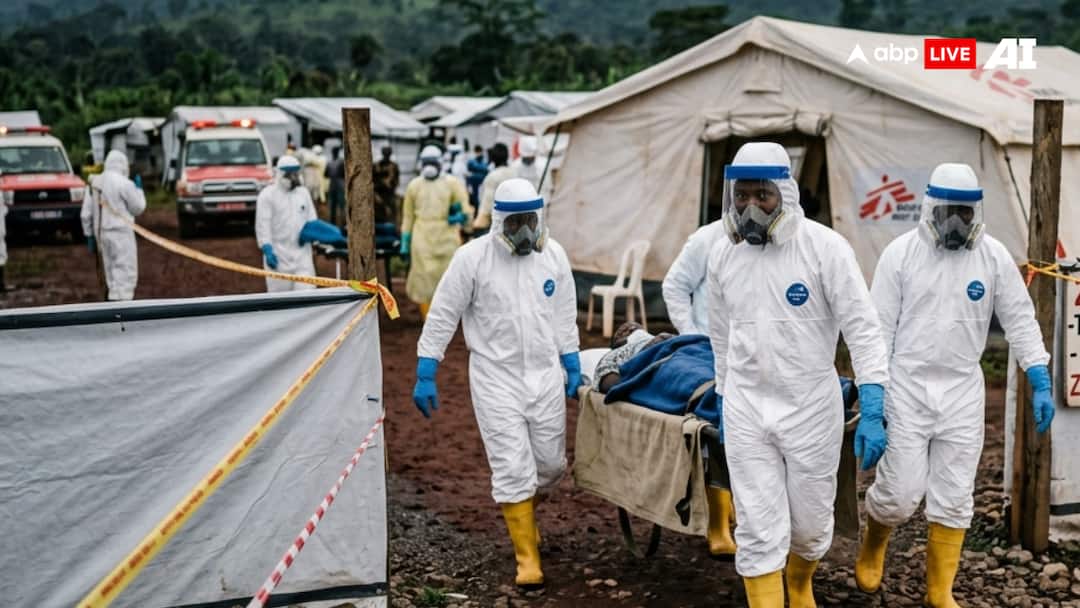
- WHO declares public health emergency over rare Ebola strain.
- Outbreak in eastern DRC now includes cases in Uganda.
- Bundibugyo strain lacks approved vaccines and targeted treatments.
- Urgent regional monitoring and strengthened surveillance are vital.
A deadly Ebola outbreak unfolding in eastern Democratic Republic of Congo has prompted the World Health Organization (WHO) to declare a public health emergency of international concern, raising fears over the spread of a rare and difficult-to-contain strain of the virus.
Health officials say the outbreak, centred in Ituri province, has already led to dozens of deaths and hundreds of suspected infections. While the WHO stressed the situation does not currently qualify as a pandemic-level emergency, concerns are mounting over the uncertainty surrounding the true scale of infections and how far the virus may have already travelled.
ALSO READ: What Is HLHS? Doctors Explain Rare Heart Condition Linked To Celina Jaitly’s Son
Rare Bundibugyo Ebola Strain Raises Alarm
According to the WHO, the outbreak is linked to the Bundibugyo strain of Ebola, a rare form of the virus for which there are currently no approved vaccines or targeted treatments.
So far, eight laboratory-confirmed cases have been identified, while approximately 246 suspected cases and 80 deaths have been reported across multiple health zones in Ituri province. The affected areas include Bunia, the provincial capital, along with the gold-mining towns of Mongwalu and Rwampara.
WHO Director-General Dr Tedros Adhanom Ghebreyesus warned that major uncertainties remain over both the number of infections and the geographical spread of the outbreak.
Virus Crosses Into Uganda
The outbreak has already extended beyond Congo’s borders. WHO confirmed that two Ebola cases have been detected in neighbouring Uganda, increasing fears of wider regional transmission.
Ugandan authorities said a 59-year-old man who died on Thursday tested positive for the virus.
Health experts believe countries bordering DR Congo face an elevated threat because of frequent cross-border travel, trade activity, and large-scale population movement.
ALSO READ: Why PCOS Or PMOS Cases Are Increasing In Young Women?
WHO Calls For Emergency Response Measures
In response, the WHO has urged both DR Congo and Uganda to activate emergency operation centres aimed at improving monitoring, contact tracing, and infection prevention efforts.
The agency advised that infected individuals should be isolated immediately and remain under treatment until two virus-specific tests taken at least 48 hours apart return negative results.
Neighbouring countries have also been asked to strengthen disease surveillance systems and improve health reporting to detect possible cases quickly.
At the same time, WHO cautioned governments against shutting borders or restricting trade and travel. The agency said such measures are often driven by fear rather than science and are not currently recommended.
Why This Outbreak Is Especially Concerning
Public health officials have expressed growing concern over the locations affected by the outbreak. Africa CDC previously warned that urban centres such as Bunia and Rwampara, combined with intense mining activity in Mongwalu, could accelerate transmission.
Dr Jean Kaseya, executive director of Africa CDC, said significant movement between affected areas and neighbouring countries makes regional coordination critical.
The mobility of workers, traders, and residents across borders has complicated efforts to contain the virus before it spreads further.
Understanding Ebola And Its Symptoms
Ebola was first identified in 1976 in what is now the Democratic Republic of Congo. Scientists believe the virus originally spread from bats.
The disease spreads through direct contact with bodily fluids or through broken skin. It can trigger severe bleeding, organ failure, and death.
Early symptoms often resemble common illnesses and include fever, muscle pain, fatigue, headache, and sore throat. As the disease progresses, patients may experience vomiting, diarrhoea, rashes, and internal or external bleeding.
There is still no proven cure for Ebola. According to the WHO, the virus carries an average fatality rate of around 50%.
Check out below Health Tools-
Calculate Your Body Mass Index ( BMI )
Calculate The Age Through Age Calculator
Before You Go
Breaking: ED Busts UP Cough Syrup Smuggling Network, ₹400 Crore Fake Firms Scam Uncovered
Disclaimer : This story is auto aggregated by a computer programme and has not been created or edited by DOWNTHENEWS. Publisher: abplive.com



