
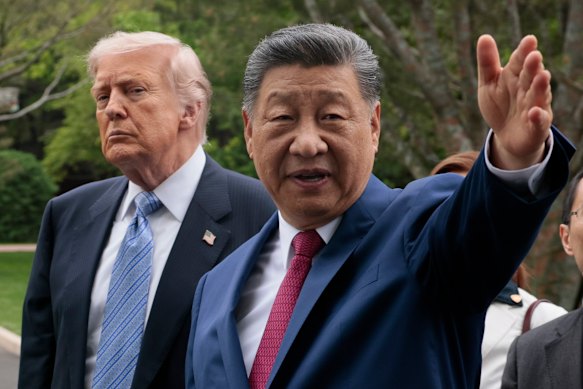
China is willing to go to war over Taiwan. That’s the unambiguous message Xi Jinping gave Donald Trump when the two presidents met for more than two hours behind closed doors last week. Xi’s larger audience was the East Asian region and the news and think-tank ecosystem that explains global affairs to the US public. That is why, even before Xi finished his remarks, China’s Foreign Ministry said he told Trump that “The Taiwan question is the most important issue in China-US relations.” Unless it was “handled properly”, there will be “clashes and even conflicts, putting the entire relationship in great jeopardy”.
The ministry downplayed the topics that Trump had been most eager to talk about with Xi: Iran and the Strait of Hormuz, buying Boeing aircraft and ending the flow of fentanyl precursors into the US.
China’s leaders do not use words like “clashes and conflicts” lightly. They prefer anodyne word salads such as “win-win co-operation”, “promote harmony”, and “shared prosperity”. But Taiwan is the reddest of red lines for China for three reasons. As a vibrant, multiparty democracy, it represents an ideological challenge to the Communist Party of China’s preferred model of governance. Taiwan has enjoyed free elections and peaceful transfers of power since 2000. It is rated 93 out of 100 on Freedom House’s yearly assessment of countries’ civil liberties and political rights. China, by contrast, is rated 9.
The second reason is that China’s leaders since at least the Ming dynasty (1368-1644) have regarded it as part of their territory. They officially incorporated Taiwan during the Qing dynasty (1644-1912), administering it as a prefecture of Fujian Province in 1683. The Qing made Taiwan a separate province in 1886. Japan annexed the island in 1895. The Republic of China regained sovereignty over Taiwan when Japan surrendered in World War II. The Republic’s leaders fled to Taiwan after losing the civil war to the Communists.
Both sides claimed to be the legitimate ruler of all China – the mainland and Taiwan. No other country today has a better claim to the island. Communist China’s claim blends modern and pre-modern concepts of sovereignty. Other ancient countries have similarly blended concepts; India and Pakistan both claim Kashmir as part of their national territory and neither accepts an independent Kashmiri state.
The third reason is well understood by military planners but not by the general public. Taiwan is a critical node in a chain of islands consisting of US allies and partners: Japan to its north and the Philippines to its south. This chain has allowed the United States to “dominate with sea and air power every Asiatic port from Vladivostok to Singapore”, as General Douglas MacArthur said in his farewell speech to Congress in 1951. US strategists today call this “deterrence” rather than “dominance”, in keeping with modern sensibilities. China cannot reach the western Pacific Ocean without going through the Miyako Strait north of Taiwan, or through the Luzon Strait south of Taiwan. Both are within range of US forces in Japan and the Philippines, respectively.
The undersea geography near Taiwan is therefore a chokepoint for China. Chinese submarines must transit shallow coastal waters before entering the deep Pacific Ocean basin on the other side. Sensors mounted at the bottom of the shallow continental shelf are connected by fibre-optic cables that come ashore in Philippine and Japanese territory for data processing by US technical intelligence. The US can detect, track and follow Chinese submarines as they cross the sensor barrier. It can trail them covertly with its own very quiet submarines, or use maritime patrol aircraft and ships equipped with antisubmarine warfare helicopters to trail them overtly. It can sink Chinese ships if ordered to do so in a crisis.
China’s calculations are thus easy to understand. A takeover of Taiwan would eliminate its fear of the undersea sensor barriers. China could then set up a new submarine base on Taiwan’s east coast, near the ports of Keelung, Su’ao, Hualian and Taitung. Its submarines could go from eastern Taiwan directly into the western Pacific Ocean, no longer needing to traverse 1240 kilometres of potentially hostile waters. It could place its own undersea sensors on Taiwan’s east coast. Its cruise missiles could deter US warships from a safe distance. China could then detect and roughly track US surface forces as far as 1000 kilometres away.
For China, incorporating Taiwan allows it to deter hostile forces off its own coastline. For the US, if China were to take Taiwan it would be free to project power into the Pacific Ocean. Little wonder, then, that Trump has sought to put the Taiwan issue into deep freeze at least until he gets past the midterm elections. As he told Fox News soon after the end of his summit with Xi, “I want them [Taiwan] to cool down. I want China to cool down.”
Professor Clinton Fernandes is in the Future Operations Research Group at UNSW. His latest book is Turbulence: Australian Foreign Policy in the Trump Era.
The Opinion newsletter is a weekly wrap of views that will challenge, champion and inform your own. Sign up here.
 Professor Clinton Fernandes is part of University of NSW’s Future Operations Research Group which analyses the threats, risks and opportunities that military forces will face in the future. He is a former intelligence officer in the Australian Army.
From our partners
Disclaimer : This story is auto aggregated by a computer programme and has not been created or edited by DOWNTHENEWS. Publisher: www.smh.com.au


