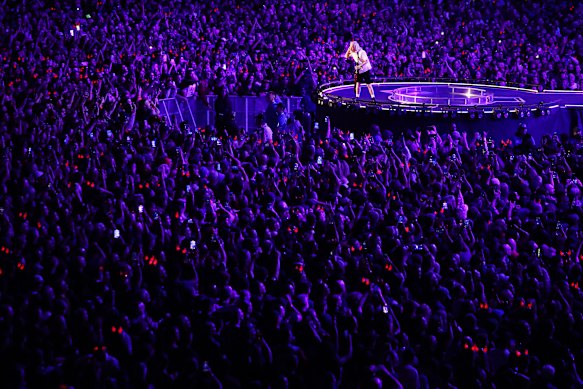

Consumers should pay a tax on concert tickets at major stadiums in NSW to fund the state’s struggling local live music scene, three peak industry associations say.
The proposal is based on the success of models used in Britain, throughout Europe and in other Western nations. However, it has raised questions about whether multinational corporations or consumers should fund the impact that large tours have on the local music economy.
In submissions ahead of Monday’s parliamentary inquiry into the state of live music in NSW, the Australian Music Venues Foundation – a lobby group representing grassroots music venues in Australia – proposes a $1 levy on every ticket for shows with a capacity above 5000 patrons. It would be applied to a defined list of major venues, such as Qudos Bank Arena, Accor Stadium and the Sydney Opera House.
The organisation is the sister agency to Britain’s Music Venue Trust, which pushed for a voluntary £1 contribution per ticket on shows with a capacity of more than 5000, agreed by participating artists, managers, agents, venues and promoters.
In February, Britain’s representative body for live music, the LIVE Trust, distributed £500,000 to seven programs funding emergency hardship for artists, venue upgrades, tour support and training and mentoring.
Based on this, the AMVF estimates a $1 levy could generate between $3 million and $3.15 million annually from five major Sydney venues alone.
“This figure is likely an underestimate, as it does not include data from all eligible venues across the state,” its submission reads. “A simple analysis confirms that a modest $1 levy on tickets at major venues represents a multi-million dollar opportunity to create a sustainable funding stream for the grassroots venues, promoters, and artists.”
However, the NSW Greens’ music, arts and night-time economy spokeswoman Cate Faehrmann, said consumers already bore multiple ticketing costs and multinational corporations should fund the local scene by being taxed more.
“There’s already multiple hidden fees and charges in every single concert ticket sold – booking fees, infrastructure fees, service fees,” Faehrmann says. “I don’t think concert-goers should have to fork out any more fees when Ticketek and Moshtix are both owned by global music giant Live Nation and making gazillions from the fees they’re already charging.
“A better idea would be for these companies to stop sending so much of their profits offshore and pay more tax here. Any fund to support live music, including independent venues and emerging artists, should be funded from these music giants’ profits, not from any additional fees imposed on audiences.”
AMVF chief executive Tam Boakes said the scheme would work only if artists cover the donation, or if consumers pay it.
“[Pop singer] Olivia Dean is touring this year, and she’s donating to us, which is that exact thing and a ticket says that, ‘This donation is included’,” Boakes said, adding that $1.10 of each ticket to Dean’s Australia tour will go to the AMVF.
“That’s ideally how we’d love to see it work, but otherwise, I guess it’s going to be like a punter, either opt in or opt out, where it will be an extra dollar … Unfortunately, that is the consumer paying.”
Music NSW managing director Joe Muller, whose organisation has also backed the levy, said the tax will help ensure large multinational promoters and ticketing companies contribute to the local music scene.
“If you think about the multinational companies that are bringing big international artists into Australia, so often, all the economic value of those shows is leaving the country – you can kind of walk into Taylor Swift, and I did a couple of years ago, and there’s not an Australian song that’s played while you’re in the stadium,” Muller says.
“As algorithmic recommendations have changed the way that Australian audiences are engaging with local artists, I think it’s essential that we look to ways of investing in our local music ecosystem to ensure that there’s a chance for local artists to be competitive here and for Australian audiences to connect with Australian artists.”
Another organisation pushing for the levy is the Live Music Venues Alliance, a coalition of independent venue operators across NSW, which says the contribution should be shared equally by the stadium, the promoter, the artist and the ticket purchaser.
“A stadium ticket levy presents a potential complementary funding mechanism for grassroots live music venues,” the submission reads.
“Importantly, this levy should operate as ancillary to existing and future government funding programs, not as a replacement for public investment. The intent is to complement government support by creating an industry-led, self-sustaining funding mechanism that strengthens the live music ecosystem.”
Find out the next TV, streaming series and movies to add to your must-sees. Get The Watchlist delivered every Thursday.
 Kayla Olaya is a culture reporter at The Sydney Morning Herald.Connect via email.
From our partners
Disclaimer : This story is auto aggregated by a computer programme and has not been created or edited by DOWNTHENEWS. Publisher: www.smh.com.au