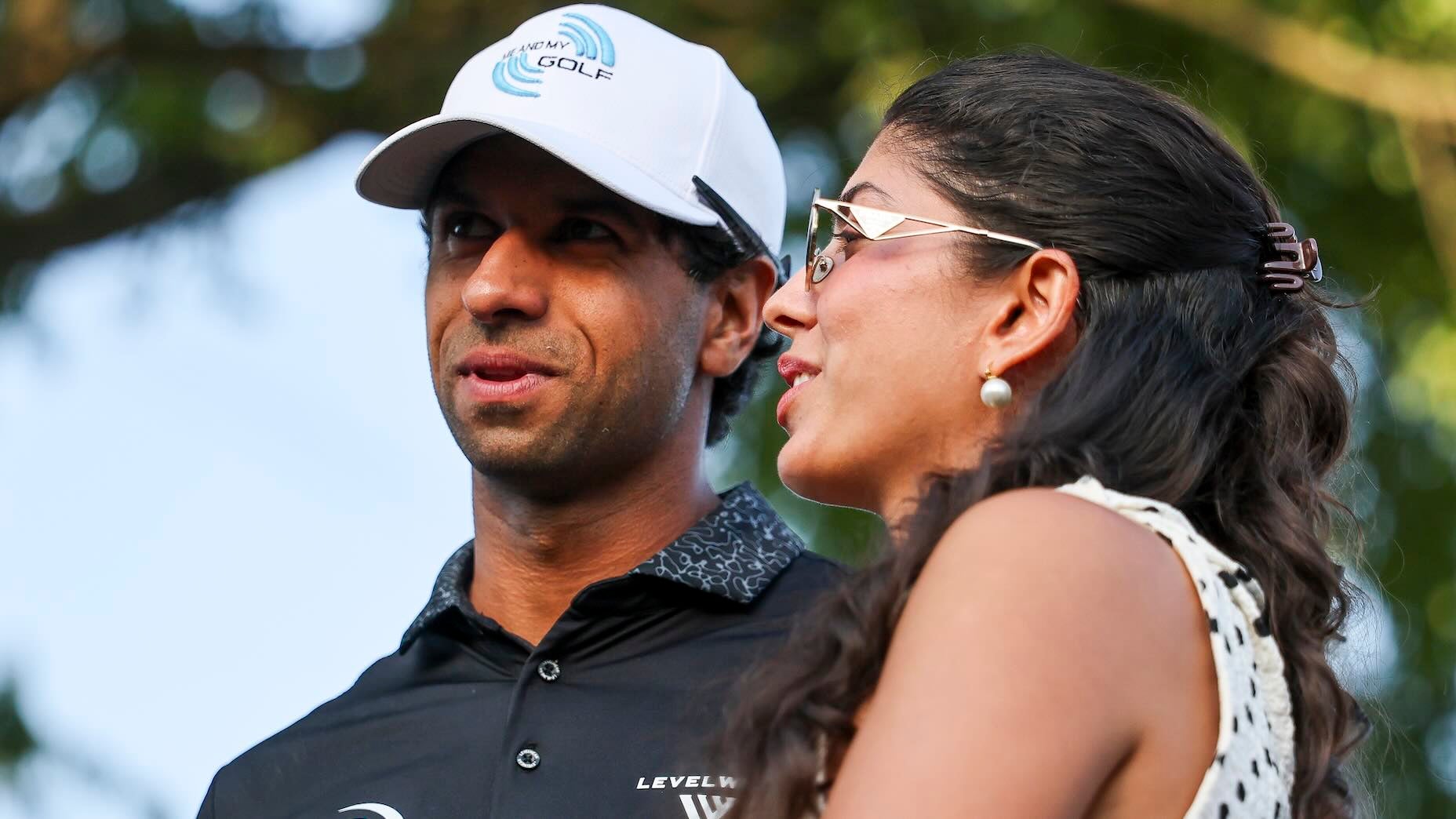
NEWTOWN SQUARE, Pa. — Aaron Rai had no idea what to do.
He’d just finished off a 1-foot putt to secure the biggest win of his professional life, emerging from a peloton of heavyweights and leaving them in the dust, building a back-nine highlight reel en route to a shocking first major championship title. But the moment the job was finished, Rai seemed suddenly lost. No fist pump. No wave. He sort of wobbled in one direction, then another. And then, as the Philadelphia faithful roared, Rai did what felt most natural.
He turned to his playing partner, took off his cap and offered his hand.
“He’s just so polite,” said Ludvig Aberg a few minutes later, chuckling at the moment. “He’s got a putt to win his first major and he still said ‘good putt’ to me? He’s taking time to look me in the eye and say well done? That stands out. That’s really impressive.
“If there’s one guy I’d love to lose to, it’s probably him.”
BY NOW, YOU’VE HEARD ABOUT RAI’S IRON COVERS. If you’re a golf fan, you likely know the story. He’s the only high-profile pro who uses them — and they’re broadly considered cringe in a sport where different ain’t good. But that’s also the point. That’s how they serve to explain Aaron. The iron covers tell his story. Here’s a concise version he offered to ESPN:
“My mom and dad worked extremely hard to support me, and my dad used to buy me the best equipment that he could, and he brought me a really nice set of irons, which he paid a lot of money for. And after every practice session he used to come home and he used to clean each groove with baby oil and a pin to get all the dirt and grime out, and then he started to put iron covers on those soon after to look after them and take care of them. So the reason I [use them] now is to remember what I came from — and also to respect the things that I have.”
It’s a remarkable telling. We could leave this piece here and you’d get the idea. Rai is different. He’s grateful. He’s humble. And he’s proud of where he came from. Also, Rai can spin a neat parable.
But plenty of sons learn habits from their fathers and then discard them once they realize they’re uncool. Not Rai. So how’d he dodge the pressures of conformity and sameness? Why isn’t he wearing a white golf glove, a brand-name hat logo, a too-cool-for-school attitude, as is status quo on Tour? He pondered the question in his post-round press conference, then returned to his father.
“I think my dad played a really big role in that,” he said. It was the two of them for most of his childhood, he said. They’d practice together, read about golf, watch Tiger Woods VHS tapes. Amrik implored Aaron to stay in his lane, to control the things he could control.
“And I didn’t really mix with a lot of other junior golfers, which didn’t give me a perspective of what was normal,” Rai added. “So I think he kind of sheltered me to be able to develop in a way that made sense for me, in a way that I guess was a little bit unique — with two gloves, with iron covers, et cetera.”
By the time Rai was a teenager, playing more serious competitive golf and ultimately at the pro level, he had enough self-belief to stay the course, to double down on himself.
“I felt like I was strong enough in why I did certain things,” he said. “I knew the reasons why I do them. I believe in the reasons why I do them. So I had no reason to really shift from that as I got older.”
AARON RAI WON THE PGA CHAMPIONSHIP the same way every golfer eventually succeeds: By being himself.
No, he wasn’t the major champ we expected. We entered this week on a run of brand-name winners. Rory McIlroy and Scottie Scheffler had won four of the last five, the last decade of PGA champs are all multiple major winners and there was every reason to believe that, like them, this week’s winner would come from the Tour’s tier of top-ranked, big-hitting alpha dogs.
Even with Sunday’s traffic-jam leaderboard — 30 players within five shots of the lead — there were enough big names in the mix that it seemed likely one would end up on top. When Rai bogeyed three of the first eight holes he seemed destined for the ranks of the also-rans.
But then Rai started building a highlight reel.
First with a bomb for eagle at No. 9 from the back of the green, where McIlroy had settled for par just minutes before.
Then with an incredible bunker shot at the short par-4 13th, landing his 40-yarder on top of a tiny shelf and yanking it to a stop, making birdie where Xander Schauffele had just made bogey.
Then with a glorious high-cut approach into the par-5 16th, the exact shot demanded by the hole and the moment, setting up an easy two-putt birdie that opened a gap on the rest of the field.
And then, impossibly, with a 68-foot birdie bomb at No. 17, the most crowded spectator area, sending the loudest roar of the week cascading across property. It was an exclamation point. Suddenly he was up by four. Suddenly the tournament was over. Suddenly everything had changed.
SO WHO IS AARON RAI? If the jury is his peers, he’ll come out okay.
Take Schauffele, the two-time major champ, who was thrilled to share his impressions of Rai.
“I’m super happy for him. He’s such a good dude,” he said. “Rarely do you feel like people work way harder than you … but Aaron is always there. He’s always in the gym. He’s always on the range. He’s always — you know, at the Scottish, I’m staying right on site there. I thought it would be fun for [his caddie] Austin and I to go putt. Aaron is finishing up his little putting session at 9 p.m. and going to the gym at 9:45.
“This was three years ago. I think that’s what it’s about. To be a major champion, you put the work in when nobody’s looking. Super pumped for him and his team.”
McIlroy, who won last month’s Masters, affirmed his approval rating.
“It looks like he’s going to win, which is great,” he said post-round. “You won’t find one person on property who’s not happy for him.”
“Aaron is a super hard-working guy,” added Matti Schmid, who finished T4. “Maybe the most hard-working guy on tour. He does everything so deliberate. Practices with so much intention. I think he does a lot of things the right way, and that’s why he’s the winner today.”
And although Jon Rahm hasn’t spent much time with Rai, he knows the iron-cover story and that tells him plenty.
“That he’s still doing it shows a lot about a person,” he said. “I have heard consistently there’s very few people that are nicer and kinder human beings than Aaron Rai.”
THERE’S A TEMPTATION TO SAY THAT RAI’S NOT COOL. That’s the subtext of the irons-cover story, of the two black golf gloves, of his insistence on politeness above all else.
But that misses the point entirely.
Rai does things his own way. Practices, plays, thinks, speaks, dresses. He won doing things his way. He’ll keep doing things his way. He’ll keep winning, too.
So he may not have had a big-time bottle-service post-round celebration lined up. But he did have something money can’t buy: His wife, Gaurika, sitting beside the stage, grinning as she lobbed a promise his way:
“I can take you to Chipotle!”
He grinned.
“We’ll probably go to Chipotle.”
With a trophy in tow.
What could be cooler than that?
Dylan Dethier welcomes your comments at dylan_dethier@golf.com.
<figure class="youtube-facade" data-content="
“>
Disclaimer : This story is auto aggregated by a computer programme and has not been created or edited by DOWNTHENEWS. Publisher: golf.com