
Yuvraj was nine years old and had never once sat inside a classroom.
In Ghatotand, a small settlement in the coal-dusted landscape of West Bokaro, Jharkhand, this was common. As schools moved farther away and daily costs piled up, many children from working families slipped through the cracks. Yuvraj was one of them. His father ran a modest catering business, and his mother managed the home.
School had remained a distant idea rather than a lived reality. He did not know the alphabet. He could not write his own name.
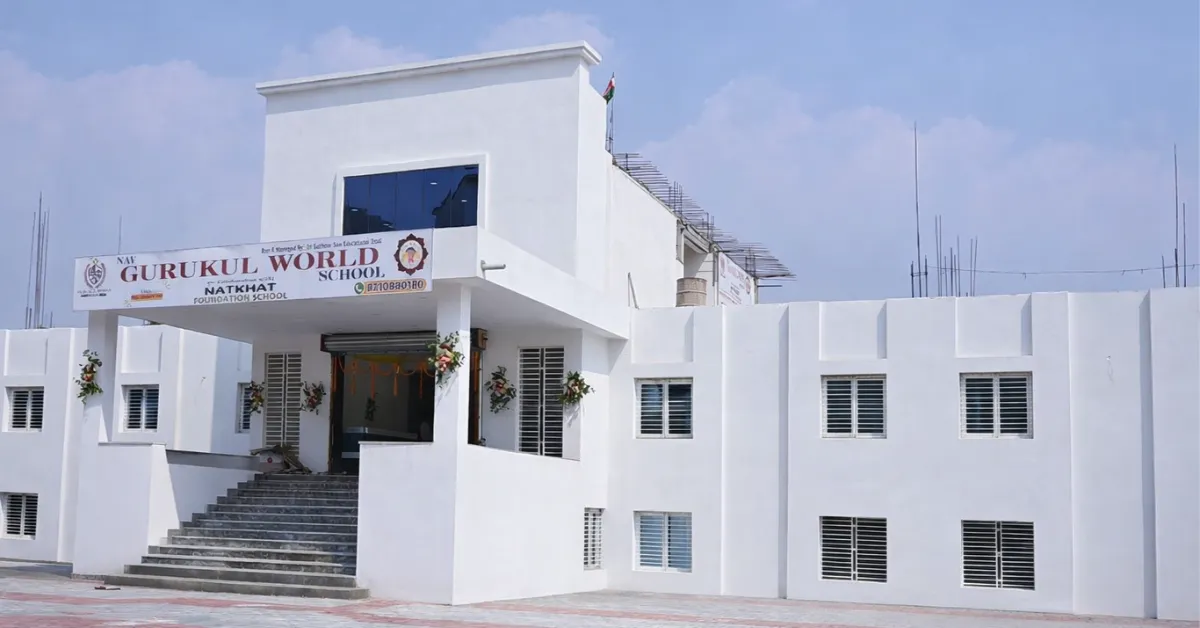
Then, in 2025, Yuvraj walked through the gates of the newly set-up Nav Gurukul World School, carrying years of missed learning with him.
Within a year, he was finishing first and second in his class. He now knows his grammar and tables, and talks about his ambitions.
His father, Rajeev Mukherjee, still gets emotional when he talks about it. “We were stunned,” he says. “He didn’t know A, B, C, D. And within one year, they prepared him so well.” He pauses and adds something that says everything: “Even when he is unwell, he wants to go to school. That is how much love these teachers have given him.”
Yuvraj’s transformation came from patient, personal attention. At Nav Gurukul, teachers did not isolate him for being nine years old and unable to read. For nearly a year, they sat with him after class, taught him through games and storytelling, and celebrated every small improvement until school stopped feeling frightening and began to feel exciting.
Once Yuvraj began enjoying school, his teachers say his natural intelligence quickly became evident. He started grasping concepts faster than expected.
For children like Yuvraj, Nav Gurukul World School became a second chance. And that second chance exists because one man made a stubborn, expensive, and deeply personal decision to come home.
That man is Nitesh Kumar.
A town that coal built, and coal took away
To understand what Nitesh built, we have to first understand what was lost.
West Bokaro sits about 60 kilometres from Ranchi, in the heart of Jharkhand’s mineral belt. Decades ago, coal mining companies established sprawling townships here, and with them came an entire world.
There were schools with hundreds of students, a stadium that once hosted national-level football matches, a hospital, a market, and residential quarters filled with families from across India. It was, in its own way, a complete community.
Ghatotand was part of that world. Children here grew up with access to quality schooling. The missionary school and the company-run institutions were their lifelines.
However, slowly, and then all at once, it began to unravel.
As mining operations expanded over the years, the township’s infrastructure was dismantled. Buildings came down, and families relocated.
The schools that had anchored this community for generations were shifted nearly 20 kilometres away. Company-run buses ferried the children of company employees and everyone else was left to figure it out.
For the families of Ghatotand and the surrounding villages, the distance became a daily barrier. A three-year-old cannot travel 40 kilometres a day. A daily labourer’s family cannot absorb a transportation cost of Rs 1,000 a month on top of school fees. And so, quietly and without much fanfare, children simply stopped going to school.
The few preschools that remained in the area offered little comfort. Teachers recited the alphabet from textbooks, and children sat in rows and repeated after them.
There was no play, no curiosity, no sense that learning could be joyful. Parents with ambitions for their children sent them outside Jharkhand entirely.
Nitesh, who had watched this pattern from afar for 15 years, came home during the COVID-19 pandemic on a work-from-home arrangement. And for the first time, he saw it all up close.
‘Why can’t we start a preschool?’
Nitesh had followed the familiar road out of Jharkhand. He had moved out to study engineering in Shimoga, Karnataka, joined the IT sector in Bengaluru, and built a comfortable life there.
Every time he returned home on vacation, he noticed the same thing: young people leaving, the brightest minds boarding trains southward, not by choice but because there was simply nothing for them here.
“From then on,” he says, “I kept seeing our best people travel to southern states just for education. Those who could afford it left. Those who couldn’t stayed back and took whatever jobs they could find.”
/filters:format(webp)/english-betterindia/media/media_files/2026/05/19/3-2026-05-19-12-11-35.png)
COVID brought him back, and something about being home again made leaving feel impossible. He saw the demolished buildings, the shuttered schools, the children in his own neighbourhood with nowhere to go.
He had land. He had savings from a previous business venture. But the spark finally arrived in the form of his wife Nutan Sahu, who worked as a legal advisor and who, one evening, asked him a simple question.
“Why can’t we start a preschool?”
Nitesh, true to his engineering instincts, began researching. He visited every preschool in the area with his young son. He sat in on classes, spoke to parents, and came away with the same conclusion each time.
The infrastructure was bare, the teaching was rote, and the children were bored. So, he decided to take matters into his own hands and build something different.
Nine months and 11,000 square feet later
In May 2024, construction began on a piece of ancestral land in Ghatotand. Nitesh told his contractor one thing: “Finish it, whatever it takes.”
For months, he stood on that site in the punishing summer heat, watching a two-storey building take shape. Proper classrooms, a dedicated play area, projectors, bright corridors that felt like they belonged to a school that children would actually want to attend.
He borrowed money, took out loans and spent every rupee from the sale of his previous business. When the building was finally complete after nine months, the neighbourhood came out to look at it and could not quite believe what they were seeing.
/filters:format(webp)/english-betterindia/media/media_files/2026/05/19/6-2026-05-19-12-12-15.png)
The total investment came to Rs 1.25 crore, with a monthly EMI of Rs 1 lakh. Nitesh was still working a remote IT job to keep his household running when he opened the school’s gates in February 2025 with a simple promise: the fee would be Rs 800 a month, even as other schools charged around Rs 2,400, and no child would be turned away because their parents were struggling.
But the building alone did not make the school. Its real strength came from the person who agreed to lead it — B V Priyamvada.
The principal everyone loved
Priyamvada, known warmly throughout the region as ‘Rosie Ma’am’, had spent 30 years in education. She was among the most respected educators in the region, a woman whose name alone carried weight in every household.
She had recently stepped away from her previous school and was, by her own account, wondering what came next.
One morning, Nitesh received a phone call. Rosie Ma’am wanted to see the school.
She walked through the entrance, looked around the bright, purposefully designed building, and went quiet for a long moment. “I heard you were constructing something,” she told him. “But I never expected this.”
She joined. And when word spread that Rosie Ma’am was going to teach here, the admissions began in earnest.
Together, Nitesh and Priyamvada built a school around a simple but radical idea: that a child should want to come. Not because their parents force them, but because something at school calls to them every morning.
The curriculum is play-based, and concepts are taught through stories and activities rather than repetition.
/filters:format(webp)/english-betterindia/media/media_files/2026/05/19/4-2026-05-19-12-12-43.png)
Every Friday is kept open-ended, giving children the freedom to create without fixed instructions. Cultural celebrations bring together festivals from different communities and faiths.
English communication, too, is practised as a daily habit rather than taught only as a subject. Nitesh remembers arriving in Bengaluru as a young engineer who knew the textbook well but struggled to hold a conversation, and he does not want these children to face the same barrier.
“The child should come to school willingly and happily,” Priyamvada says, “and go home with the same happiness. They should also develop critical thinking skills.”
In its very first year, nearly 100 children enrolled, a sign of how many families in the area had been waiting for a school like this for their three- to eight-year-olds.
‘My child is excited about school now’
Today, a little over a year later, the school has enrolled over 200 children from four villages and expanded up to Class 5. Some students travel more than 10 kilometres each way to attend, a sign of how far families are still willing to go for a school they trust.
That growth is visible in the everyday life of the school. Walk through Nav Gurukul World School on any given day, and you will find Class 2 students performing a skit about road safety, earnest and thoroughly rehearsed.
You will find nursery children sitting completely still, listening to a teacher spin a story, their eyes wide and their small hands folded in their laps.
You will find a girl named Vaishnavi in Class 3, whose parents are not formally educated but who has decided, with the certainty only a child can muster, that she will become an IPS officer because last year, they planted saplings in science class and watched them grow.
And for Aarav, a UKG student, ask him his favourite animal or colour and he will list them all out: “I love black, orange, blue, green, giraffes, elephants, dogs, cats, lions…” His excitement with his new vocabulary spills out in a long, delighted list.
You will also find the parents, who speak about this place with a gratitude that is not performative.
Dhananjay Vishwakarma, an engineer whose three-year-old son Taksheel attends nursery, describes it simply. “From the very first day, he comes home and tells us what he learned. A new poem, a new activity, every single day. He has never once cried about going to school. He just says: ‘I am going.’”
/filters:format(webp)/english-betterindia/media/media_files/2026/05/19/5-2026-05-19-12-14-30.png)
And then there is Yuvraj’s father, who takes a breath before he speaks. “They never once told us to pull him out because he was behind. They just worked with him, patiently, every single day. My son comes home and teaches me things now.”
Nitesh pays part of the teachers’ salaries from his own IT income. The 10 teachers here earn Rs 8,000-10,000 a month, more than double the local standard, because Nitesh believes that people who are asked to shape children’s lives deserve to be treated with dignity.
There are 15 staff members in total. Some days, the finances are precarious. But the school has never shut its doors.
Planning beyond Class 5
But Nitesh is not done.
The last remaining major school in this area is expected to relocate by 2030, which means Ghatotand and the surrounding villages will need what he is building now more than ever.
He is already planning to expand into a full secondary school so that children who begin their journey here do not have to pack their bags and leave when they reach the higher grades.
“I kept seeing Jharkhand’s best minds leave because there was nothing here for them,” he says. “I don’t want to stop people from going. I just want leaving to be a choice, not the only option.”
Jharkhand has coal, iron ore, forests, and some of India’s most resilient people. But for too long, many of its children have grown up without the educational infrastructure that could help them stay, learn, and build a future closer to home.
Nitesh, with borrowed money, an engineer’s obstinacy and a belief that no child should have to travel 40 kilometres for a decent education, is trying to change that, one classroom at a time.
/filters:format(webp)/english-betterindia/media/media_files/2026/05/19/avantika-featured-image-template-8-2026-05-19-12-37-54.png)
Back in Ghatotand, Yuvraj wakes up every morning and gets ready for school without being told. His father watches him and thinks about the nine years that were lost, and the years ahead that now look vastly different.
For Nitesh, this is the reason Nav Gurukul World School exists. It is for children like Yuvraj, who needed patience before marks, encouragement before pressure, and a classroom close enough to feel possible.
Today, the CBSE-affiliated school serves over 200 children from Pre-KG to Class 5. Nitesh now hopes to expand it into a full secondary school, so that the children of Ghatotand and nearby villages can continue learning close to home. To support the school’s expansion through CSR partnerships or community support, readers can reach Nav Gurukul World School at [email protected].
All images courtesy Nitesh Kumar
Disclaimer : This story is auto aggregated by a computer programme and has not been created or edited by DOWNTHENEWS. Publisher: thebetterindia.com



