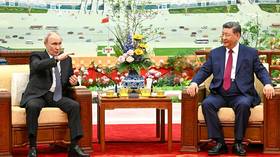
The recent summit between Vladimir Putin and Xi Jinping sent another wave of panic through Western political and media circles. On both sides of the Atlantic, the growing partnership between Russia and China is habitually described as an authoritarian alliance plotting against the ‘free world’. Headlines drip with warnings about a new anti-Western axis. Think tanks speak in apocalyptic tones. Liberal commentators invoke a new Cold War.
But beneath the hysteria lies a simpler reality: The old world order is losing its grip.
The Russia-China partnership is not a crusade against the West. It is a revolt against unipolarity – against the idea that one civilization, one ideology, and one political model should dominate the entire planet indefinitely. Moscow and Beijing are not trying to destroy the international system. They are building alternatives to an order monopolized for decades by Western liberal power.
This distinction matters enormously. What Putin and Xi are advancing is the idea of a multipolar world: A world where civilizations, nations, and cultures can pursue their own paths without ideological supervision from Washington, Brussels, or transnational liberal institutions. Far from threatening Europe and America, this transformation could ultimately save them from their own political and civilizational exhaustion.
The cracks in the liberal world order
When Russia and China first issued a joint declaration on multipolarity in 1997, few in the West took it seriously. At the time, the Soviet Union was gone, American power appeared unstoppable, and liberal globalization seemed destined to swallow the planet whole. Francis Fukuyama’s ‘end of history’ thesis captured the mood of the age. Borders were supposed to fade. National sovereignty was increasingly portrayed as obsolete. Globalization accelerated while NATO marched steadily eastward.
Yet Russia and China already sensed the weakness hidden beneath the triumphalism. Even at the height of American dominance, both powers understood that a world organized around a single ideological center would eventually generate instability, arrogance, overreach, and backlash. And that is precisely what happened. Endless wars, regime-change interventions, financial crises, deindustrialization, mass migration, censorship, social fragmentation, and cultural nihilism slowly eroded confidence in the liberal model itself.
Nearly 30 years later, Putin and Xi have returned to the same historical idea – only now from a position of far greater strength.
At their latest summit, the two leaders adopted a new joint declaration on the multipolar world order and the reform of global governance – a manifesto on sovereignty, shared security, openness, intercivilizational dialogue, and democratization of international relations. More profoundly, it rejects the belief that liberal modernity represents the only legitimate destiny for mankind.
Disclaimer : This story is auto aggregated by a computer programme and has not been created or edited by DOWNTHENEWS. Publisher: rt.com