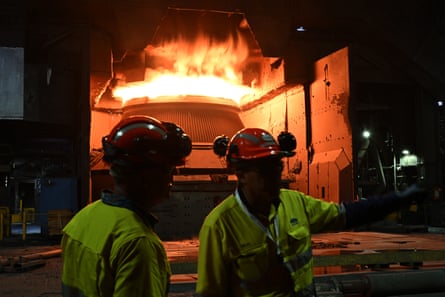
BHP quietly dumped plans for an iron ore processing facility that would have cut emissions drastically, despite internally rating it as having “excellent social value” and being “well-aligned” to its shareholder-endorsed climate plan and decarbonisation targets.
In 2025 the mining giant was well advanced in its plans to build a beneficiation plant near its Jimblebar open-cut mine in the Pilbara, which would greatly improve the purity and quality of its iron ore.
BHP knew higher quality iron ore was desired by steelmakers across the globe, including in China, where government pressure has forced the industry to reduce its emissions.
Using higher quality iron ore is one of the cheapest ways for steelmakers to reduce their emissions.
The Jimblebar facility appeared to be a win-win for the miner. The higher quality iron ore would allow it to charge customers a premium and the project was deemed to have a positive return on investment.
It was estimated the project would reduce scope-three emissions – those released by BHP’s customers – by 1.7m tonnes a year, the equivalent of taking more than 350,000 cars off the road.
This is the equivalent of about three-quarters of the entire annual emissions coming from BHP’s vast Western Australian iron ore division, including its mines, trucking fleets and the dirty power generation it uses to feed its inland power grid.
But in June 2025, internal documents show, the company quietly shelved the project, cancelling all further work.
BHP decided that the plant had marginal economics and would struggle to compete for capital with other projects.
The cancellation is yet another example of BHP either shelving or delaying major projects that would have reduced emissions.
An exclusive investigation based on documents leaked to the Guardian and Four Corners reveals that the mining giant has put on ice a 50-megawatt solar and 20MW battery project in the Pilbara, despite it having board approval, and indefinitely delayed an almost 500MW system of solar, wind and battery storage.
The company has also continued to make major acquisitions of polluting diesel trucks for its Pilbara operations, despite pledging to electrify the fleet, and has war-gamed options to significantly delay major investments needed to hit net zero by 2050 emissions goal.
Using a cache of documents dubbed the BHP files, the investigation has raised serious questions about the strength of Australia’s safeguard mechanism, the federal government’s key climate policy.
In a statement, BHP did not respond specifically to questions about the plant. But it said it had made significant progress on its scope-one and scope-two emission reduction targets.
The company spent US$60m on reducing potential scope-three emissions in 2024-25 and collaborated with 11 steel producers representing 22% of global steel production.
It is also assessing other ways to reduce steelmaking emissions, aside from the beneficiation plant, including blast furnace abatement, carbon capture pathways and investigating electric smelting furnaces.
‘Growing green iron demand’
Chinese steelmakers are under significant pressure to reduce emissions.
Last year the Chinese government expanded its national emissions trading scheme to include the production of steel and announced it would require steelmakers to increase the amount of green energy used in their processes.
At the same time, the implementation of the European Union’s carbon border adjustment mechanism is starting to increase the cost of emissions-intensive Chinese steel and making green steel more affordable for European customers.
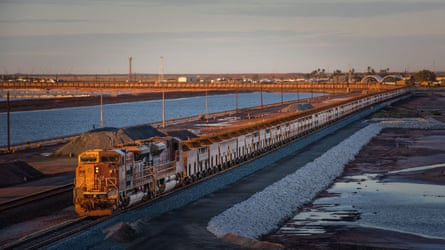
The battle to reduce emissions in Chinese steelmaking has in turn put pressure on iron ore exports from Australia, worth A$100bn and about 55% of total Australian exports to China in 2024. Australia’s iron ore is typically composed of the mineral hematite, which experts say makes green steelmaking more difficult, unless it is processed first.
A University of Queensland economist, Prof Christoph Nedopil, said Chinese steel mills were now looking for greener sources of iron.
“Without meeting a growing green iron demand from China, Australian ore producers either have to substitute their Chinese markets with other markets, accept lower prices or reduce production,” he said. “Beneficiation plants in Australia can provide higher grade iron ore that would then require less energy and emissions to make into iron and then steel.”
A University of New South Wales expert on green metals, Prof Yansong Shen, said beneficiation plants like that proposed at Jimblebar were strategically important in reducing emissions in iron and steelmaking.
He said beneficiation was a practical and comparatively low-risk option to reduce steelmaking and ironmaking emissions.
The economics of building beneficiation plants was competitive but not straightforward, he said, because they added capital cost, energy consumption, water demands and operating complexity to a supply chain.
“In the current market, there is growing commercial pressure for higher-grade ores because steelmakers are under increasing decarbonisation pressure,” Shen said. “This is improving the economic attractiveness of beneficiation projects globally.
“But beneficiation should not be viewed as a standalone solution – it is best understood as part of a broader decarbonisation strategy combining ore quality improvement, process efficiency, renewable energy and eventually low-carbon ironmaking technologies.”
Nedopil said beneficiation plants were likely to reduce overall emissions but posed other environmental risks.
“While the iron ore might be higher grade after beneficiation, the process uses significant water resources, possibly depleting already scarce water resources in the Pilbara,” he said. “Also, tailing storage, that is the storage of the significant volumes of slurry of water mixed with the crushed rock and potential chemical leftovers, requires good environmental management.”
Disclaimer : This story is auto aggregated by a computer programme and has not been created or edited by DOWNTHENEWS. Publisher: theguardian.com