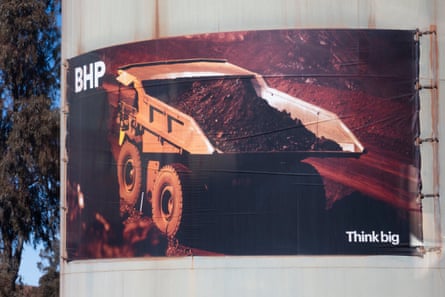
BHP has continued to spend hundreds of millions of dollars buying diesel trucks in the Pilbara despite internal documents suggesting it would increase emissions and be “misaligned” with its decarbonisation goals.
The mining giant is Australia’s biggest consumer of diesel and trucks are its biggest single source of diesel emissions. Replacing the fleet with battery-electric trucks is considered a critical step in the multinational’s efforts to decarbonise.
The company had planned to begin trialling electric trucks in Western Australia in 2024 and to begin rolling them out in 2027-28.
But an exclusive investigation based on documents leaked to the Guardian and Four Corners can reveal that, far from embracing electric trucks, BHP has continued to buy polluting diesel trucks for its Jimblebar mine. It also plans to use diesel trucks at a proposed new mine.
Public documents for Ministers North, a planned mine roughly 85km north-west of the town of Newman, show the mining giant is planning to use diesel trucks and expects they will account for most of its direct emissions at the site.
“The largest source of [direct greenhouse gas] emissions is associated with diesel consumed by heavy haulage and ancillary equipment,” the company told the Environmental Protection Authority of Western Australia last year.
The documents suggest BHP expects the mine to be operational until at least 2041.
BHP warned the EPA that technology for battery-electric trucks was not ready and that “these delays will impact the previously projected timelines for deploying battery-electric heavy mobile equipment and locomotives” across its Western Australian iron ore division.
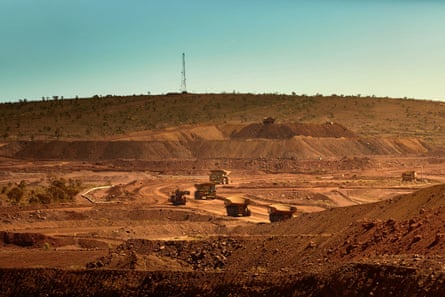
The same approach was taken at Jimblebar, a huge iron ore mine near the town of Newman, where much of the ageing truck fleet required replacement or refurbishment between 2024 and 2027.
Internal documents show that BHP decided in 2022 that it would refurbish its Jimblebar fleet to extend its life by 60,000 hours, or about eight years.
That plan would have neatly lined up with its goals to electrify the entire fleet in the 2030s, allowing it to keep the refurbished diesel trucks going for long enough that it could replace them with battery-electric trucks when the technology was available.
“This approach also established a potential replacement window for [zero-emission material movement trucks] between FY30 and FY35,” the documents say.
The 2022 plan warned that buying a new diesel fleet in the mid-2020s, rather than refurbishing the existing ones, would mean BHP was next due to replace the trucks between 2038 and 2041. This timing would be “misaligned with BHP’s climate change strategy that targets full displacement of diesel by 2040”.
But the plan changed in 2023. Documents show BHP had achieved a “material reduction in cost” for new diesel trucks.
The company then authorised the purchase of 62 diesel haul trucks at Jimblebar at an estimated cost of more than $500m. The internal documents said this would meet a goal of “40% diesel displacement by 2040”.
The documents also said this was in line with its climate goals because it was “minimising capital investment in new diesel trucks” at Jimblebar.
BHP presented its second climate action transition plan to shareholders in 2024. It made repeated references to the planned transition to electric trucks, initially through Western Australian Iron Ore, which “will likely be our first operated asset to progressively roll-out electric haul trucks and excavators towards the end of the 2020s”. The plan was overwhelmingly endorsed at the company’s 2024 annual general meeting.
Just a year later, in its 2025 annual report, BHP flagged a dramatic slowdown in its shift away from diesel trucking, blaming “low technology readiness” among truck manufacturers.
“These delays will impact our previously projected timelines for deploying battery-electric heavy mobile equipment and locomotives at [Western Australian Iron Ore],” the report said.
In a statement to the Guardian, BHP said no Australian miner was now using 240-ton battery-electric haul trucks because “the technology is not advanced enough to scale to an operational fleet”.
“To support the acceleration of this technology, BHP is partnering with equipment producers to run trials of battery-electric equipment including two 240-ton battery electric haul trucks being trialled on a BHP site in the Pilbara, and four battery-electric locomotives which we plan to commence trialling in coming months,” a spokesperson said.
Aaron Morey, the chief executive officer of the industry group the Chamber of Minerals and Energy of Western Australia, said: “There is currently no mining operation anywhere in the world with the scale, complexity and operating conditions of the Pilbara running a fully electrified haulage fleet, because the technology to do so simply does not exist.”
The company’s claim that the technology is not ready is at odds with the actions of one of its key competitors, Fortescue, which has ordered 360 battery-electric haul trucks from two suppliers – Liebherr and XCMG – and brought forward plans to fully power its mining assets in the Pilbara using wind, solar and battery.
BHP said: “Announced commitments by some companies to acquire new equipment in the future does not mean such equipment currently exists.”
Experts and environmental groups say the attempt to blame equipment manufacturers ignores BHP’s oversized role in driving investment in new technology.
Naomi Hogan, the head of engagement at the Australian Centre for Corporate Responsibility, said BHP’s approach had also left it hostage to the global fuel crisis caused by the Iran war.
“BHP and Rio Tinto can actively accelerate technology advancements through investment, procurement, and how they design and operate their assets to be electrification ready,” she said. “That includes building the renewable power needed to support electrification on remote sites and ensuring new operations are designed to accommodate low-emissions equipment.”
BHP consumed 1.23bn litres of diesel and received $622m in fuel tax credits from the federal government in the 2025 financial year, according to analysis of data from Australia’s tax credit scheme.
Tim Buckley, a director of the thinktank Climate Energy Finance, said BHP had doubled down on diesel trucks while backing a Minerals Council of Australia campaign against a proposal to limit fuel tax credit rebates to $50m a company each year.
“I think BHP is not just ignoring change, they are actively trying to undermine any change,” he said.
Disclaimer : This story is auto aggregated by a computer programme and has not been created or edited by DOWNTHENEWS. Publisher: theguardian.com