
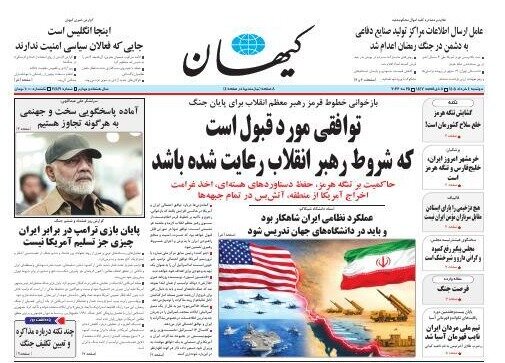
Kayhan, in an article, outlined ways to achieve a permanent end to the war with the United States. According to the article, America’s war against Iran follows very specific rules, and without understanding them, achieving a lasting end to the conflict is impossible.
The United States has based its main strategy on economic sanctions and uses the threat of war to ensure that sanctions have a decisive impact on Iran’s situation. If Iran can neutralize the sanctions, it will also achieve a permanent end to military and security threats. To do this, three steps are necessary: First, domestic positions must be firm and unified. Second, Iran must be resolute regarding a new legal regime for the Strait of Hormuz based on long‑term national interests, and abandon behaviors that mistakenly signal weakness. Third, Iran must firmly insist on preserving enriched nuclear materials and the full nuclear fuel cycle. These measures will open international pathways for Iran, rendering economic sanctions and the naval blockade ineffective. As a result, the shadow of war will be permanently lifted, and deterrence will be established.
Iran: The battlefield and negotiations are not separate or opposing paths
The Iran newspaper analyzed the active diplomatic approach alongside military actions aimed at reaching a final agreement. In critical historical moments, a country’s most important asset is neither military power alone nor diplomatic capability alone, but public trust in the decision‑making process and national cohesion. Today, the country faces a situation in which developments on the battlefield, political maneuvers, and intensive negotiations are all intertwined and part of a single trajectory. In such conditions, more than ever, trust must be placed in national decision‑makers and the negotiating team, allowing officials to carry out their mission within the framework of national interests. Recent regional developments show that the battlefield and negotiations are not two separate or contradictory paths, just as gathering in the street and public opinion are not outside this equation. Today, the battlefield, negotiations, and the street form three demonstrations of a single strategy that must ultimately serve national interests.
Sobh-e-No: Iran no longer falls for America’s tactics
Sobh-e-No examined the current positive atmosphere for reaching an understanding with the United States, alongside Iran’s deep distrust of Washington. Although a positive environment has emerged that might lead to a memorandum of understanding, the US may still launch an attack, as it has in the past. Whenever positive news about negotiations and agreements increases, the situation becomes more dangerous. This distrust has become an unwritten rule in Iran–US relations after the JCPOA era. According to the article, Trump manages “strategic ambiguity” by combining maximum threats with offers of negotiation. But Iran is no longer deceived by these tactics. Until the US takes practical steps to lift sanctions and guarantees it will not withdraw from agreements again, Iran will continue to move along the border of possible peace just as it moves along the border of possible war.
Etemad: Trump’s three miscalculations in confronting Iran
Etemad outlined what it sees as Trump’s strategic errors in the war with Iran. The first mistake was viewing the battlefield in a one‑dimensional way—believing that bombing alone would determine the outcome. Iran, however, elevated the conflict to a higher level: the arena of the global economy. When Iran introduced the Strait of Hormuz as a decisive variable, Trump was forced to focus all his efforts on containing the consequences of its closure—yet he could not reopen it. The second miscalculation was blind trust in Israeli military and intelligence reports, which presented an unrealistic picture of Iran’s capabilities. The third was failing to understand the concept of a regional war. Trump either did not grasp the idea or dismissed it. When one regional country after another came under attack, he finally realized what a regional war meant: the expansion of conflict to all U.S. bases and allies.
Donya-e-Eqtesad: A “Helsinki Pact” for the Persian Gulf
According to Donya-e-Eqtesad, Saudi Arabia is pushing Europe toward a “Persian Gulf Helsinki Agreement” with Iran because Washington has failed. When military power cannot impose deterrence, oil becomes politics—and now the Strait of Hormuz, rather than the Pentagon, is writing the security rules of the Persian Gulf. Countries are moving along two paths: a unilateral path to protect their own interests, and a collective path to design a new framework that prevents the next shock. Saudi Arabia is taking the lead in the collective path—not out of a love for mediation, but because the cost of continued turmoil has become higher than the cost of reaching an agreement. It is proposing something like a “Persian Gulf Helsinki Pact” with Iran, aimed at establishing non‑aggression principles, structured economic normalization, and mechanisms for monitoring and enforcement.
Disclaimer : This story is auto aggregated by a computer programme and has not been created or edited by DOWNTHENEWS. Publisher: tehrantimes.com



