
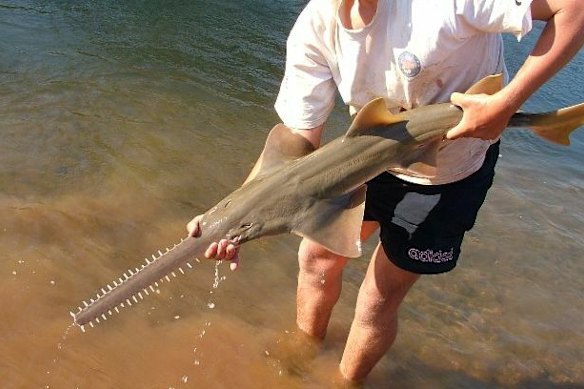

Environmentalists warn a major river in northern Western Australia and its inhabitants – including the endangered freshwater sawfish – are under threat from a groundwater management plan that will result in the equivalent of more than 31,000 Olympic-sized swimming pools being taken from the region each year.
The WA government says the draft plan provides a clear framework for managing the Martuwarra Fitzroy River catchment, and delivers on an election commitment to protect the river while “supporting sustainable economic opportunities for communities, environmental priorities and pastoral interests.”
The river is the state’s largest, stretching more than 700 kilometres across the West Kimberley with a catchment area of 90,000 square kilometres.
However, concerns have been raised over its proposed management – particularly plans to more than double groundwater extraction from the current 32 gigalitres each year to nearly 76 gigalitres.
One standard Olympic-sized swimming pool holds 0.0025 gigalitres.
Australian Marine Conservation Society shark and ray campaign manager Leonardo Guida said the freshwater sawfish was already on the brink, and warned the plan could push them over the edge.
“The Martuwarra Fitzroy is the global reference point for what a relatively healthy and undisturbed population looks like, and with northern Australia being the last place on the planet the species has a chance of recovering, protecting the river is an absolutely fundamental part of supporting that recovery,” he said.
“Every litre taken from tropical systems like this has an impact – if this draft plan allows more groundwater to be taken it increases the risk that there will be negative impacts.”
Guida said it was important to get the management plan right, and further precautions were necessary.
“This is a key milestone for this river – the state government and governments of all levels have the opportunity to get this water plan right, to put in place safeguards for species like the sawfish and protect this river for everyone,” he said.
Environs Kimberley executive director Martin Pritchard said groundwater-fed refuge pools allowed the freshwater sawfish to survive the Kimberley region’s dry spells.
“The underground water stores that feed these refuge pools are absolutely critical in a landscape that’s so hot and dry,” he said.
“Sawfish won’t survive without these pools, which also provide life support for barramundi, a whole range of other fish, freshwater prawns, and big trees and vegetation that sustain birds, possums, bats and insects.”
Pritchard said he was concerned the water could eventually be used for fracking, with a proposal by Black Mountain Energy for 20 oil and gas wells stating it would need two billion litres to operate.
Another concern raised was that there had been no study into how the current use of groundwater had impacted the region.
In 2025, the Auditor General also released a scathing report stating the Department of Water and Environmental Regulation was not monitoring water extraction from the state’s aquifers effectively.
“The Kimberley is the most intact tropical savannah on the planet,” Pritchard said.
“If we don’t know what the current impacts are, we shouldn’t be opening the doors to take more – it would be completely reckless.”
He said one gigalitre of water was enough to irrigate 100 hectares, and therefore additional water usage also opened the doors to further clearing of land for agricultural use – something he described as unacceptable.
Conservation scientist Angela Pursey analysed the draft plan and said expanding groundwater extraction was an incredibly risky proposal.
“Even relatively small drops in groundwater levels in a system like the Fitzroy can translate into significant changes in river flows, wetlands and dry-season refuges,” she said.
“If this expansion goes ahead, we risk the collapse of entire ecosystems that depend on these waterholes and once they’re gone, they’re almost impossible to bring back.”
A Department of Water and Environmental Regulation spokesperson said the groundwater plan was necessary to “protect the vital connection between surface water and groundwater, set clear allocation limits and support sustainable economic development while safeguarding the river’s cultural and environmental values.”
“This draft is based on conservative assessments of sustainable groundwater recharge and reflects years of engagement that delivers a balanced approach,” they said.
“Under the draft plan, no new dams or surface water licences will be granted on the Fitzroy River or its tributaries, and further groundwater extraction from aquifers connected to the river is restricted.
“Proposed allocation limits totalling 75.7 gigalitres per year for groundwater have been suggested. No allocation limits were previously set for groundwater in the Fitzroy River catchment.
“Safeguards for sawfish and other aquatic species are embedded throughout the plan.”
The draft plan is open for public comment until June 30.
Community information sessions are also being held in Perth, Broome, Derby, Halls Creek and Fitzroy Crossing.
 Holly Thompson is a journalist with WAtoday, specialising in education and the environment.Connect via X or email.
From our partners
Disclaimer : This story is auto aggregated by a computer programme and has not been created or edited by DOWNTHENEWS. Publisher: www.smh.com.au


