
It’s one of the most transformative experiences we can have in life and about 80 per cent of us go through it. Yet until recently, little was known about how becoming a parent changes our brains.
One misreported, misunderstood article from 1997 cemented the urban myth of “baby brain”, a term used to describe a subjective decline in cognition. Titled Pregnant women get that shrinking feeling, it stated that women’s brains shrink by up to 7 per cent during pregnancy.
Media outlets had a field day with headlines, like “She’s pregnant and her brain is shrivelling”, “Baby … is eating my brain cells” and “All stomach and no brain”. Motherhood became pathologised, calls were made to forewarn women of their impending mental doom, and lines of supplements were developed to combat it.
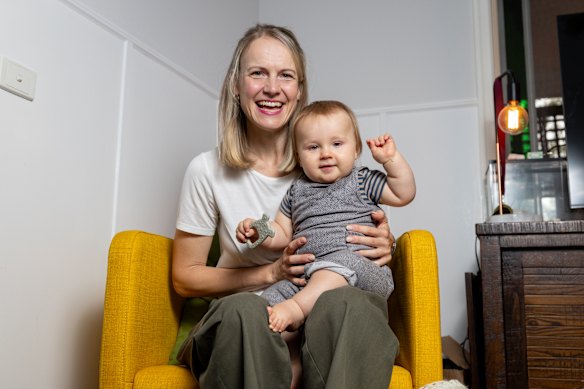
Before she gave birth to 10-month-old Louis, Jess Weijers expected her brain to turn to soup. “The way people talk about it, it’s like mothers go instantly dumb,” says the 44-year-old.
The phenomenon is substantiated by new mums themselves: up to 81 per cent of women who have been pregnant report “baby brain”.
Why, then, does a new study confirm that “baby brain” is a myth?
For the study, presented today at the Women’s and Children’s Health Summit in Melbourne, 300 new parents and 100 non-parents were given comprehensive cognitive assessments over the course of two years.
The men who were not fathers reported better subjective memory than all other groups, however the new mums and dads performed similarly on all objective measures. These effects were the same regardless of the baby’s age.
This came as a surprise to the researchers, who anticipated that the parents’ cognition would be worse than non-parents and would slowly improve as the baby got older.
“While people might be subjectively experiencing what we would call ‘baby brain’, we’re not able to find objective evidence for it,” says lead author, Associate Professor Sharna Jamadar, from Monash University’s Turner Institute for Brain and Mental Health.
“New parents are not actually performing worse than non-parents. They just feel like that they are.”
A streamlined brain
Our brains do change “enormously” as a result of parenthood, just not in the way we typically think.
Throughout pregnancy and after giving birth, there are significant structural changes to every part of a mother’s brain. Research from 2016 found there was around a 4 per cent loss of volume, while subsequent research consistently shows structural remodelling throughout the brain.
“It sounds like degeneration and dysfunction,” admits neuroscientist Dr Sarah McKay. “But similarly to what we would see during adolescence, it’s this streamlining and refining, sort of turfing off the superfluous synapses and doubling down on the ones that we need.”
And while we might think bigger is better, for brains that’s not always the case.
This streamlining makes networks within the brain more flexible, responsive and efficient. Mothers also tend to score higher on tests of empathy, and enjoy unique neuroprotective benefits to brain function in late life.
“There’s a constant levelling up that you have to do each year you’ve got children,” McKay says. “It’s cognitively demanding, right? It’s challenging and it builds resilience.”
McKay, author of Baby Brain: The Surprising Neuroscience of how Pregnancy and Motherhood Sculpt Our Brains and Change Our Minds (for the Better) adds: “I would say the sum of the neuroscience is telling a story of adaptation versus dysfunction and forgetfulness.”
Weijers says such findings are a relief: “You’re not becoming dumb, you’re actually reprioritising and focusing.”
Early parenthood was a shock as she processed the enormity of the change and was figuring out how to be a parent.
It can still feel like a “twilight zone”, she says. But, she also feels an awe and confidence she hadn’t expected. A heightened sense of what really matters in life and how precious the time is also means she is less fazed by the little things.
“I have changed,” she says.
A transformative experience
As for the subjective experience of “baby brain”, Jamadar says there may not be cognitive decline, but there is radical change, which can feel the same.
“You’re sleep-deprived, you’ve got hormone and brain changes,” Jamadar says. “You’ve got all these new things that you need to learn how to do … and that’s difficult.”
She likens it to getting a job in another country that speaks a different language: “All of a sudden you’re a fish out of water, and you start to question your competency… and that’s a transformative experience that is a lot less critical than keeping a little baby alive.”
Understanding what underlies the experience of “baby brain” is important because it highlights that there is nothing wrong with new parents, it is just that the transition is hard.
“This was the first study to look at these effects in dads as well as mums, and we found the largest decline in subjective cognition was in the dads. As a society, we often discount how much the transition to fatherhood is affecting men too.”
What it suggests, she says, is that new mothers and fathers need help to get through this period.
McKay echoes the sentiment.
“If women are reporting that there is something changing in their brain, and it’s not their brain, we need to make sure that we are targeting the right interventions,” she says.
“It’s no good telling women, ‘Oh, your brain changed during pregnancy to make you feel slow and sluggish, and forgetful. And so what we’re going to put some sell you some supplements’.”
Rather, it’s an issue of social support, and making sure new parents are being buoyed: “We need to start talking about how to support them.”
Make the most of your health, relationships, fitness and nutrition with our Live Well newsletter. Get it in your inbox every Monday.
 Sarah Berry is a lifestyle and health writer at The Sydney Morning Herald and The Age.Connect via X or email.
From our partners
Disclaimer : This story is auto aggregated by a computer programme and has not been created or edited by DOWNTHENEWS. Publisher: www.smh.com.au