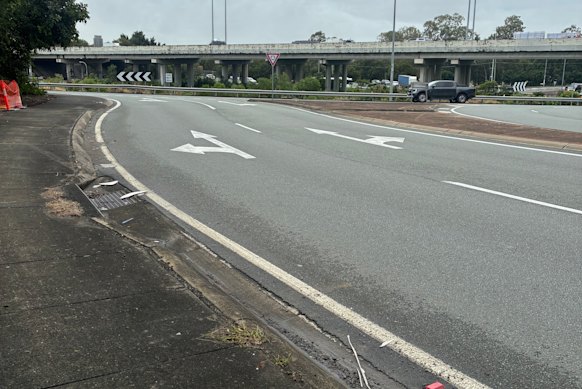
A dual-lane roundabout south of Brisbane, with 12 entrances and exits, is so confusing and poorly designed that near-misses and crashes happen there every day, according to frustrated locals.
Drivers in the wrong lane to exit onto the motorway or a local road try to do it anyway, only to collide with a vehicle in the correct lane.
Others find themselves in a nose-to-tail smash after misjudging a gap in the traffic.
The spot – dubbed the “Bin Chicken Roundabout” on Google Maps for the ibises living in its centre – is under the M1 between Eagleby and Beenleigh, about 45 minutes’ drive south of Brisbane’s CBD.
It’s also been pitch-black at night for months, with a traffic sign warning of a “lighting outage ahead due to theft”.
Analysis by CrashDash of Queensland government data can reveal the Brigade Drive, Saverin Road, Blackbird Street and Pacific Highway roundabout is the worst spot for crashes in the Greater Brisbane area.
There were 43 crashes reported to police between July 2022 and June 2025. In March this year, a 23-year-old man died after a Toyota ute collided with pylons.
Tow truck drivers have described the layout as confusing, particularly for non-locals, with incidents of crashes and near-misses happening every day.
Some crashes happen when people entering via City Road from the left lane try to keep going around to the Brigade Drive side of the roundabout, while a driver in the inside lane legally takes the northbound on-ramp onto the Pacific Motorway.
At the southbound exit, both lanes can continue around the roundabout, but only the left can exit to the Pacific Motorway.
Crashes also happen there, as depicted above, and at the exit onto City Road.
Two weeks ago, George Phillips was leaving Beenleigh to drive northbound on the M1 towards the Brisbane CBD and entered the roundabout from City Road.
He took the right-hand lane, which would allow him to exit as early as the M1 to travel north, or continue around to any of the other exits.
The left-hand lane leaving from City Road must exit to either Blackbird Street or the M1 on-ramp, and no further.
However, in Phillips’ case, he said another driver tried to continue around the roundabout from the left-hand lane in front of him as he tried to exit onto the Motorway – leading to a crash resulting in thousands of dollars worth of damage.
“That resulted in me collecting the driver’s side of this individual’s vehicle at a reasonable speed,” he said.
“This is a very common ‘near miss’ for me to see, I would say once a week even I would personally see this exact act.”
Professor Narelle Haworth, a chair at the MAIC-QUT Road Safety Collaboration, said roundabouts were generally safer than traffic lights for motorists because they usually encouraged drivers to slow down, which meant crashes were less serious.
But while radial roundabouts with a 90-degree angle which slowed traffic were used in countries such as Germany and Sweden, Australian traffic engineers often used tangential roundabouts, which allowed more cars to travel through each hour.
Haworth said multi-lane roundabouts could also be less safe, particularly at higher speeds.
“Once it gets to be multi-lane, then the roundabout can’t be as tight, and so it’s not slowing the traffic down as much,” she said.
“And again, you layer on top of that the issue that people are having to cut across the paths of other vehicles. So your multi-lane roundabouts are generally, unless they’re very well-designed at lower speeds, they don’t work as well.”
Logan Mayor Jon Raven said copper theft was responsible for the lack of lighting at the roundabout, which he noted was a state-controlled road that fell under the responsibility of Transport and Main Roads.
He said his council was working closely with police, Transport and Main Roads, Energex and other local governments to prevent further thefts.
“It can cost up to $20,000 to replace copper worth just $2000 and Logan City Council has already spent more than $200,000 this financial year on repairs to infrastructure under our control,” he said.
“Yesterday, I met with Transport Minister Brent Mickelberg, and he confirmed repairs and preventative measures are under way on state-controlled roads in Logan.”
Raven said lights should be turned back on across Logan by October, depending on the weather.
CrashDash’s analysis showed across Greater Brisbane there were 23,641 crashes over three years, or about 22 per day. Of those, 262 were fatal and 10,367 were serious. Most crashes happened on weekdays, from 3-5pm, and most were rear-ends.
TMR was contacted for comment but did not respond by deadline.
CrashDash creator Anthony Aisenberg said the findings were based on analysis of publicly available state government crash data that groups together all the traffic incidents that occurred within a 100m radius of each location.
“While crash data is open, it is not visible, and it is pretty tricky to gain access to,” Aisenberg said.
Follow this link to view street-level crash data for Brisbane.
Start the day with a summary of the day’s most important and interesting stories, analysis and insights. Sign up for our Morning Edition newsletter.
From our partners
Disclaimer : This story is auto aggregated by a computer programme and has not been created or edited by DOWNTHENEWS. Publisher: www.smh.com.au