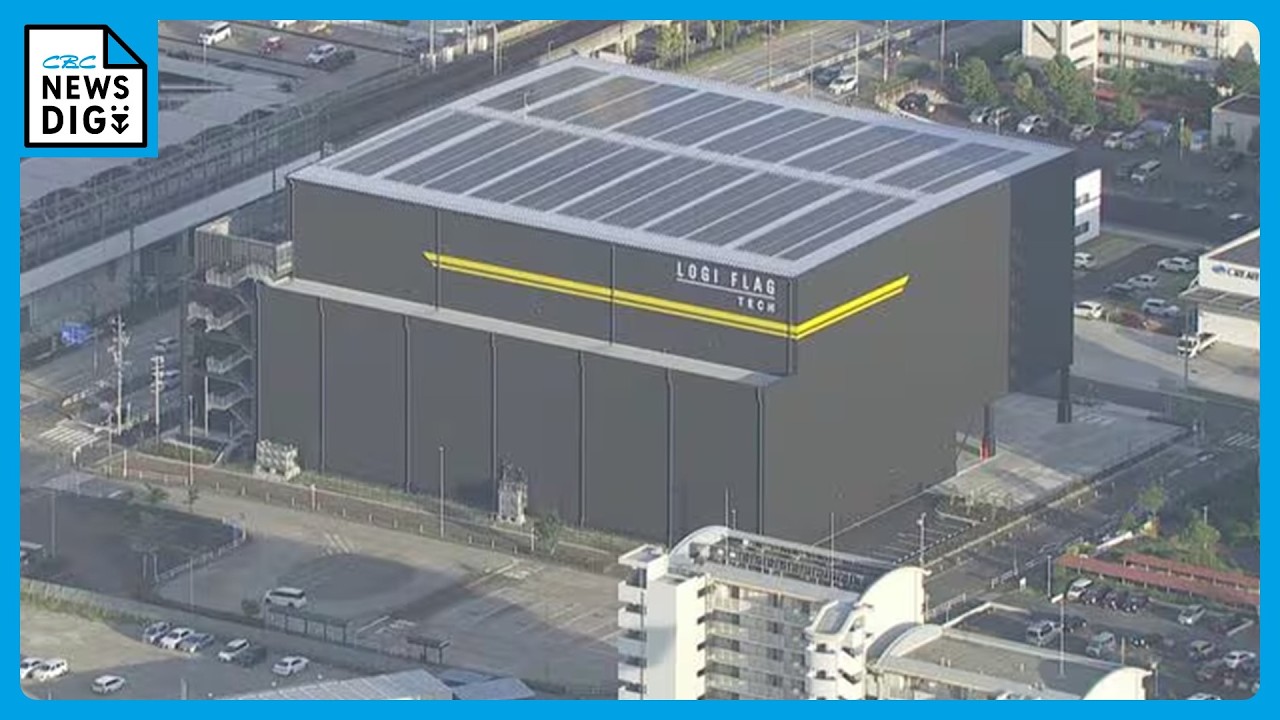
NAGOYA –
A new fully automated freezer warehouse opening in Nagoya in August aims to tackle chronic labor shortages and harsh minus 25-degree working conditions in Japan’s growing frozen food logistics industry, while also introducing environmentally friendly refrigerants and futuristic remote-monitoring systems.
One of the facility’s biggest features is its extensive automation system, introduced to address chronic labor shortages in the frozen storage industry.
“The inside of freezer warehouses is extremely cold, and workers have traditionally faced harsh conditions, so we decided to automate the system,” said Ryo Sugimoto, vice president of Kasumigaseki Capital.
Working inside freezer warehouses has long been considered physically demanding, contributing to industry-wide staffing shortages. The company also sees Nagoya as an ideal logistics hub following Japan’s trucking work-style reforms introduced in 2024.
“With reforms affecting truck drivers, it’s becoming difficult to make round trips between the Kanto and Kansai regions within a single day,” Sugimoto explained. “Nagoya sits in the middle, so it can serve as an important relay point.”
During a media tour held on May 26th, reporters entered the warehouse, where temperatures in the storage area are maintained at minus 25 degrees Celsius.
“The space is enormous, and if you stand still for too long, you feel like you could freeze,” Takigawa said.
A towel soaked in water froze solid within moments inside the storage zone. The warehouse, which reaches the equivalent height of a second- to fifth-floor building, is designed to accommodate a wide range of cargo.
Frozen foods brought into the facility are managed through a fully automated system, allowing the number of workers inside the freezer area to be reduced to roughly one-quarter of conventional operations.
The facility is also addressing environmental concerns linked to refrigerants.
“Many freezer warehouses still use fluorocarbon refrigerants, but we need to transition away from them,” Sugimoto said.
The warehouse uses environmentally friendly natural refrigerants instead of fluorocarbons. Advanced economies are being required to cut hydrofluorocarbon usage by 85% by 2036 as part of global efforts to reduce greenhouse gas emissions.
The transition is affecting not only cold storage warehouses, but also air conditioners, display cases and vending machines, forcing companies across industries to adopt non-fluorocarbon technologies.
Another eye-catching feature of the new facility is its futuristic office space.
“The office looks like the cockpit of a spaceship,” Takigawa said. “At first glance, the central desk appears empty, but it contains built-in monitors.”
The office was designed with a near-futuristic theme and allows staff to monitor conditions inside the warehouse remotely. The goal, company officials say, is to completely change public perceptions of logistics work.
“We want to erase the image that working in frozen warehouses means enduring minus 25-degree conditions,” Sugimoto said. “Even though it’s a freezer warehouse, workers no longer need to operate directly in those harsh temperatures. We hope this leads to a new style of work reform.”
Experts say Japan’s cold storage industry faces mounting challenges beyond labor shortages.
“Working for long periods in extremely low temperatures is physically exhausting,” said Yuji Yano, professor at Ryutsu Keizai University. “Unless wages are exceptionally high, workers would rather choose other types of warehouses.”
Yano added that older cold storage facilities are increasingly becoming obsolete due to environmental regulations and rising construction costs.
“Older freezer and refrigerated warehouses are gradually becoming unusable,” he said. “Construction costs today are overwhelmingly higher than in the past, making rebuilding difficult. If existing warehouses can no longer be used, supply capacity could decline significantly.”
Despite these challenges, demand for frozen foods in Japan remains strong, ensuring continued need for freezer and refrigerated warehouses.
Climate change is also increasing the importance of temperature-controlled logistics.
“Even products like chocolate now require temperature-controlled storage,” Yano explained. “Because of rising temperatures, goods increasingly need to be stored in climate-controlled warehouses from around Golden Week onward.”
As frozen foods remain an essential part of modern life, experts say further improvements to labor conditions and logistics systems will be necessary.
“Frozen food logistics involve particularly harsh working conditions,” Yano said. “Compared with other products, the potential benefits of automation and mechanization are much greater.”
Source: CBC
Disclaimer : This story is auto aggregated by a computer programme and has not been created or edited by DOWNTHENEWS. Publisher: newsonjapan.com