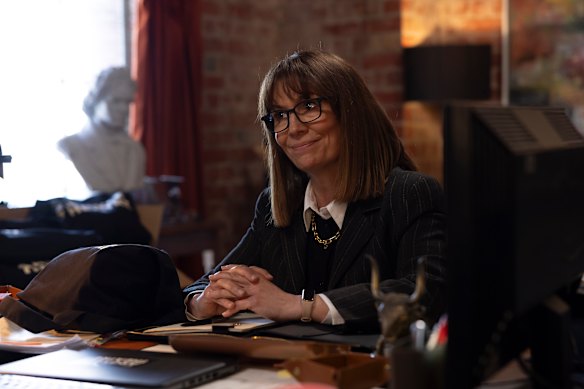
There’s a moment in the second episode of the ABC’s new comedy, Bad Company, that sums up one of the most common tensions in the workplace. “How do you think your role helps the company strategically meet KPIs?” asks corporate boss Julia McNamara, played by a deadpan Kitty Flanagan.
It’s a version of a question that’s familiar to most Australian workers, and it sets up a dramatic response by the theatrical Margie Argyle, a creation of the hilarious Anne Edmonds. “KPI, KPI, KPI!” she screams. “Key Performance Indicator! But an indication of what? Love? The suffering of my fellow workers? Are we not more than human resources?”
The exaggerated back-and-forth sums up the conflict at the centre of the show, set in an inner-city theatre company but recognisable everywhere: loose versus rigid, free-range versus rule makers, creative versus corporate.
Bad Company, which airs its final episode this Sunday, is angling to join the pantheon of great Australian workplace comedies, and if given enough rope to let the creative powerhouses really flow, it might just get there.
The canon is healthy. There was Frontline, which satirised a fictional TV newsroom. The Games, which followed the bumbling setting-up of the Sydney Olympics. Utopia skewered bureaucracy in government.
The Hollowmen did the same thing for the prime minister’s office. Summer Heights High ventured into the workplace of schools, Rake the legal chambers, and Fisk captured the suburban mundanity of small and family businesses (just don’t mention the Australian version of The Office).
So why are Australian workplaces so funny on screen? And what do all the best portrayals have in common? The elephant in the room is that they’re almost always developed and made by the ABC.
We owe considerable thanks to publicly funded television that takes risks on quirky, offbeat shows that look strange on paper. (“You’re telling me the entire show is set inside a small wills and probate office with just four main characters?” )
Australian workplaces are unique settings. For the most part, we don’t take ourselves too seriously, and our inclination towards self-deprecation is fertile ground for laughs. We also – let’s admit it – excel in red tape, processes and the type of corporate BS that translates directly into fuel for great comedy.
Every time a character has an awkward conversation next to the coffee machine, or struggles with the photocopier settings, or argues over which brand of biscuits are reserved for clients versus staff, it triggers an uncomfortable familiarity, no matter which industry you work in.
Where many international workplace comedies overwork their scripts to jam a neat redemption into a half-hour show, or fluff their characters with warmth, we are happy to fill the screen with many of the loveable weirdos we meet in everyday life.
Instead of skewering each other, we punch towards all the systems we’ve built around us, like corporate hierarchies, unnecessary meetings and indecipherable acronyms. We also have the advantage of a relatively large and visible public sector that’s concentrated predominantly in a single city (sorry Canberra), a ripe setting for satire.
Australia produces the best workplace comedies in the world, a by-product of our environment and our laid-back approach to work. We don’t take work as seriously as other nations, in real life or on screen, and that’s the perfect place to start a joke about what happens when a corporate boss and a creative employee walk into a meeting.
Tim Duggan is author of Work Backwards: The Revolutionary Method to Work Smarter and Live Better. He writes a regular newsletter at timduggan.substack.com.
Get workplace news, advice and perspectives to help make your job work for you. Sign up for our weekly Thank God it’s Monday newsletter.
 Tim Duggan is the author of Work Backwards, Cult Status and Killer Thinking. He co-founded Junkee Media and writes a monthly newsletter called OUTLET.
From our partners
Disclaimer : This story is auto aggregated by a computer programme and has not been created or edited by DOWNTHENEWS. Publisher: www.smh.com.au