

There are bigger domestic battles than who does the cooking, who cleans the toilet, and who’s stuck doing the laundry. A prime struggle in any relationship is this: who makes the magic? Who remembers the birthdays? Who bakes the birthday cakes, gets the gifts and wraps them? Whose job is it to be cheerfully resilient when the birthday baby starts sobbing from exhaustion before the candles are even lit? Who plans for the future?
One young mum – a description she loves – set out to find the answer and to turn down the conflict. She was the perfect person for the job. Leah Ruppanner, 45, is a professor of sociology at the University of Melbourne, soon to be a visiting professor at Harvard, and the author of Drained. Her book is a manual for anyone who wants to lighten the mental load.
So what exactly is the mental load? As a sociologist, Ruppanner had spent more than 20 years looking at the division of domestic tasks, but even in households where housework appeared pretty equal, the women were still stressed to the max. “I thought, you know I can’t keep just documenting housework time and childcare time … there’s something else we’re missing and what we’re missing is this kind of invisible thinking work. Emotional thinking.”
It’s the keeping track of the family juggle, anticipating when things might go wrong, planning with everyone’s hopes and dreams in mind. Crazy hair day at school? Sure. Bought the Manic Panic and made sure it’s washable. It’s about constant availability and sustained commitment to all the details. Everything, everywhere, all at once – and not forgetting the permission note for the excursion.
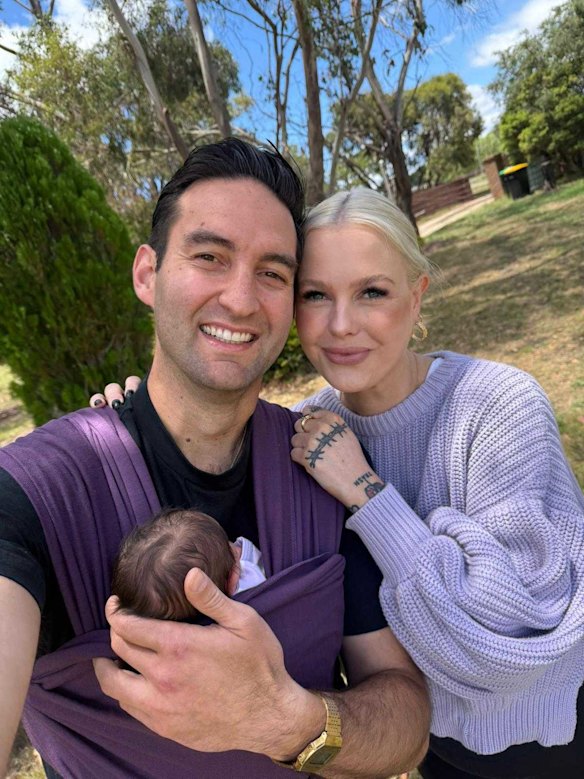
Meet two very different couples. Josh Burns, 39, and Georgie Purcell, 33, are both politicians. He’s federal Labor, she’s Animal Justice in the Victorian Legislative Council and facing an election later this year. They’d known each other for a while but hard-launched their relationship in mid-2024. Their daughter, Lilah, was born last December. Burns’ seven-year-old daughter from his first marriage, Tia, lives with them half the time – between the home they own in Kyneton, north-west of Melbourne, and their rental in St Kilda.
“Each week, we run a schedule that sees us travelling between the two houses based on work and family arrangements, and Josh obviously also goes to Canberra,” says Purcell, explaining their juggle. “We have a lot of animals as well, so the mental load and logistics in our relationship are significantly exacerbated by our lifestyles and living arrangements.”
So, who does what and when? “I’m probably more of the runner of the household at the Kyneton place, and Josh definitely runs the household at the St Kilda place,” she says.
Despite the chaos, the couple agrees they regularly “go out of our way to try and help each other”.
The second couple, Brynn and Grant Quick, of Berowra, NSW, are both 41 and have two kids, 10 and 13, full-time jobs and a commitment to making their relationship equal across all domains – and that includes taking on the concept of the mental load with the help of Ruppanner.
Brynn is an academic at Macquarie University and Grant is a solutions engineer with Salesforce. By the time Ruppanner came into the Quicks’ lives, they’d already done some groundwork. They’d both come from families where communication wasn’t great, and they were determined not to repeat those behaviours.
“We wanted to be very explicit in communication; it’s been 17 years, and we’re still doing that,” says Brynn. Grant laughs, addressing his wife: “I think you’re just more open and so you’ll coax it out of me if you can sense there is something off.” They describe what happens when the going gets tough: they keep it even, so it’s more like a business meeting.
“As we talked about it, I came to understand there was a lot more going on than I realised.”
Grant Quick
That’s what Ruppanner calls relationship hygiene, or tending to each other. Grant says: “When it comes to making our marriage successful, I feel like we both put ourselves probably a little bit far down the list. What makes us successful is that we at least communicate a lot and we have shared values in that we both see our children’s futures as being of primary importance.”
A few years back, when Brynn was going away to a conference, she used a spreadsheet to help ensure things would run smoothly. “I thought, ‘I have all of this in my head, but that didn’t necessarily mean Grant knew that I had all of this in my head.’ ”
She realised it was exhausting her, and the realisation came about at the same time as she volunteered for Ruppanner’s study. This is when she came face-to-face with the concept of the mental load.
Grant admits he was sceptical. “At first I was a little bit dismissive. I was like, ‘I have a mental load, too. Do you know how many things I carry at work?’ But as we talked about it, I came to understand there was a lot more going on than I realised.”
Ruppanner’s research revealed eight categories that make up the mental load. “Life organisation” speaks for itself: it’s the billion administrative tasks our lives need to work smoothly. “Emotional support?” That’s clear, too: the way we bolster those in our family who need it when, for example, encountering difficulties with friends or stress at work. When our family downloads, we are the recipients.
Ruppanner explains “relationship hygiene” beautifully: the mental work of taking care of relationships for oneself, as well as one’s children, partner and extended family. “Individual upkeep” (ensuring you are physically and mentally well) and “Safety” are more straightforward.
But Ruppanner has three types of mental load that need more of an explanation: “Meta-care” (where you worry about what kind of world we are living in; whether you are contributing to a good world); “Dream-building” (planning happy and secure futures); and “Magic-making”: did you remember to buy your mother-in-law’s favourite flowers?
As part of her work, Ruppanner designed a tool kit – she calls it the mental load audit – to help people identify, and then stop doing, the things that sap their energy. She’s confident her tool kit can work.
“Australians have a can-do attitude,” she says. “Let’s give this a go and see what happens because the risk of doing nothing or not addressing it outweighs the benefits of trying to fix it right now.”
And she has one final piece of advice. After you’ve done your mental load audit and discovered what you need more time for, “Come back into the conversation with your partner with your goal. It might be something small, like a 45-minute walk.”
The turning point for Purcell and Burns was preparing for Lilah’s arrival. They moved in together, and into a bigger rental. “There are times when you have to give each other a chop-out, and even if it’s something like going to the gym, that can be the difference between feeling like the day is overwhelming, or the day is manageable,” says Burns.
Adds Purcell: “Having a partner who understands and takes responsibility for the mental load is really important to me. I have such a huge mental load at work, so I don’t want the expectation of having to ask or explain the things that need to be done when I come home. Feeling like you’re taking on a management role of your partner can be the demise of a relationship. We actively talk about the mental load.”
As for planning their future, it’s one part of the mental load Burns and Purcell haven’t quite yet sorted. Will Tia and Lilah have another sibling?
Burns took a huge chunk of parental leave when Lilah was born. “If we did it again, Georgie would have to be willing to do that.” He says he feels a real contentment at the moment, particularly because Tia adores her tiny sibling. “We will see what happens with the election [in November] but I wouldn’t say never. [Although] every time we walk past a vasectomy clinic near our home, Georgie says, ‘I think we should go and visit them.’”
As for Brynn and Grant, after some productive chat, they have sorted out what they want for their future: “We’re very aligned on what we want out of life, and we work together to do it.”
Drained: Reduce Your Mental Load to do Less and Be More (Allen & Unwin) by Leah Ruppanner is out now.
Get the best of Sunday Life magazine delivered to your inbox every Sunday morning. Sign up here for our free newsletter.
From our partners
Disclaimer : This story is auto aggregated by a computer programme and has not been created or edited by DOWNTHENEWS. Publisher: www.smh.com.au


