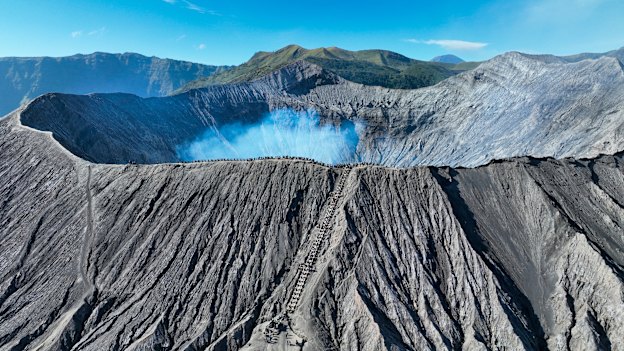
We travel across the Java Sea by Zodiac, then it’s an hour by four-wheel-drive, a trudge across fields of volcanic ash, and then the clincher – 250 vertical steps to the top of East Java’s brooding Mount Bromo. As we steady our shaking legs to peer into its swirling depths, there’s a rumble, a burst of sulphur and the heavens open.
Water cascades down our rain jackets, filling pockets and pelting our faces as we make a slow retreat on this darkening mountain, a pony with a neon-pink tail, spooked by thunderclaps, dancing beside us.
Weeks later these events keep replaying in my mind, joining others just as bizarre: a proboscis monkey doggedly dog-paddling in croc-infested waters; an elated water-buffalo “jockey” dancing in mud; a village bride anointing our foreheads in oil; the huge butterfly that perches on an expedition leader’s sunglasses, a whale shark performing a ballet below us.
We share these and more other-worldly moments with just 17 others, discovering extraordinary nature aboard a Borneo & Beyond cruise through Indonesia. The 12-day Pearl Expeditions’ cruise on the boutique Paspaley Pearl – built in 2021 but then refitted for its inaugural expedition cruise in 2025 – marries heart-stirring adventure with on-board luxury, filling a maximum of 30 guests with adrenaline one minute, finest wagyu and wines the next.
Yet, it also leaves plenty of time to stare at sunset seas, spot soaring seabirds or read in the sun.
Sign up for the Traveller Deals newsletter
Get exclusive travel deals delivered straight to your inbox. Sign up now.
DAY ONE: Setting sail
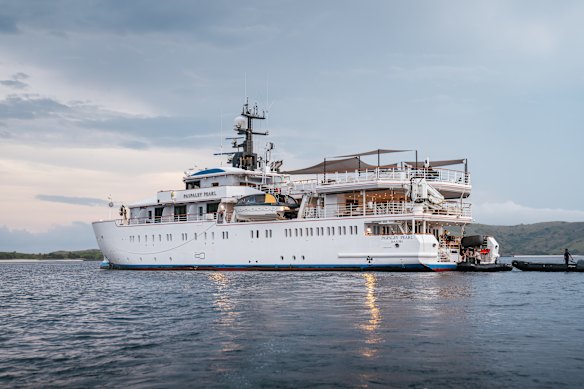
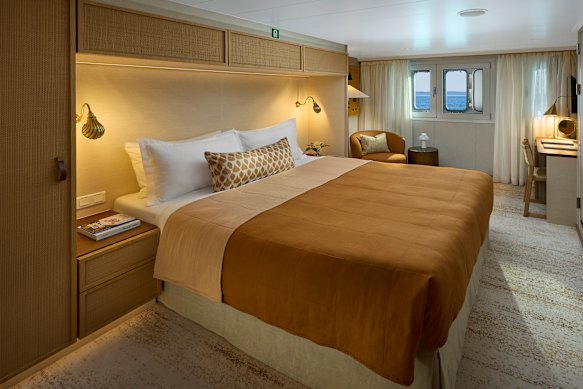
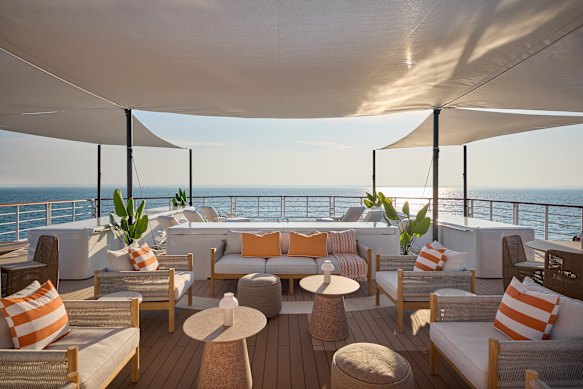
Small (53.5 metres or 175 feet), but perfectly formed: the three-deck white Paspaley Pearl, with its polished timber handrails and blue and red trim, doesn’t disappoint on this overcast afternoon in Bali’s Benoa Harbour. After meeting our fellow passengers on the top deck for drinks and canapes we head to our Horizon Suite cabin, home for the next 12 days. While light and roomy at 20 square metres, it’s still a master in space-saving design.
A king bed is high enough to store bags underneath and is flanked by slim wardrobes and bedside tables with self-closing drawers. There’s more storage above the bed, adjustable reading lights, digital TV, pull-out pegs behind the door for jackets or snorkel gear, a desk, fridge, and floor-to-ceiling glass doors leading to a wide balcony with two chairs and a panoramic view.
The marble bathroom has a rain shower with a window to the sea and a pull-out clothesline, (something we’re grateful for later), Aesop products, bathrobes, hairdryer, and strap shelving, which means toiletries are never in danger of falling in rough weather.
A blast of a horn – a small boat has ventured too close to us – and we rush to the top deck. We’re sailing, seen off by fat gulls.
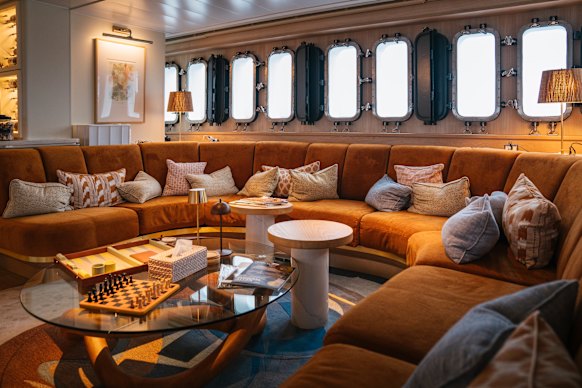
The Paspaley family, pioneers of the Australian South Sea pearling industry, own this vessel and over drinks with fellow travellers in the Ocean Deck dining room, which includes a bar, lounge, white tablecloths and a curated bookshelf (The Girl with a Pearl Earring; Steinbeck’s The Pearl, tomes on the pearling industry) talk turns to epic ocean voyages and the many wonders of the deep. It’s clear we all have common passions: nature, the prospect of an adventurous itinerary on a small ship, good food, and the baked-on-board sourdough served with dinner (a chef’s selection and an alternative menu each night).
Later on our balcony under the night sky, Indonesian gamelan music at our hotel still playing in my head, I puzzle at a waft of cloves across the gentle seas until I detect the faint glow of an Indonesian fisherman’s cigarette from a tiny boat in the distance.
DAY TWO: Getting our bearings
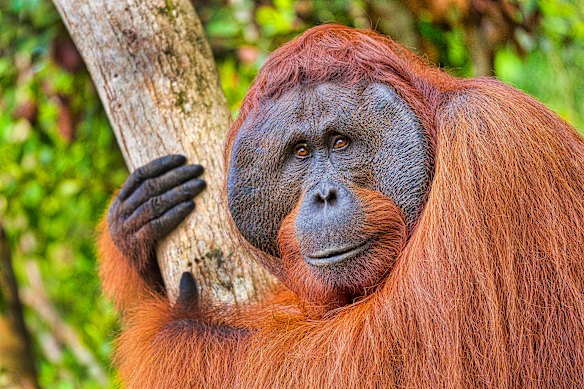
“If we spot a false gharial, I’m buying champagne.” Cara, one of our four expedition leaders, is making a point: while we all have monkeys – namely orangutans, (technically not monkeys but great apes) – on our minds in the lead-up to our expedition to Tanjung Puting National Park, on Kalimantan, the Indonesian side of Borneo, she is keen to open our eyes on this sea day to so many more of the wonders of the biologically rich area we are sailing into.
The gharial – a small, slender-jawed crocodile – is extremely difficult to spot in the wild in Borneo, its homeland, and the world’s third-largest island. Animals such as these stunned naturalists like Alfred Russel Wallace, whose work in the 19th century led to the creation of the Wallace Line, a natural boundary separating the distinct animals of Asia and Australasia.
This is an area of near-constant volcanic activity and seas rich in life-spawning nutrients. Indonesia, we’re told, is the world’s largest archipelago, ranked only behind Brazil in biodiversity, and is home to 17 per cent of the world’s birds, 25 per cent of the fish and 12 per cent of mammals. The sea is calm, but there’s a distinct undercurrent of excitement.
DAY THREE: Be prepared
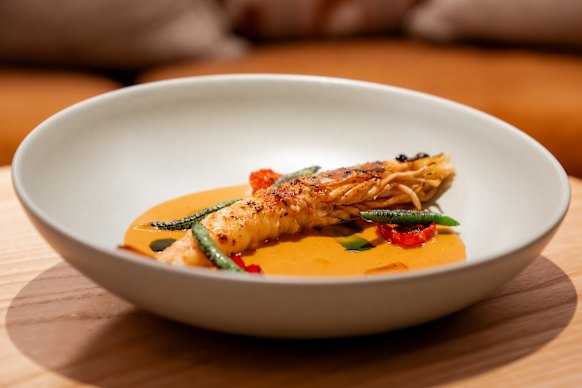
We quickly become attuned to the rhythms of the Paspaley Pearl. We now know there will be shot glasses full of tasty health-giving liquids alongside the cooked-breakfast options – ranging from nasi goreng to eggs Benedict – plus platters of fresh fruit and pastries in the mornings; and that the magic sourdough will make regular appearances.
It’s our final sea day before our adventuring begins, and our time has not been wasted: we’ve learnt how to enter and exit a Zodiac; tried on and selected snorkel gear; learnt the intricacies of two types of life jackets, (the slimmer black varieties will be used for scooting about in Zodiacs), and informative yet entertaining talks have provided us with context, alerted us to dangers and taught us what to look out for. We are ready.
DAY FOUR: Orangutan business
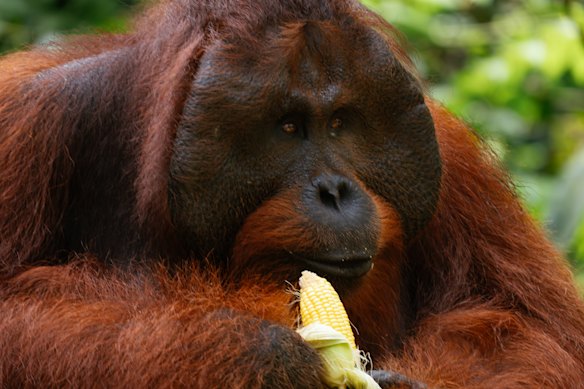
Atlas the orangutan is king of his jungle. He knows it, other orangutans know it, and we know it, mainly by his don’t-mess-with-me attitude and the large flanges, or cheek pads, on the sides of the face, found only on fully mature males.
It’s sticky-hot in Borneo’s Tanjung Puting National Park, as Atlas and about a dozen other wild and semi-wild orangutans swing down from draping branches in thick forest to feast on bananas and corn left out at the same time each day on a wooden platform in Pondok Tanggui, an orangutan rehabilitation area. Sometimes they visit, sometimes they don’t.
We’re lucky. Atlas makes a grand entrance, shouldering his way to the food, where he sits in all his seemingly grumpy glory while smaller orangutans, including mothers clutching too-human babies, join him. The only sound is the crunch of corn cobs as Atlas and his minions chow down, kernels scattering, banana peels flying.
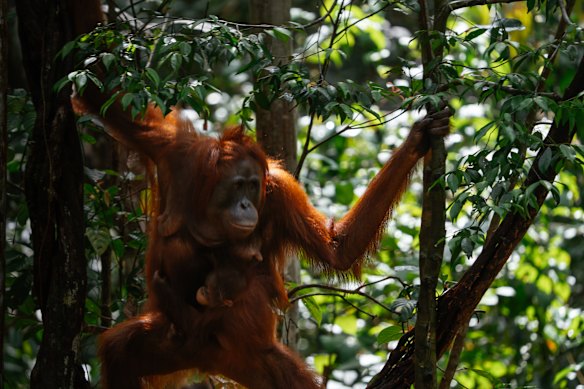
Two orangutans try to sneak away with a pile of corn, only to wither under Atlas’ gaze, causing them to drop their bounty at his feet. Another dashes up a tree with a stash of bananas, pauses as if he can’t believe he has gotten away with it, then scurries off when Atlas snorts at him. Meanwhile, giant blue butterflies flutter under the dappled sun, landing on shoulders and sunglasses.
These are not our first orangutan encounters. Earlier today we travelled in two Zodiacs along Borneo’s narrow, coffee-coloured Sekonyer River. This croc-infested waterway is fringed by thick peat and tropical lowland forest, and from the moment we leave the ship at the junction of the Kumai River, we are caught in a head-swivelling game of Spotto.
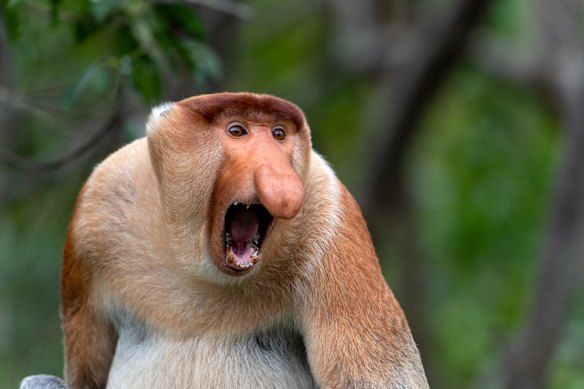
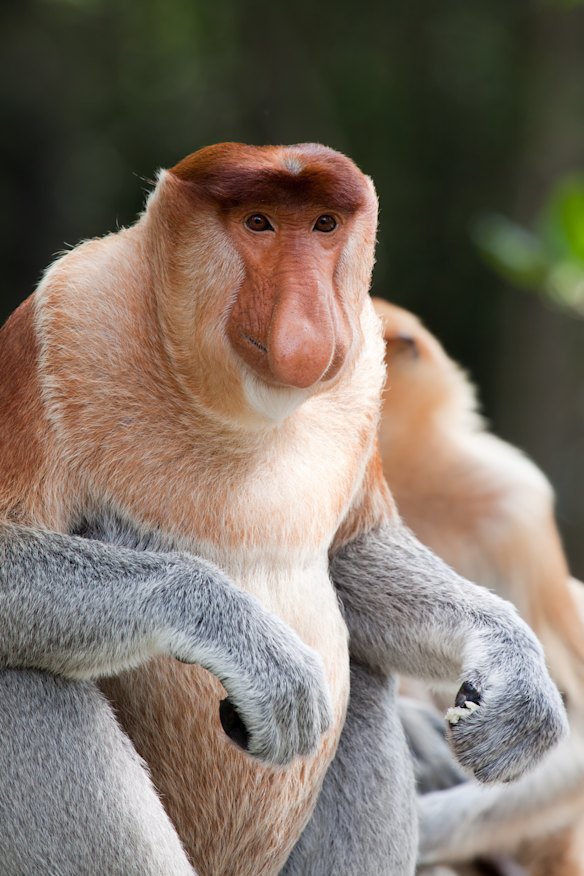
Proboscis monkeys with their comical noses scamper along the shoreline, one causing a collective gasp as it plunges into the tannin-rich water, while chattering macaques seem to perform for us as they swing from branch to branch. Our guides point out orangutan “nests” along the way, a mix of sticks and large leaves in treetops that the animals make each night. And every so often heads turn as a tuft of orange is seen flitting through the forest.
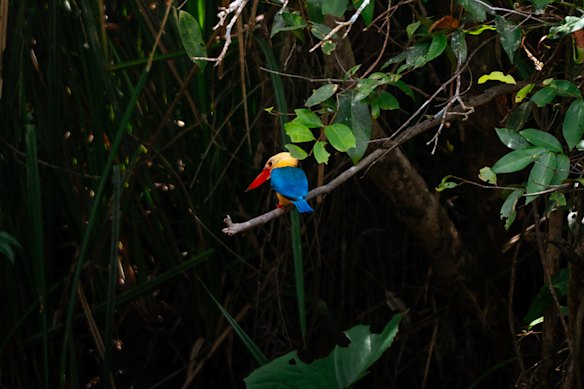
There’s a cry. Mark, our resident twitcher, points to a cartoonish silhouette of a hornbill atop a branch. We watch as it takes off, its wingspan seemingly the size of a hang-glider.
About half-way to Pondok Tanggui, it’s decided we need to transfer one of our people to the Zodiac behind us to even out the weight, so we pull up close to a bank. As the careful exchange is made, there’s a flash of orange in a bush just metres away. We’ve managed to stop exactly where an orangutan is hiding – or has it been tailing us?
After our visit at the orangutan rehabilitation centre, we’re back on the river, but this time we swap the adventurous pace of the Zodiacs for a more relaxed journey by klotok, a traditional wooden houseboat. On this vessel we can walk around, lounge on cushions, have lunch (including delicious pisang goreng, or fried bananas, bought from a passing vessel) as we meander down the river.
But we don’t relax for long. Iridescent kingfishers startle us from our own perches as they light up the riverbanks; a large croc is spotted right below a group of monkeys who seem to be tempting fate on the shoreline, then our hearts are in our mouths again as a proboscis monkey is spotted dog-paddling beside us, its submerged nose resembling an upside-down snorkel.
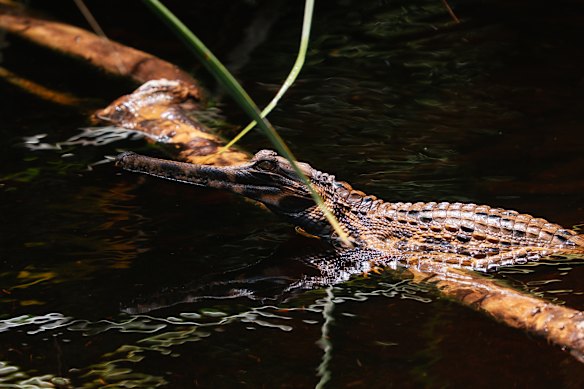
A cry from the deck. “Cara! We found one!”
There in the waterway, surrounded by reeds, is an impossible-to-spot-yet-there-it-is, tiny, mottled false gharial.
Tonight’s chef’s menu? Lobster cocktail, lamb shoulder, spiced cous cous, labneh, panna cotta AND champagne.
DAY FIVE: Rumble after the jungle
Orangutans: they’re all we can talk about. But as our expedition leaders outline our visit to East Java’s active volcano, Mount Bromo, which involves trekking on a sandy caldera and climbing 250 steps, we realise tomorrow will be huge.
In the late afternoon we watch a garfish jump through the water like a skipped stone before a plump booby swoops in to retrieve it for dinner.
DAY SIX: Painted ponies & a steamy cauldron
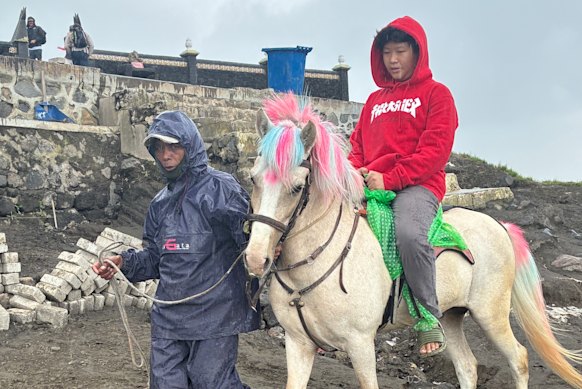
Of all the things you might expect to see at the base of an active volcano, white ponies with neon-green, blue and pink-dyed manes and tails are not on the list.
But after we emerge from a four-wheel-drive and survey the black Tengger Caldera (aka the Sea of Sand) that we need to traverse before climbing a stairway to the 2329-metre Mount Bromo rim, these come-to-life My Little Ponies that can be hired by those not keen on walking makes as much sense as anything else.
Even so, we choose to walk after the long drive here from Probolinggo on the north coast of East Java, where the Paspaley Pearl has anchored. We’ve travelled first by Zodiac, then by four-wheel-drive. Our driver, “Risky”, volunteers his name only after we hit the winding road to Mount Penanjakan, a ridge across from Mount Bromo, so we can see the volcano in all its glory before climbing it. It looks just like a child’s drawing: cone-shaped, with a swirling cloud above.
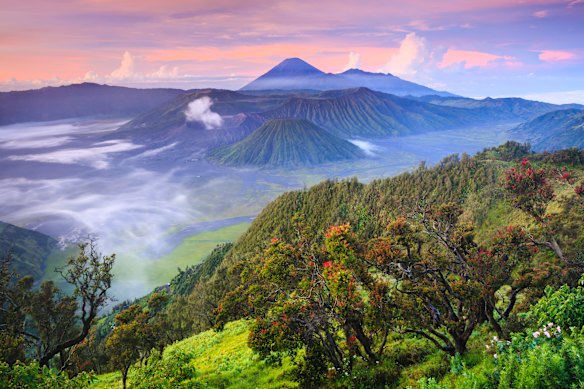
While the drive has taken us through lush vegetation and crops (all that good volcanic soil) and past colourful shops and hostels, the caldera itself is a world of black and grey, sand and stone surrounded by crater walls.
A wind has picked up and there are drops of rain as we trudge across the inky shifting sands, passed occasionally by a horse and nervous rider. By the time we reach the stairway (to heaven or hell?) the sky has darkened and we pull on rain jackets. Then it’s a slow climb to the top, made so by our need to keep turning to say “wow” at this otherworldliness that seems to stretch forever.
As we reach the top, we’re warned not to move too far – just metres away is a yawning misty chasm about 800 metres wide, and the only barrier between it and us are remnants of an ancient stone fence. It’s easy to see why this is a sacred site for the local Tenggerese Hindu people, who throw offerings into the void once a year. There’s a rumble, a choking sulphuric smell, and then the heavens open as we pick our way back down the steps, as spooked as the neon horses who dance beside us.
DAY SEVEN: Bull racing
Eggs, cooking oil, herbs, beer, some sort of sauce. We can’t see everything that the bull owners and trainers, some wearing black felt fedoras, mix into a brownish concoction before pouring it into the mouths of their charges, but the animals don’t seem to object. In fact, the small bulls, Madura cattle known for their speed and agility, nuzzle the wooden feeding funnels as if asking for more.
We’re in Sumenep on the island of Madura, in East Java, famed for its Kerapan Sapi (bull racing) that dates back to the 13th century.
And like so much we’ve seen so far, the spectacle in front of us is something that shouldn’t make sense. A roving band of a dozen or so musicians in green and red costumes with ornate headdresses – plus sunglasses and runners – wander outside the sandy, grass-lined racetrack, playing their drums and kazoo-like instruments in perfect formation.
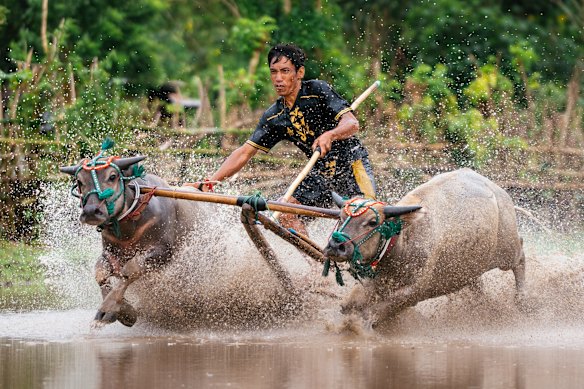
Meanwhile, highly prized bulls, decorated with tassels, flags and red halters and attached to wooden “sleds”, are led to parallel starting lines at the track for essentially a two-bull race. Soon they are tearing at breakneck speed over about 120 metres, their jockeys somehow balancing on two wooden poles the animals drag behind them.
There are gasps from the grandstand as a slight jockey falls towards the finish line, but he manages to do an athletic roll to safety, walking away sheepishly (rather than bullishly). There’s no betting, but the spectators, mainly men, appear heavily invested in the outcome. The prize? Bragging rights, and, from what we can see, the odd box of chocolates.
We leave via a market at the racetrack entrance where various cuts of meat – including heads, necks and innards – vegetables and salted eggs are laid out on tables and rugs, and stall owners sit and laugh and gossip.
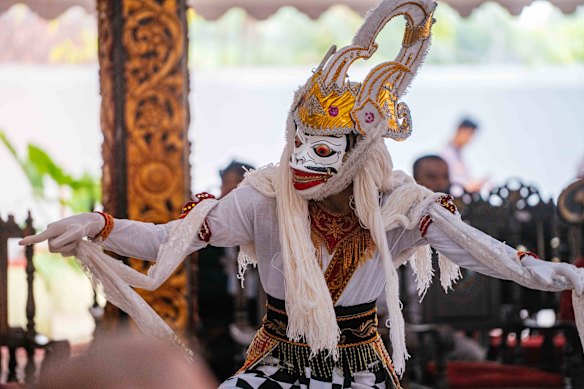
Sumenep is also home to the 18th-century Palace Museum, built by descendants of Madurese princes. Here we watch dancers in ferocious monkey masks, look at royal portraits and relics – including a king’s bed chamber – and covet exquisitely handcrafted knives and scabbards that, while for sale, might not make it through customs.
DAY EIGHT: A wedding and water buffaloes
Our expedition leaders are excited: today’s journey, to Jorok Village in Badas, Sumbawa, is one they say we won’t forget. First, because we’re to be guests at a wedding, and second, because the people of this pretty agricultural village, who have had few visitors since the pandemic, have been so welcoming to Paspaley Pearl guests that it has earned a special place in this new vessel’s history.
After travelling by Zodiac and bus we’re greeted by a dozen men in traditional costume out the front of colourful houses.
We’re led to a large shed where we’re shown a table of herbal remedies used to treat everything from indigestion to infertility. Children play traditional instruments and young girls in pink and green silk robes perform a dance with incredibly intricate – and hypnotising – hand movements.
One boy playing a pipe solo with gusto stops abruptly. A woman touches his shoulder, explaining through our guide: “He’s dizzy, it’s Ramadan, and he hasn’t eaten.”
Trays of Indonesian sweets, including dadar gulung (delicious coconut pandan pancakes) arrive for us, all made by the veiled women of the village, who are also fasting. Our expedition leaders express our thanks and say how touched we are that they have gone to such trouble during Ramadan, and there’s an unspoken moment when hands are clasped, hugs exchanged.
Yes, unforgettable.
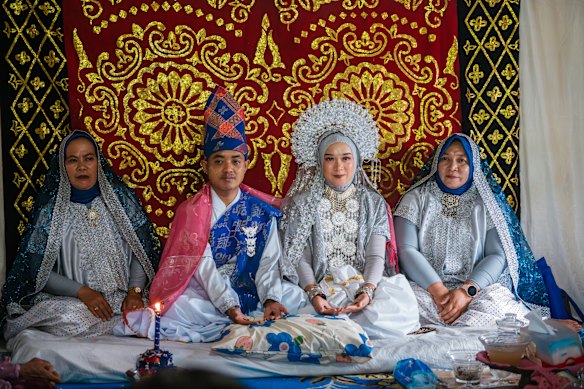
We are taken to a nearby house. Inside a candlelit room is a bride in an elaborate silver headdress and robes. She kneels on the floor, the groom, in crimson, indigo and white, beside her. We sit opposite, nod to their relatives, and bear witness to the blessings for the union, as our foreheads are anointed with oil and guests erupt in good wishes.
Next we head to a celebration of an entirely different kind.
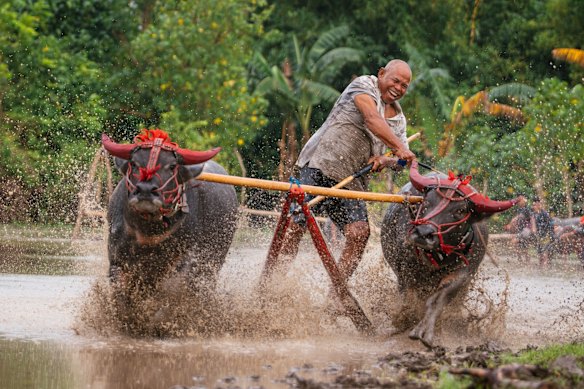
More racing, this time water buffaloes. There’s no sandy track, but rather a mud field, which means the “jockeys” are covered in an occupational hazard – mud and buffalo dung – by the end of each race. The crowd is jovial, the jockeys seemingly even more so, bowing to claps and cheers and waving boxes of chocolates in the air.
As we board the bus to head back to the Pearl we turn to see one jubilant soul perform a victory dance in the mud.
DAYS NINE &10: Dragons and pink beaches
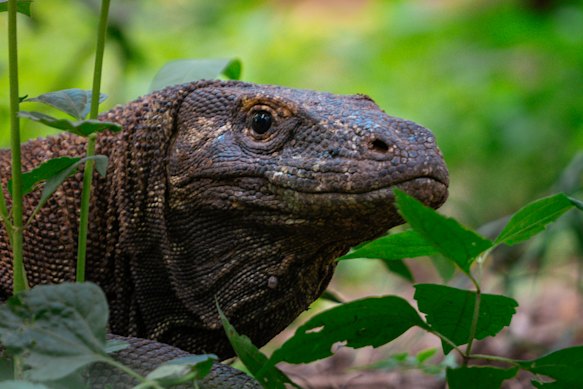
They may not breathe fire, but Komodo dragons have another trick up their sleeve. Once thought to kill prey via bacteria in their saliva, it’s now been shown they possess a venom that can cause rapid blood loss – not the most comforting thought as we trek through scrub on Komodo Island, our guide armed with a large stick “just in case”.
The dozen or so reptiles we encounter appear docile – until they move. Much like crocodiles, our guide says, dragons that can weigh up to 90 kilograms and grow up to three metres, play a long game when it comes to prey, lying statue-still for ages before lurching at 20km/h to pounce on lunch. (That stick seems to have shrunk.)
It also becomes clear that besides venom, this apex predator has weaponised its inner laziness. Instead of building the giant mounds of nests used to house their eggs for eight months, they just pilfer those carefully built by clueless megapode birds. Yes, they have staff.
We spend two days anchored off Komodo National Park, which is composed of three major islands (Rinca, Komodo and Padar) and many smaller ones.
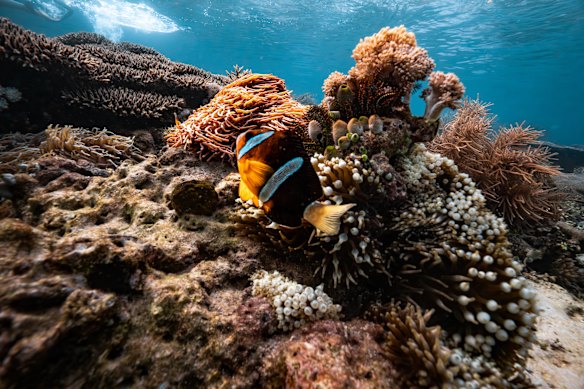
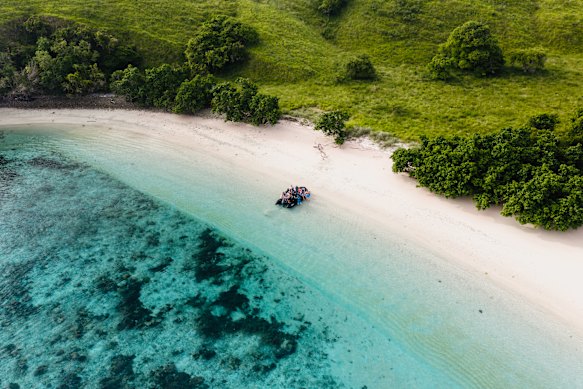
In the afternoons we zip between islands by Zodiac and snorkel at almost deserted pink-sand beaches, formed by red-toned tiny organisms that live in the coral. Here brightly coloured fish and corals are just metres from the shore. We spot a turtle, a giant clam, starfish.
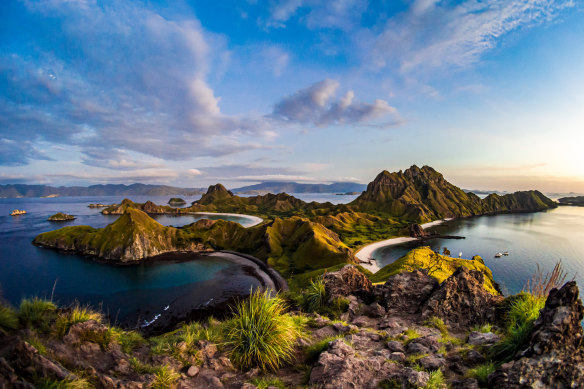
On Padar Island we climb 850 steps to a lookout, along the way encountering a green tree snake (venomous), signs warning of dragons, clouds of butterflies and a vista that is replicated exactly on the 50,000-rupiah note.
DAY 11: Whale sharks
Josh Burkinshaw
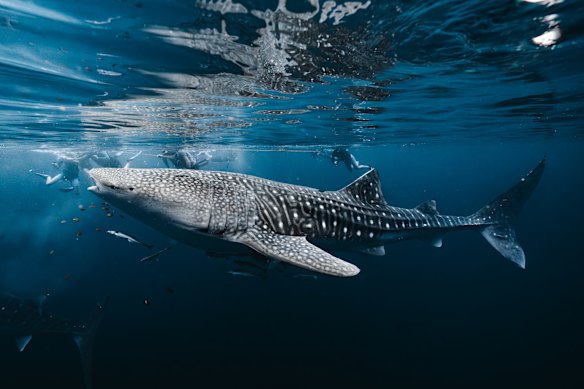
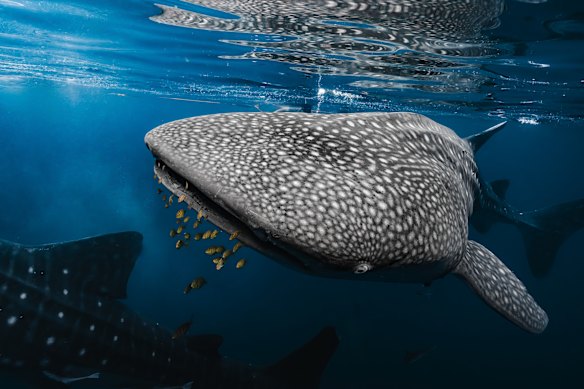
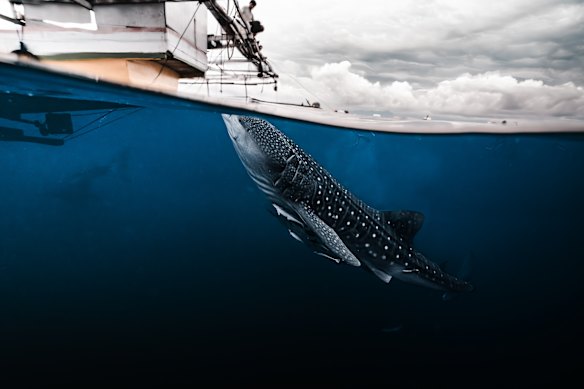
The first rule of whale-shark diving? Everything is up to them. Sometimes they will appear when fishermen (who once used to hunt them) throw a small portion of natural whale food below a floating fish platform, or bagan; other times these gentle giants that can reach up to 12 metres in length just won’t. If they do appear, stay still while holding on to a floating line: never approach, never touch.
It’s 6am, we’ve had breakfast and are waiting nervously on deck. In the distance we spot the Zodiacs with our expedition leaders heading back after checking the bagan in Saleh Bay, Sumbawa. A thumbs up. Good news. Even better news. Cara is holding up four fingers. Four whale sharks.
We’re ecstatic.
Soon we’re floating on parallel lines, nine of us on each. The air is misty. A large shape looms below. A shot of nerves, then wonder. I lower my goggles under the surface and see a giant mottled form glide past. I splutter, try to keep my emotions in check. There’s another. I look under again, and a large eye looks back at me. We stare; stare some more. A nudge – one of them is nuzzling me from behind. I hold my breath and it pirouettes away, soon replaced by a smaller, less curious, giant. We’re here for an hour, the whales are no longer being fed, but they are in no hurry to leave.
My goggles fog up. Tears.
DAY 12: Return to Bali
Our voyage has ended, and we take with us new things to unpack. Yes, there’s the sugar-cane water bottle (guaranteed to break down in landfill), but there are also fresh friendships, memories that are part of us forever, and a heightened appreciation of the deep beauty and interconnectedness of the natural world and the importance of protecting it.
THE DETAILS
CRUISE
The 12-day Orangutans, Dragons & Whale Sharks, Bali to Bali cruise on the Paspaley Pearl departs January 12, 2027 and January 23, 2027. From $20,995 a person for Ocean Double/Single Stateroom. Includes all accommodation on the Paspaley Pearl, exceptional meals and premium beverages, all shore excursions (except third-party activities) with specialist expedition team, port taxes, fees and gratuities. See pearlexpeditions.com or email concierge@pearlexpeditions.com
FLY
Jetstar, Qantas and Virgin fly daily between Australia’s capital cities and Denpasar, Bali.
The writer travelled as a guest of Pearl Expeditions.
Disclaimer : This story is auto aggregated by a computer programme and has not been created or edited by DOWNTHENEWS. Publisher: www.smh.com.au