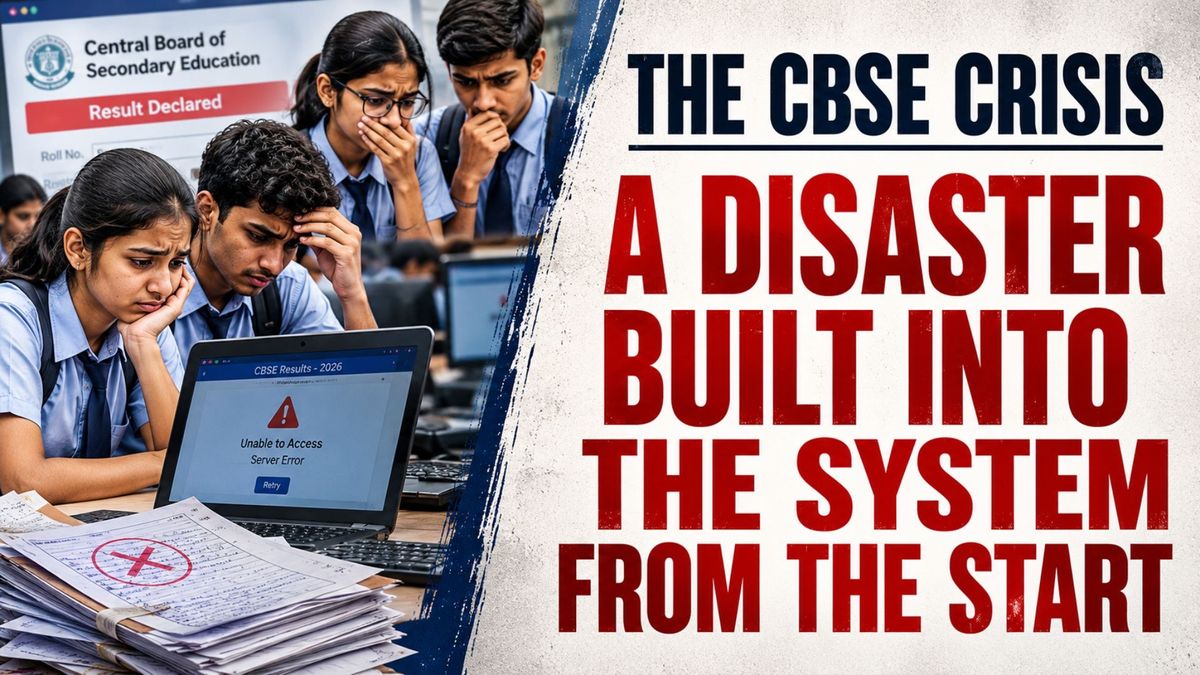
In May 2026, the Central Board of Secondary Education (CBSE) announced Class 12 results that sent shockwaves through over 17 lakh households across India. The culprit was not a mysterious plague or a war — it was a piece of software. CBSE’s maiden large-scale foray into On-Screen Marking (OSM) — a digital evaluation framework deployed for the first time at national scale — detonated into one of the most consequential examination scandals in post-independence India.
Students received wrong answer sheets. Blurred, illegible scans were marked by evaluators. Pages went missing. Portals crashed. Marks plummeted. The national pass percentage plunged to 85.20%, the lowest in seven years. The vendor at the centre of the storm, Coempt Edu Teck (formerly Globarena Technologies), had already cratered examination systems in Telangana — twice — in 2019 and 2023, leaving behind a trail of suicides and judicial intervention.
The Promise That Became a Powder Keg
The idea of the CBSE On-Screen Marking system — is, in principle, unimpeachable. Answer scripts are scanned, uploaded to a secure digital portal, and evaluated by examiners on their screens. Marks are auto-tabulated, eliminating totalling errors. Access is decentralised — teachers from any CBSE-affiliated school anywhere in the world can log in and evaluate. Transparency is built in: students can access scanned copies of their own papers.
The Board had, in fact, conceived OSM back in 2014 but shelved it then because the technology to scan bound answer booklets without cutting them was unavailable, and loose pages risked getting misplaced. A decade later, CBSE decided the technology had matured sufficiently to attempt a grand rollout — not as a pilot with a few thousand scripts, not as a phased five-year transition, but as a single, all-in deployment covering 98,66,622 answer books across approximately 40 crore (400 million) scanned pages for Class 12 students alone.
In February 2026, CBSE formally notified affiliated schools that CBSE On-Screen Marking would be implemented for the Class 12 board examination 2026, promising multiple benefits: elimination of totalling errors, automated coordination, faster evaluation, wider teacher participation, and — crucially — the abolition of post-result verification of marks, which the Board declared unnecessary given the digital system’s accuracy.
The Controller of Examinations, Sanyam Bhardwaj, was so confident he declared the system would deliver results in a compressed nine-day evaluation window, down from the traditional twelve-day physical cycle, and told PTI that “my evaluation is going very perfectly, better than the previous evaluation.” Training was promised: dry runs, instructional videos, a call centre, and practice sessions for examiners. The Board was, to use its own words, “proud” of the rollout.
The pride came before a spectacular fall.
Also Read: How NEET Let the Paper Leak—And Why It Will Happen Again
How CBSE OSM Failed: A Multi-Layered Systems Collapse
The collapse of the CBSE On-Screen Marking rollout was not a single event but a cascade of simultaneous failures across hardware, software, human capacity, and governance.
The Scanning Catastrophe
At the very foundation of the CBSE OSM chain lies scanning quality. If a student’s handwritten answer sheet cannot be legibly digitised, the entire downstream evaluation is compromised — evaluators are, in effect, marking air. Students who accessed their scanned copies post-result discovered pages that were blurred to the point of illegibility, with evaluators apparently having assigned marks to content they physically could not have read. In one representative Reddit post that went viral, a student described “completely illegible” copies where “you can’t read a single line,” yet examiners had “marked them with red ticks and assigned arbitrary scores.” Worse, some students received answer sheets that were not theirs at all — a different student’s handwriting, a different student’s responses, tagged to their roll number in CBSE’s system.
Vedant Shrivastava became the human face of this failure. He posted his Physics answer sheet on X, and the difference in handwriting was immediately apparent to his family, his teachers, and, ultimately, to CBSE itself, which admitted the error and sent him the correct scanned copy. Sanjana, another student, described scoring 11 out of 70 in Chemistry theory — a grotesquely improbable result — and found that every page of her Chemistry script belonged to someone else. CBSE’s own admission that it “discarded around 30 answer sheets due to issues like unclear images and duplicate entries” without re-scanning them — meaning some students may have been evaluated on nothing at all — crystallised the scale of the administrative delinquency.
The Portal Meltdown
The failures did not end at evaluation. When students tried to access their scanned copies for verification and re-evaluation, they encountered a post-result services portal that was not ready for prime time. It crashed under load, rejected payments, generated inflated fee demands (one widely circulated report quoted figures as high as Rs 69,000 per subject before the Board was forced to correct itself), and generally functioned as a deterrent rather than a redressal mechanism.
CBSE was eventually compelled to slash fees dramatically — Rs 100 for a scanned copy, Rs 100 for verification, Rs 25 per question for re-evaluation — and promised full refunds if marks increased after scrutiny. That this fee rationalisation took a national political controversy to achieve is itself a damning commentary on institutional empathy. IIT Madras and IIT Kanpur were roped in as technical firefighters, tasked with stabilising a portal that should have been stress-tested before results were declared.
The Training Deficit
Warning signs had flashed months earlier. During a mandatory mock evaluation session on 26 February 2026, teachers reported portal access failures, slow system performance, inadequate internet connectivity in schools, and errors in teacher data on the OASIS portal.
A senior teacher from a Delhi-based DAV school went on record to describe the system as facing “repeated glitches,” with subjects like Business Studies and Biology barely commenced even weeks after the board examinations ended. CBSE’s own Controller dismissed these concerns, insisting the system was “on track.” Principals were allegedly instructed by regional officers to record videos supporting the CBSE OSM system after complaints surfaced — a damage-control exercise that, when it leaked, backfired spectacularly. The institutional instinct, once again, was to manage perception rather than fix the problem.
The Vendor at the Centre of the Storm: Coempt Edu Teck and the Telangana Precedent
If the technical failures were the body of the scandal, the vendor question is its inflammatory heart. The company entrusted with building and running the OnMark digital evaluation platform for CBSE is Coempt Edu Teck Pvt Ltd, a Hyderabad-based firm. CBSE floated its Request for Proposal on the Central Public Procurement Portal on 28 August 2025, conducted an e-bidding process, and awarded the contract to Coempt Edu Teck as the “qualified bidder,” reportedly beating out firms including Tata Consultancy Services. What CBSE did not publicly disclose — or apparently investigate — was that Coempt Edu Teck was formerly known as Globarena Technologies Pvt Ltd.
The Telangana Tragedy of 2019
In April 2019, the Telangana State Board of Intermediate Education (TSBIE) declared Class 11 and 12 results that stunned the state. Of 9.7 lakh students who had appeared, over 3.28 lakh — more than a third — failed. Many were bright students who had sailed through the year; their parents and teachers were incredulous. The culprit, as a government-appointed inquiry committee confirmed, was a “bubbling error in the OMR sheet” caused by the software deployed by Globarena Technologies, which the TSBIE had engaged for its examination processing. The consequence was not merely administrative embarrassment.
In the days following the results, students across Telangana — shattered by failure they had not earned — took their own lives. At least 19 to 21 students were reported to have died by suicide within a week. Protests erupted. The National Human Rights Commission (NHRC) issued notices to the Telangana government. Petitions were filed in the Telangana High Court seeking action against Globarena, re-evaluation of papers, and compensation of Rs 50 lakh to each bereaved family. The government appointed a three-member expert committee to probe the firm.
The 2023 Repeat
If 2019 were Globarena’s only infamy, the story might have ended there. It did not. In 2023, the same entity was again linked to anomalies in Telangana’s intermediate examinations, with 19 students dying by suicide in a single week as parents blamed the software firm. The pattern was identical, the consequences were catastrophic, and the institutional response was again reactive, slow, and inadequate.
By the time CBSE was awarding its 2026 contract, this history was publicly available. As Leader of the Opposition Rahul Gandhi pointedly observed, “It took us 30 seconds to figure out that this company was earlier called something else.” Gandhi demanded an independent judicial inquiry and an SIT, asking what relationship Coempt’s management had with the government, what procedures were bypassed, and why background checks were not conducted.
CBSE’s official defence was that it had followed General Financial Rules “scrupulously” and awarded the contract to the lowest qualified technical bidder. The CEO of Coempt, VSN Raju, maintained that the Telangana matters had been litigated in the High Court and the Supreme Court with no finding of wrongdoing against the company, and that the name change from Globarena to Coempt was a “branding exercise” under company law. Whether this defence is legally adequate is a separate question from whether it is institutionally responsible. The question that haunts the episode is not merely procedural — it is moral: when a vendor’s prior deployments have been linked to student suicides and judicial proceedings, does “following GFR” exhaust the Board’s duty of care?
The Political Firestorm and the Ministerial Response
Union Education Minister Dharmendra Pradhan found himself at the intersection of institutional accountability and political heat. His response was, in some ways, more candid than what Indian public discourse usually expects of ministers. “Certain discrepancies have come to our notice, and I take responsibility for them,” Pradhan said after a review meeting at CBSE headquarters. He was also unusually direct about accountability: “If someone is intentionally responsible, we will not spare them, whether it is within the CBSE or outside, or within the government.” He defended CBSE OSM as a “progressive instrument” that is “student-centric” and globally adopted, while promising IIT teams would fix the portal glitches.
The political opposition, led by Gandhi, was less interested in technicalities and more in the systemic indictment — the choice of vendor, the scale of harm, and the government’s silence at the highest level. Gandhi accused PM Modi of “no answers, no accountability, no shame.” Pradhan accused Gandhi of being “frustrated after repeatedly losing elections” and opposing “scientific advancement.”
In this back-and-forth, the students — the actual victims — risked being reduced to political collateral. The more disquieting revelation was CBSE allegedly instructing school principals to record videos praising the OSM system even as complaints mounted — an institutional reflex more concerned with managing optics than with providing relief. That is the deeper crisis: not the technology’s failure but the system’s unwillingness to acknowledge it until the outrage became politically unsustainable.
Also Read: NEET 2026 Paper Leak: Inside the System Built to Keep Failing
NEET-UG 2026: A Second System Collapses Simultaneously
The CBSE OSM disaster did not occur in a vacuum. It detonated alongside an equally, if not more, consequential crisis in India’s medical entrance examination system. NEET-UG 2026 was conducted on 3 May 2026 for over 22 lakh candidates. Within days, a “guess paper” circulating on WhatsApp and Telegram was found to contain over 120 questions that matched the actual examination paper.
On 12 May 2026 — the very week CBSE declared its compromised results — the National Testing Agency (NTA) cancelled the NEET-UG 2026 in its entirety, only the second full cancellation of any national exam in post-independence India after the 2015 AIPMT. The CBI was handed a comprehensive probe; by late May, 11 accused had been arrested from Delhi, Jaipur, Gurugram, Nasik, Pune, Latur, and Ahmednagar. The re-examination was scheduled for 21 June 2026, pushing back the entire medical admissions calendar for the year.
The Supreme Court was characteristically scathing. A bench of Justices P.S. Narasimha and Alok Aradhe observed that the NTA “appeared not to have learnt its lesson” from 2024, when a paper leak in Hazaribagh and Patna had triggered the Vanshika Yadav v Union of India litigation. In that 2024 case, the Court had declined to cancel the exam, constituted the Radhakrishnan Committee (chaired by former ISRO chief K. Radhakrishnan) to recommend 101 reforms, and broadly trusted the government’s submissions that the breach was not “systemic.” Twenty-one months later, the breach repeated at greater scale.
The Court’s 2024 direction that “the process be duly strengthened” had effectively been reduced to a Steering Committee that met on paper but failed to implement the Radhakrishnan panel’s central recommendation: migration from the OMR pen-and-paper format to a Computer-Based Test, which would have structurally reduced the possibility of a physical paper leak. The minister admitted there had been “a breach in the command chain” while simultaneously claiming the recommendations had been implemented “word for word.” The contradiction was hard to miss.
Why Did the Government Not Learn Its Lessons?
This is the question that cuts through the noise. It is not hyperbole to say the government had ample warning — from Telangana in 2019, from Telangana again in 2023, from NEET 2024, from UGC-NET 2024, from teachers flagging CBSE OSM portal failures in February 2026, from the Radhakrishnan Committee’s own 101 recommendations sitting in a file. The pattern of failure is consistent enough to constitute institutional negligence rather than bad luck.
Several pathologies explain the pattern.
First, there is the problem of compressed timelines driven by political optics. CBSE deployed OSM at full national scale — 40 crore scanned pages — most probably without a phased pilot. The desire to announce a “digital India” milestone appears to have outpaced operational readiness.
Second, there is the procurement myopia that treats the lowest qualified bid as automatically the right bid, without fitness-for-purpose scrutiny. A vendor’s litigation history in two state-board disasters was apparently insufficient to trigger deeper due diligence.
Third, there is the structural absence of independent technical oversight for examination bodies. The NTA and CBSE both function under the Ministry of Education, making internal accountability circular and self-referential.
Fourth, the Public Examinations (Prevention of Unfair Means) Act, 2024 — enacted in the wake of NEET 2024 — criminalises paper leaks and vendor misconduct with up to 10 years’ imprisonment and Rs 1 crore fines. Its enactment was the right legislative instinct, but legislative architecture without enforcement culture is a road without vehicles.
Fifth, and most fundamentally, India’s examination governance philosophy has not yet absorbed the lesson that high-stakes examinations — ones that determine access to medicine, engineering, and the future — require a zero-fault tolerance that ordinary procurement processes cannot deliver.
The Radhakrishnan Panel, constituted after NEET 2024, had recommended “DigiExam” authentication (Aadhaar, biometrics, AI analytics), mobile testing centres for remote areas, multi-session testing formats, and permanent NTA staffing — all structurally sound ideas. The Steering Committee constituted to implement these recommendations over 18 months apparently failed to flag the non-implementation of CBT migration before the 2026 examination. This is institutional inertia at its most dangerous: committees are constituted, reports are filed, monitoring is promised, and the next crisis arrives on schedule. The matter is once again before the Supreme Court.
The Students in the Crossfire: The Human Cost of CBSE OSM
Behind every percentage point in the CBSE pass-rate decline — from 88.39% in 2025 to 85.20% in 2026, the lowest in seven years — are individual students whose futures ride on Class 12 marks. Board results determine admissions to colleges, professional courses, and scholarships. For Vedant Shrivastava, the wrong Physics answer sheet is not an abstraction — it is a corrupted record that, if uncorrected, could cost him his preferred college. For the over four lakh students who applied for scanned copies, the process was itself traumatic: portal crashes, inflated fees, illegible PDFs, and the anxiety of not knowing whether the sheet uploaded was even theirs.
The immediate grievance-redressal measures adopted by CBSE — fee reductions, IIT involvement in portal stabilisation, promises of full refunds on mark increases, extension of deadlines — are welcome but insufficient on their own. What is needed alongside them is a credible, time-bound commitment: every student whose marks were demonstrably affected by a scanning error, a mismatch, or an unmarked page must receive corrected results before college admission deadlines, with no additional cost and no bureaucratic obstacle course. The Board’s statement that “no child will be allowed to suffer due to a technical error” — reportedly scripted into the very videos principals were asked to record — needs to be operationalised, not merely narrated.
CBI Probes and Court Orders Cannot Fix a Broken System
India now has a well-worn template for examination crises: controversy erupts, CBI is invoked, Supreme Court issues notice, minister acknowledges responsibility, committee is constituted, report is filed, implementation is monitored, next crisis arrives. NEET 2024 followed this template. NEET 2026 is following it again. The CBSE OSM controversy, while not yet attracting CBI intervention, has attracted demands from the Opposition for a judicial inquiry and SIT investigation.
The Supreme Court’s growing impatience is evident. In the NEET-UG 2026 hearings, the bench issued notices on petitions seeking the replacement or dissolution of the NTA, with the Court observing it was “sad” that the agency had not learnt from 2024. The Court has also been careful to avoid stepping into the realm of managing examinations itself — Vanshika Yadav (2024) was premised on judicial restraint, trusting executive machinery to deliver on its commitments. That trust has been betrayed. The appropriate judicial response now may lie, as the Supreme Court Observer perceptively notes, “between a continuing mandamus and a dismissal” — probing what the Steering Committee actually monitored, what it flagged, and what it failed to report before 2026.
But courts cannot run examinations. CBI investigations are essential to criminal accountability but do not fix systemic infrastructure. The lesson we must absorb — and have failed to, repeatedly — is that CBI probes and judicial interventions are the last resort of a governance system that has already failed, not a substitute for the institutional capacity that should have prevented the failure in the first place.
One Diagnosis for Two Crises
The CBSE OSM fiasco and the NEET-UG 2026 paper leak appear superficially different in character — one is a technology deployment failure, the other a criminal conspiracy involving paper leaks circulated on WhatsApp. But they share a common diagnosis: India’s examination infrastructure is governed by bodies that are chronically understaffed, technologically under-resourced, institutionally isolated, politically exposed, and culturally averse to admitting failure until failure becomes nationally undeniable.
The NTA, restructured in 2024 to focus only on higher education entrance examinations, still conducted NEET 2026 in pen-and-paper OMR format while CBT migration was deferred to 2027 — a decision that the 2026 paper leak immediately vindicated as catastrophically wrong. CBSE, rolling out OSM, abolished post-result mark verification simultaneously, eliminating the safety valve precisely when it was most needed. Both decisions reflect an institutional culture that conflates ambition with preparation. The result is a generation of students who cannot trust that their examinations are fair — and that loss of trust in public examinations is, arguably, the most corrosive outcome of all.
Way Forward: A Practical Architecture for Reform
India does not lack for reform committees or reform reports. What it lacks is the political will to implement them without waiting for the next catastrophe. The following recommendations are not new in isolation — many appear in the Radhakrishnan Panel’s 101 points — but their urgency is now acute.
(i) Mandatory Phased Pilots Before Full Deployment. No examination technology should be deployed at full national scale without at least two years of phased piloting — starting with a representative sample of five to ten lakh scripts, under independent technical audit, with publicly released quality metrics before scale-up. CBSE OSM for Class 12 should have been piloted in 2024, evaluated in 2025, and deployed at scale only in 2026-27 at the earliest.
(ii) Independent Technical Audit Authority. An autonomous Examination Technology Audit Authority (ETAA), structurally independent of the Ministry of Education, should be created to certify vendor fitness, audit scanning quality, conduct stress-tests on portals, and publish pre-deployment readiness reports. This body should have statutory authority to halt deployment if readiness standards are not met.
(iii) Enhanced Vendor Due Diligence Beyond GFR. The General Financial Rules mandate procedural compliance, not substantive fitness assessment. Examination vendors handling the digital infrastructure of high-stakes national examinations must undergo enhanced background verification that includes prior track record in analogous deployments, litigation history, and adverse outcomes in previous engagements — regardless of whether the entity has been formally found guilty by a court. The Comptroller and Auditor General of India (CAG) could specifically review, in a proactive manner, vendor selection for examinations affecting more than 10 lakh students and make its findings public in an effective manner, if necessary delinking its exercise from the statutory audit reports, which take time.
(iv) CBT Migration for NEET and Other High-Stakes Exams. The Radhakrishnan Committee recommended CBT. The NEET 2026 paper leak has proven the cost of deferral. The transition must begin with a hybrid model (encrypted question papers transmitted digitally, students answering on paper) in 2026 itself, with full CBT by 2028 at the latest. Every year of delay is a year of gambling with more than 20 lakh students’ futures.
(v) Separate Student Grievance Tribunal for Examination Matters. The current process — portal applications, verification, re-evaluation through the board itself — is slow, expensive, and structurally conflicted, since the adjudicator is also the respondent. A Statutory Examination Grievance Redressal Tribunal, with a time-bound adjudication mandate of 30 days, would provide credible, independent relief.
(vi) Reinstate Post-Result Verification as a Safety Net. CBSE’s decision to abolish post-result verification of marks simultaneously with the first-ever deployment of CBSE OSM was an astonishing gamble. The safety net must be restored — not as a routine, but as a quality-assurance backstop that is available when the primary system fails. Digital accuracy claims do not justify eliminating the right to verify.
(vii) Mental Health Support Protocol. Every CBSE and NTA examination crisis has a human health dimension that goes unacknowledged in official press releases. A mandatory protocol should require the Board and NTA to activate counselling helplines, publish them prominently, coordinate with school principals, and monitor social media for distress signals whenever a major result-related controversy erupts. The Telangana experience — where students died by suicide — is a permanent reminder that these are not administrative failures alone. They are human tragedies.
(viii) Parliamentary Oversight Committee for Examination Bodies. A dedicated Parliamentary Standing Sub-Committee on Examination Integrity — cutting across the existing Education Committee — should receive mandatory annual reports from CBSE, NTA, and other examination authorities on technology deployments, vendor contracts, complaint volumes, and systemic risks. Sunlight is the best disinfectant.
(ix) Activate the Public Examinations (Prevention of Unfair Means) Act, 2024. This legislation, enacted in response to NEET 2024, provides for imprisonment of 3 to 10 years and fines up to Rs 1 crore for organised examination crimes, and bars convicted service providers from conducting examinations for four years. It should be actively invoked in current investigations — not merely cited in press releases. Its deterrent value depends entirely on demonstrated enforcement.
(x) Long-Term: A National Examination Integrity Commission. India needs a permanent, statutory, multi-member National Examination Integrity Commission with representation from the judiciary (retired judges), technology experts, educationists, student representatives, and civil society — modelled in part on Election Commission-style independence. Such a body would provide the institutional continuity that ad hoc expert committees structurally cannot.
The CBSE OSM disaster and the NEET-UG 2026 paper leak are not isolated incidents. They are the latest symptoms of an examination governance system built on ambition without infrastructure, speed without safeguards, and accountability without independence.
The students of 2026 — 17 lakh of them in CBSE Class 12, over 22 lakh in NEET — have paid the price of institutional hubris. Union Education Minister Pradhan’s candour in accepting responsibility is a better start than the default ministerial denial, but ownership of blame is not the same as structural reform.
India’s examination system does not need another committee — it already has their reports. It needs the political will to implement what has already been recommended, the institutional courage to deploy technology only when it is genuinely ready, and the moral imagination to remember that behind every roll number is a human being whose life cannot be rescheduled like a re-examination.
Disclaimer : This story is auto aggregated by a computer programme and has not been created or edited by DOWNTHENEWS. Publisher: theprobe.in