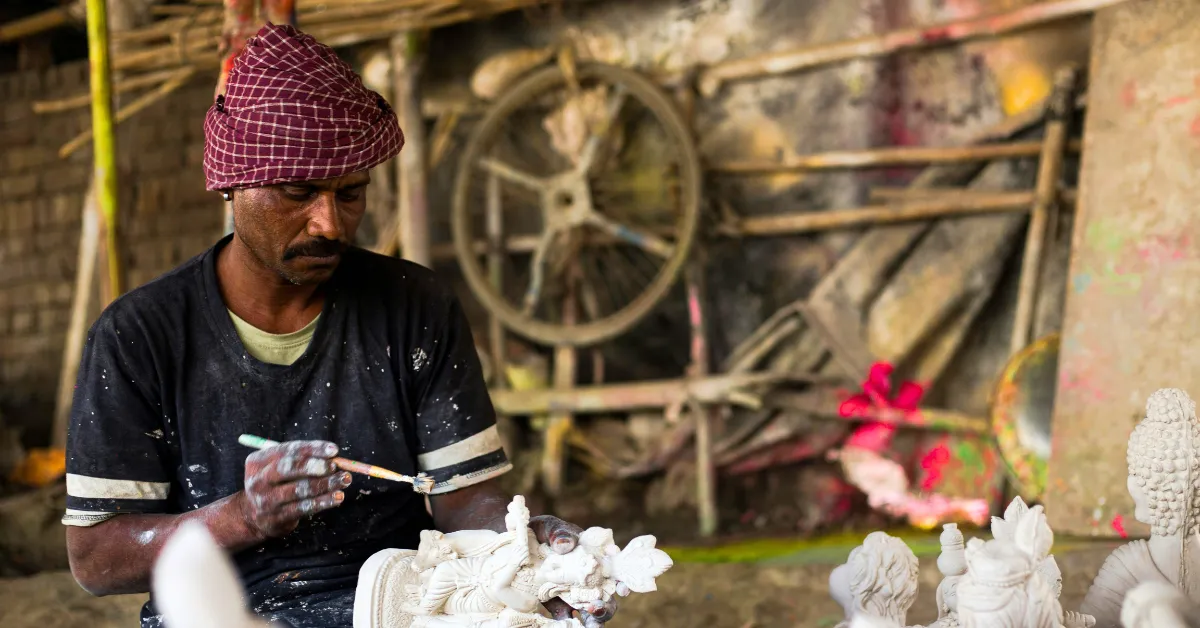
Layers of clay come together to tell a story. A musician playing a drum, a village procession, a traditional figure or a beloved folk hero – all carefully sculpted onto terracotta panels by artisans in Molela, Rajasthan.
For generations, this small village has been turning its locally sourced clay into artworks that are admired far beyond India’s borders.
But the appeal of Molela’s art lies not only in the stories it tells. Artists and collectors from around the world are equally fascinated by the material itself.
Known for its unique composition, workability and durability, Molela clay has become the foundation of a craft tradition that dates back centuries.
A village where clay became a storyteller
Nestled on the banks of the Banas River in Rajasthan’s Rajsamand district, Molela has long been known for its distinctive terracotta craft.
Historians trace the tradition back several centuries, when local potter communities began creating clay plaques depicting cultural figures, folk heroes and ancestral symbols for pastoral and tribal communities across western India.
These terracotta plaques were commissioned by patrons who travelled from parts of Rajasthan, Gujarat and Madhya Pradesh to carry home representations rooted in community memory and local tradition.
The heritage of Molela is one of the reasons artists continue to be drawn to its clay. Every artwork carries material value as well as centuries of cultural memory and craftsmanship.
Over time, the village became synonymous with this specialised art form. Knowledge of preparing the clay, sculpting figures and firing the plaques was passed down through generations of artisan families, helping preserve a craft that remains alive even today.
The heritage of Molela is one of the reasons artists continue to be drawn to its clay. Every artwork carries not just material value, but also centuries of cultural memory and craftsmanship.
The secret lies in the clay
What sets Molela clay apart is its distinctive composition. Traditionally, artisans mix the local clay with donkey dung, whose organic fibres improve the material’s strength and flexibility.
This process helps prevent cracks during drying and firing, creating a clay body that is both durable and easy to shape.
For artists, this means greater freedom to experiment with intricate forms and fine details. The clay remains responsive during sculpting while retaining its structural integrity, making it particularly suitable for the elaborate relief work that Molela is known for.
Its porous nature also allows it to withstand the firing process more effectively, ensuring that even highly detailed creations retain their form.
/filters:format(webp)/english-betterindia/media/media_files/2026/05/29/molela-clay-2026-05-29-15-13-22.png)
It is this rare balance of malleability and durability that has drawn attention from artists, designers and collectors across the world, many of whom continue to explore the possibilities of this centuries-old material.
Sculpting stories instead of pots
The uniqueness of Molela clay is matched by the equally distinctive way it is used.
Unlike traditional pottery that is shaped on a wheel, Molela artisans create flat clay plaques known locally as thalas. Upon these surfaces, they carefully build scenes by layering coils and pieces of clay, gradually bringing figures and narratives to life in raised relief.
The resulting artworks are rich in texture and depth. Gods, goddesses, animals, musicians, village communities and scenes from everyday life emerge from the surface, creating compositions that feel both sculptural and storytelling-driven.
For contemporary artists, this technique offers a unique creative language. It allows them to combine the dimensionality of sculpture with the narrative possibilities of painting, transforming simple clay panels into detailed visual stories.
A tradition rooted in folklore and community life
Molela’s terracotta tradition has long been connected to folklore, community memory and local life. Historically, artisans crafted plaques depicting cultural figures, folk heroes and ancestral symbols, which were commissioned by patrons from Rajasthan and neighbouring regions.
These terracotta images were often placed in traditional village spaces and community settings.
/filters:format(webp)/english-betterindia/media/media_files/2026/05/29/molela-clay-2026-05-29-15-16-33.png)
As the craft evolved, artisans began portraying scenes from daily life — farmers at work, village celebrations, weddings and festivals. The plaques became records of community life, preserving the people, practices and stories of the region.
Today, artists around the world continue to draw inspiration from Molela’s storytelling tradition, adapting its techniques to explore contemporary themes while remaining connected to its cultural roots.
Colours from the earth
The beauty of Molela art extends beyond its sculpted forms. Traditional pieces are decorated using natural mineral pigments and organic materials that complement the earthy character of the clay.
Artisans use colours derived from minerals and clay slips, often binding them with vegetable gum before applying a protective lacquer finish. The resulting palette is striking, featuring warm reds, earthy browns, blacks and muted metallic tones that enhance the relief work rather than overpower it.
In a world increasingly focused on sustainable practices, these natural finishing methods add another layer of appeal. They reflect a craft tradition that works closely with local resources while preserving techniques refined over generations.
Why Molela continues to inspire artists worldwide
What makes Molela clay remarkable is not just its composition or the beauty of the finished artworks. It is the way material, technique and tradition come together to create something deeply rooted in place.
/filters:format(webp)/english-betterindia/media/media_files/2026/05/29/molela-clay-2026-05-29-15-17-33.png)
Every Molela plaque begins with clay sourced from the surrounding land and shaped by skills passed down through generations.
It carries stories of folklore, community life and craftsmanship, all preserved in terracotta relief.
For artists across the world, Molela offers something increasingly rare — a medium that combines creative possibility with a living cultural heritage.
Sources:
Molela Clay Work by DIGI
‘Molela Clay Work: Rajasthan’s Unique Handmade Terracotta Plaques’ by Incredible India
Disclaimer : This story is auto aggregated by a computer programme and has not been created or edited by DOWNTHENEWS. Publisher: thebetterindia.com