Israeli troops have captured a clifftop castle as they made their deepest incursion into Lebanon in more than 26 years, further shattering a nominal US-brokered ceasefire and complicating efforts to extend the separate truce between the Washington and Tehran.
After days of intense fighting and airstrikes in nearby villages, the Israeli defence minister, Israel Katz, said the military had captured Beaufort Castle, also known as Qalaat al-Shaqif, which it had used as a base during its previous occupation of southern Lebanon between 1982 and 2000.
The Israel Defense Forces (IDF) already controlled territory up to the Litani River in its campaign against Hezbollah, but troops are now pushing towards the Zahrani River, about six miles north.
The French foreign minister, Jean-Noël Barrot, requested an emergency meeting of the UN security council on Monday to discuss Israel’s military operations in Lebanon, which he described as unacceptable.
“Nothing can justify the prolongation of Israeli military operations in Lebanon and its increasingly deep occupation of Lebanese territory,” he said.
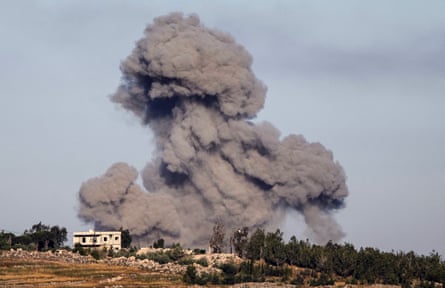
Images and footage showed Israeli and Golani Brigade flags flying over Beaufort Castle, which overlooks much of southern Lebanon, giving it strategic importance, as shelling echoed across the surrounding hills and plumes of smoke rose from the area.
The IDF said it had “launched an operation in the Beaufort Ridge and Wadi al-Saluki area of southern Lebanon to dismantle Hezbollah infrastructure and expand its control of the area”.
Israeli forces appear to be positioning themselves for a potential encirclement of Nabatieh, a city that serves as an economic centre and a cultural heartland for southern Lebanon.
Prof Yagil Levy, the head of the institute for the study of civil-military relations at Israel’s Open University, described the latest advance as no more than “victory of image”.
“There was already debate in 1982 over how necessary the capture of Beaufort really was,” he said. It attempts to present an accomplishment within a public discourse that increasingly assumes that Israel is not winning.
Protests are growing in the northern communities, criticism is emerging from within the military over soldiers’ vulnerability to drone attacks, Hezbollah remains intact, and there is no realistic plan for its disarmament.”
The advance also poses a challenge to stalled negotiations between the US and Iran, as Tehran wants any deal to end fighting in Lebanon as well. Observers have said Israeli officials and military commanders want to inflict as much damage as possible on Hezbollah before a potential deal imposes new limits or stops the current offensive.
The fighting in Lebanon has been the broadest spillover of the Iran war, displacing more than 1.2 million people as a result of Israeli strikes and evacuation orders since 2 March. A truce officially began on 17 April but has never been observed. Israel and Hezbollah accuse each other daily of violations as justification for their attacks.
For many in Lebanon, Nabatieh carries a significance that extends beyond its strategic value. Long regarded as a symbol of resistance, the city has repeatedly been on the frontline of Israeli military campaigns and is deeply embedded in the political and historical memory of southern Lebanon.
Israeli forces have moved past the towns of Zawtar al-Sharqiyah and Mayfadoun in recent days and are approaching Choukine, where local people were ordered to evacuate on Saturday amid fears of further military operations.
Taking over Nabatieh would deal a blow to Hezbollah’s morale, said Mohanad Hage Ali, a senior fellow at the Carnegie Middle East Center, a thinktank based in Beruit.
Addressing fears of a virtual annexation, he said: “Given the level of destruction in the so-called ‘yellow zone’, the range of possibilities is between denying the return of the population, and annexation/settlement in a similar fashion to the West Bank.
“Annexation is no longer a wild conspiracy theory. There are ministerial statements to this effect from Israel’s finance and national security ministers, among others.”
Lebanon’s prime minister, Nawaf Salam, accused Israel on Saturday of “pursuing a scorched-earth policy and collective punishment” by “destroying towns and villages, and forcing their inhabitants into exile” in the south of the country. He said the country was facing a “dangerous” escalation and called for “a swift and real ceasefire”.
The actions would bring “neither security nor stability” to Israel, he said.
Salam defended his government’s engagement with its southern neighbour after military delegations held security talks in Washington on Friday. More US-brokered negotiations are planned next week.
He said the outcome of the talks was not guaranteed, but called them “the least costly path for our country and our people”.
Reuters reported the Israeli military as saying one of its soldiers had been killed in combat in southern Lebanon.
Hezbollah said earlier on Saturday that it had targeted the air traffic control unit at the Meron base in northern Israel, a strategic surveillance and command facility near the Lebanese border. The group also claimed responsibility for rocket fire towards Kiryat Shmona, one of the Israeli communities most exposed to the conflict.
Videos on social media appeared to show beachgoers in northern Israel running for shelter as Hezbollah rockets were launched towards the area, according to local media. The barrage was the first fired from Lebanon towards the coastal city of Nahariya in three weeks.
The Lebanese health ministry sayid Israeli attacks had killed at least 3,371 people since 2 March, when Hezbollah drew Lebanon into the Middle East war in support of Iran. The group said it had attacked Israel in retaliation for the death of Iran’s supreme leader in US-Israeli strikes when the war erupted on 28 February.
With Agence France-Presse and Reuters
Disclaimer : This story is auto aggregated by a computer programme and has not been created or edited by DOWNTHENEWS. Publisher: theguardian.com