- Gymkhana order highlights Delhi’s poor sports and leisure infrastructure.
- Delhi significantly lags global cities in liveability and public facilities.
- Unlocking land bank and redeveloping LBZ crucial for new infrastructure.
- Gymkhana debate offers opportune time for radical urban correction.
Rarely has attention towards Delhi’s sporting and leisure infrastructure been drawn as sharply as it was when the Ministry of Urban Development ordered the resumption of land occupied by the Delhi Gymkhana Club. With the unquestionable sovereign right to eminent domain comes the sovereign responsibility to provide robust urban facilities to its citizens. The measurable failure to provide abundant sporting and leisure infrastructure in Delhi is a genuine deficit that merits being addressed prudently and urgently.
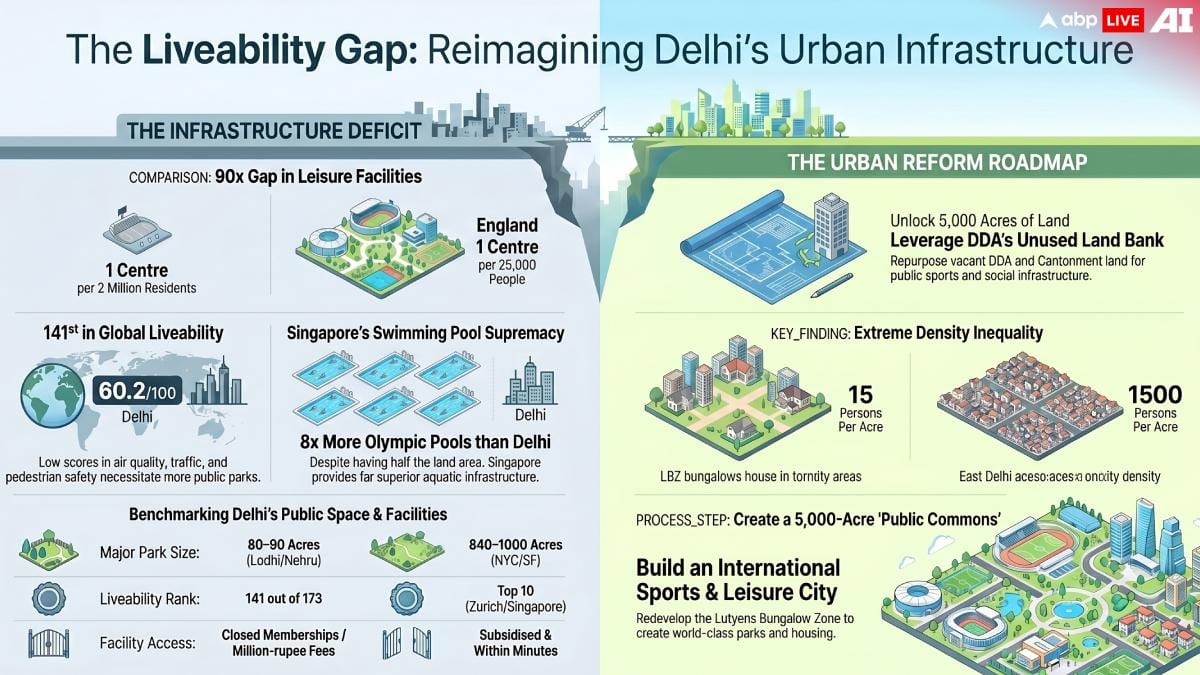
Delhi’s urban gaps are notable. In the Global Liveability Index published by the Economist Intelligence Unit, New Delhi scored only 60.2 points out of 100 while the highest score was more than 97. In air pollution Delhi ranks as the worst capital city in the world. In the Tom-Tom traffic index New Delhi ranks as the 23rd most congested.
ALSO READ: From A Rs 130 Band Bill To Today’s Turf War: Delhi Gymkhana’s Curious History Of Power And Protocol
Most Delhi roads have poor driving surfaces and pedestrian pathways are discontinuous making it impossible for a senior citizen or a lady to walk a mile without breaking a limb or being hit by a motor-vehicle. That increases the need for parks, sports and leisure facilities for senior citizens, retired officials and playgrounds for children.
Correlation In Competitiveness
There is a strong correlation between competitiveness rankings of countries and the position of their major cities on the EIU liveability index. The IMD World Competitiveness Ranking places Switzerland first with 100 points, Singapore second with 99.44 points, Hong Kong third with 99.22, and Denmark fourth with 97.51 points.
In 2025 India ranked 41st among 69 countries in competitiveness (two places lower than its 39th position in 2024), and New Delhi’s position in the EIU liveability index is 141 out of 173 countries. While the competitiveness ranking assesses the quality of national institutions and the capacity to attract and retain skilled professionals who drive innovation, investment and growth, the liveability index covers leisure, sports and other social infrastructure that make a city comfortable.
The nations (and cities) that lead both the competitiveness and liveability rankings , Singapore, Switzerland (Zurich), Denmark (Copenhagen) , share a visible common feature: they aggressively build parks, community clubs, sporting complexes, and social institutions, and they maintain them, because they understand that the battle for talent in a globalised world is not won only by salaries. It is won by liveability. A global engineer, a fund manager, an executive choosing between cities for postings is choosing not just a job , but a life, even beyond office hours.
Zurich in Switzerland, despite the snowy weather, provides more than twice as many public swimming pools as Delhi. Singapore, with a land area half of Delhi, has eight times more Olympic pools per resident than Delhi. It has allocated significant land to build 24 outdoor swimming centres mostly with Olympic-size (50 metres, 8 lanes) pools.
Nearly every public and residential complex has dedicated children’s wading pools and learner pools, many with slides and water play areas. Apart from this, Singapore has 17 track and field stadia, 16 indoor sports arenas, 15 indoor gyms, and 10 tennis centres. Crucially, there are 108 mid-sized, subsidized community clubs, which provide mainly older residents for leisure, recreation and sports and are accessible by public transport within minutes of any resident’s home. Singapore’s Vision 2030 sports master plan proposes to further reduce the citizen-to-facility ratio.
Amongst other cities, the Victorian government has given land on perpetual lease to the Melbourne Cricket Club and backed that up through an Act of Parliament. Dubai is rapidly expanding community clubs and is building new regional sports complexes. In Japan, all local authorities operate a training gym or sports centre open to the public with rock-bottom admission prices per visit with about 2,000 sports facilities open in the Tokyo area.
England has 2,727 leisure centres, for 57 million people, that is one leisure centre per approximately 25000 residents. Delhi has merely 16 DDA sports complexes for 33 million people, one per 2 million residents. The ratio is roughly 90 times worse, with no waiting list, because memberships are closed. Only the LG Delhi can bestow membership out of turn.
Against this backdrop, Delhi’s position is pitiful for a national capital with global ambitions.
What’ll Happen To Gymkhana Members?
The Gymkhana’s 27.3 acres contain 30 tennis courts, 2 swimming pools, multiple squash courts, a walking track, a gymnasium, a library, 2 reading rooms and extensive green grounds which can be further leveraged for international events, as they have been in the past.
Where do the 15,000 citizens and more connected with it, majority of whom are old and in need of senior support, now go for their sporting and leisure facilities?
They will be forced to consider private clubs such as DLF, Unitech, Taj, Lodhi and Jaypee (coincidentally, now part of the Adani real-estate empire), whose membership fees cost millions of rupees, far beyond the reach of the upper-middle class retired professionals. The losers are known. The gleeful winners from Gymkhana’s closure will be such private companies.
The solution is a drastic replanning, redesigning and repositioning of Delhi’s urban spaces to create and permit the creation of sports and leisure facilities on a war-footing in each locality. DDA’s unused land bank of about 5000 acres and the hugely untapped potential of government properties sprinkled all across all Delhi, including in the Cantonment areas and Dhaula Kuan should be unlocked to yield optimal value for sports and social infrastructure.
ALSO READ: Centre Won’t Take Forceful Possession Of Delhi Gymkhana Club Land On June 5: SG Mehta Tells HC
The LBZ Opportunity
The Lutyens Bungalow Zone encompassing an area of nearly 6,900 acres ,with merely 950 bungalows for ministers and high public officials with a density of 15 persons per acre is in stark comparison with say East Delhi’s – 1,500 people per acre.
The LBZ should be redeveloped to yield a 2,000 acre, high-security, premium residential township for its VIPs and about 5000 acres of ‘public commons’ can be equitably released for public parks and a world-class International Sports and Leisure City, with lots of sporting infrastructure, even housing. This will also help to bring down prices of residential property in Delhi (enhanced FAR should be permitted), attract foreign investments and solve the need for sports and social infrastructure.
It is noteworthy that Central Park of New York is built over 840 acres and Golden Gate Park in San Francisco over a 1000 acres, while the best parks in Delhi like the Lodhi Gardens, Sunder Nursery and Nehru Park occupy a paltry 80-90 acres each, with a proportionately lower citizen footfall.
For long the urban planning, infrastructure and governance architecture of Delhi has ignored the social facility and elder citizen aspect. The Gymkhana debate is an opportune time for a radical course correction so that all citizens of Delhi can lead a healthy and happy life. Can the cure of a malady be worse than the disease itself? And then, if abundant sports and leisure facilities are easily available, perhaps even diehard members will not miss the Gymkhana Club.
(The author is a former Secretary to the Government of India)
Disclaimer: The opinions, beliefs, and views expressed by the various authors and forum participants on this website are personal and do not reflect the opinions, beliefs, and views of ABP Network Pvt. Ltd.
Before You Go
India 2047 vision: AI Will Transform Research and Coding, India Can Build Global AI Giants: Rajan Anandan
Disclaimer : This story is auto aggregated by a computer programme and has not been created or edited by DOWNTHENEWS. Publisher: abplive.com