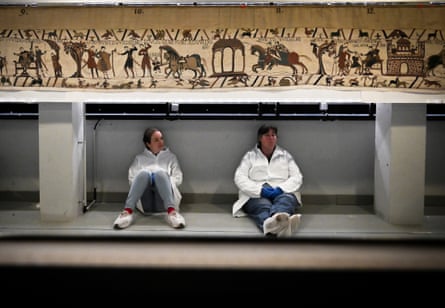
As the Bayeux tapestry wends its way across the Channel in a top secret operation there will be no jolts, no bumps, no shakes or vibrations – unlike the voyage of William the Conqueror whose 1066 victory at Hastings the artefact recounts.
“Nothing has been left to chance,” Catherine Pégard, the French minister of culture told a gathering to mark the historic loan, which will be physically achieved with the tapestry, which is really an embroidery, transported in a specially constructed cradle within a container, the minister said.
“All and any vibration that could pose a risk to the fibres of the tapestry will be absorbed. The container is the result of scientific and technical savoir faire and has been tried and tested,” she said, adding that she could not give details of when and how the tapestry would be moved “for security reasons.
Humidity in the container will be controlled and the rails on which the tapestry is hung have been fitted with shock absorbers.
“Never in the history of moving such an object have so many test runs been carried out. Everything has been thought of,” Pégard said.
The 11th-century work, measuring 70-metres long (230ft) and 50cm (20 ins) high, depicts the Norman invasion of England in 1066, in which William the Conqueror defeated King Harold of England, who is represented in his final scenes in the embroidery with an arrow in his eye. It is due to go on display at the British Museum on 10 September until 11 July 2027.
The loan was agreed after the tapestry’s permanent home in the northern French town of Bayeux in Normandy closed for renovations and for a new building dedicated to the artefact to be completed.
It has been seldom moved since the middle ages. Once was in the winter of 1803-1804 when Napoleon Bonaparte feared an English invasion and ordered it to be transported to Paris. In the second world war, France’s German occupiers first transferred it by van to a repository then requisitioned it and moved it to the Louvre in Paris as allied troops advanced after D-day.
For the British side, Lord Peter Ricketts, the former British ambassador to France and UK special envoy, said he would first answer one crucial question. “Yes, of course we will give the tapestry back, safe and sound,” he told a gathering of French politicians, officials and specialists.
“And we will entirely guarantee the protection of this precious work for the time it is with us.”
The British Museum said it would be displayed flat in one continuous length in a specially made case. It will be shown along with other works from UK and European institutions, including illustrated manuscripts, to put it into historical contest.
In return, treasures from the British Museum representing all four nations of the UK – including Sutton Hoo treasures and the Lewis chess pieces – are to be sent to museums in Normandy.
The tapestry is considered one of the key artefacts in English and British history.
The loan of the tapestry, which is already in a fragile state, is controversial. Conservators, historians and heritage experts fear the move will damage the tapestry, a Unesco World Heritage artefact, and were angry at the French president Emmanuel Macron’s 2025 offer to allow it to travel to the UK for 18 months.
Pégard said: “Some people ask if we have the right to move this precious object key to our history and I understand them. For the conservators their first mission is to conserve, but this is a work that lives through the eyes of those who see it.”
Pégard added the loan would “allow the English people to contemplate on their own soil the act that was the birth of their nation”.
More than an entente cordiale it was an entente amicale – and act of friendship “marking 1000 years of shared history … and occasional rivalry”, she said.
The exact provenance of the tapestry is unknown. It is thought to have been commissioned by William’s half-brother Bishop Odo of Bayeux in the 1070s to decorate the city’s cathedral and was almost certainly sewn by English women.
It features 58 scenes created in four stitches and thread in 10 natural dye colours, including 623 humans, more than 700 animals, 37 buildings and 41 ships and other vessels, plus 93 or 94 male genitalia depending on which British expert is counting.
Ricketts said everyone in the UK knew the story of 1066 and the Battle of Hastings.
“Why such a fascination for a battle we lost?,” he said. “Because it is central to our national story.”
Disclaimer : This story is auto aggregated by a computer programme and has not been created or edited by DOWNTHENEWS. Publisher: theguardian.com