If you’re a consumer of the titillating, you’ve been well-fed recently. The rise of ‘romantasy’ fiction, the success of audio erotic apps like Quinn and the phenomenon that is Heated Rivalry means that sex, or at the very least the aesthetic of sex is everywhere again.
Not since Fifty Shades of Grey – which unleashed a flood of “kinky” fiction in television, film and print media – has there been such a commitment to the mantra that sex sells.
Amid all this, there’s been a steady increase in the interest surrounding sex work. Maximum Pleasure Guaranteed is centred on a divorced mum who’s having regular sessions with a cam boy, the new season of Euphoria has Sydney Sweeney’s character Cassie creating content for OnlyFans, and the platform is also at the heart of the Elle Fanning dramedy Margo’s Got Money Troubles and a new Stan* reality series Turned On: Dirty Sexy Money.
After more than a decade in the industry – and now viewing it from the relative distance of semi-retirement – I am noticing the change. Sex workers are no longer always written as cautionary tales. We get to be funny now. Smart, savvy businesswomen – it’s almost always still women – with home lives, relationships and taxes. Occasionally, we’re even emotionally well-adjusted.
Seeing sex workers portrayed as ordinary people shouldn’t be revolutionary, but it still feels surprisingly fresh. Yet representation alone isn’t the same thing as understanding.
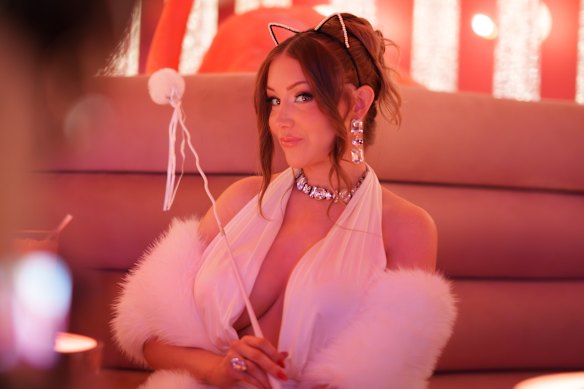
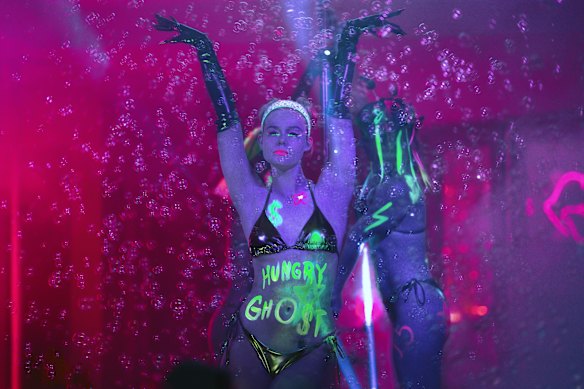
Turned On, for instance, claims to “pull back the curtain on an industry shrouded in mystery and controversy”. The series features plenty of real sex workers, yet it often seems uncertain about what it wants to reveal. Focusing on the “opulent and outrageous lives of adult content creators on the Gold Coast”, it follows a group of women who work at the same talent agency – some of whom make “over $1 million a year for as little as two days’ work a week”. To judge by the first episode, it’s less focused on the realities of sex work and more on the business of turning sex work into a brand, as well as the aspirational lifestyle that comes with a specific level of success and privilege.

This show is about sex work in the same way The Real Housewives of Sydney is about real housewives that live in Sydney.
It’s probably important that I come clean here: I did not make millions on OnlyFans. I didn’t even come close. For a period of time, I was far too busy doing the kind of sex work that might make some of this show’s cast visibly uncomfortable. And that’s part of the tension sitting quietly underneath the series.
The conflict between cast members Ruby Drew and Mia Bailey briefly brushes up against a very real divide: the tendency for some online creators to position themselves as somehow separate from, or above, the broader sex industry. It’s a distinction that is not only naive, but one that the public rarely makes in return. On Euphoria, Cassie is the butt of the joke when she says the same: “I am not a sex worker … I’m a performer who uses my body to tell stories.” Unfortunately, before Turned On can really examine that tension, it does an abrupt about-face toward relationship drama and classic reality TV conflict.
This show is about sex work in the same way The Real Housewives of Sydney is about real housewives that live in Sydney.
The quieter moments, however, are far more revealing. Hayley Summer talks of her anxieties above love and intimacy. Ruby speaks candidly about body image, and the confidence her work has given her.
The word empowerment appears frequently in conversations about sex work because the alternative can feel uncomfortable to acknowledge. If it isn’t empowerment – or self-discovery or sexual liberation – what is it? Sometimes, quite simply, it’s work.
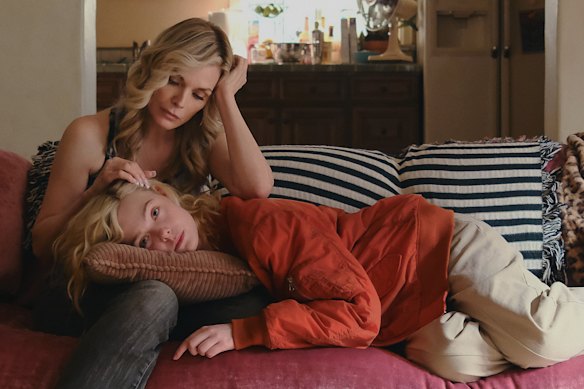
I was frustrated about this in Margo’s Got Money Troubles. Though 19-year-old college student Margo (Elle Fanning) joins OnlyFans because she needs a flexible way to make money after the birth of her child, her content slowly becomes reframed as a form of elevated self-expression – as art. This is a familiar trope in narratives about sex work. In Pretty Woman, sex work becomes romance. In Magic Mike, it becomes performance. In The Girlfriend Experience, it becomes “research” into intimacy. The work itself is rarely allowed to stand on its own terms; it has to become something different, something “better” and thus more palatable to the audience.
At its core, however, Margo depicts something television often tries to soften or dress up: need. People turn to sex work for all sorts of reasons, but money is still one of the most common. Not some heightened level of cinematic tragedy, or divine inspiration. It’s often just bills, medical expenses, rent, childcare, survival, flexibility and circumstance.
The series, based on Rufi Thorpe’s 2024 novel of the same name, is honest about the reality of content creation, as well as the sheer amount of work required to attract the kind of attention that translates into income. And it’s also right about where the risks often lie. It’s not exclusively from anonymous men on the internet, but from people closer to home. Family, former partners, people you thought were friends. Exposure has always carried risk, even before the internet ensured that content could long outlive the person who made it.
That risk has long informed the structure of these stories. A woman enters the industry, usually reluctantly, accidentally or out of desperation. There’s a shopping montage somewhere around episode three. The money is thrilling at first, the freedom intoxicating. She discovers confidence, community, maybe even empowerment. Then comes the inevitable moral accounting: the emotional fallout, the fractured relationships, the danger, the public exposure, the quiet sadness lurking just beneath the surface. By the end, television reminds us that no woman could possibly pass through sex work unchanged.
The real story is out there, but you’re unlikely to find it on television. Sex workers have always had a major presence online, despite attempts to remove them from these spaces. The rise of platforms like TikTok has enabled a level of sex-worker storytelling that did not exist a decade ago. There is no shortage of voices and yet, when it comes to screen adaptations, we continue to focus on a very specific slice of the industry, the one that is arguably the most visually compelling and monetisable. Shows like Turned On are selling something long before they are saying anything meaningful about the people they depict – whether that’s a fantasy, a lifestyle, a platform, or the promise that maybe you could do this too.
The truth about sex work is usually far less cinematic than television would like it to be.
Perhaps that’s the real tension. The truth wouldn’t necessarily be entertainment – at least not in the way we currently define it, but the interest is absolutely there. For anyone willing to work with sex workers, rather than just observe them, the stories are waiting. And the payoff, creatively, culturally and even financially, could be enormous.
Turned On: Dirty Sexy Money is streaming, with episodes dropping weekly, on Stan. Margo’s Got Money Troubles is streaming on Apple TV.
*Stan is owned by Nine, the publisher of this masthead.
Want more TV? We’ve got you.
Disclaimer : This story is auto aggregated by a computer programme and has not been created or edited by DOWNTHENEWS. Publisher: www.smh.com.au