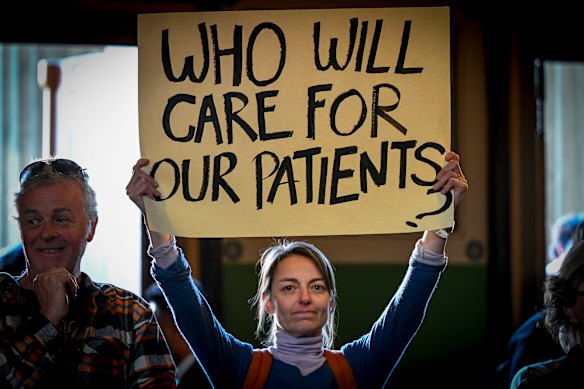
The board of prominent inner-Melbourne medical provider cohealth faces being sacked and replaced by a state administrator following widespread financial and management failures, a long-awaited independent report reveals.
The scathing review, released by the federal government on Wednesday, recommends that Victorian Health Minister Harriet Shing issues cohealth a formal final warning to prove it is effectively run, or face a complete government takeover.
Under the Health Services Act, the state government holds powers to appoint an administrator to seize control of community health assets if local governance fails. The review panel said intervention was now required after cohealth’s executive management kept its soaring deficits hidden from the board by using reassuring language in formal paperwork until February 2024.
Shing said she was carefully considering the findings, and working with the Commonwealth and cohealth to implement the recommendations.
“It’s my strong expectation that cohealth demonstrates the integrity, transparency and accountability required to deliver the important health services some of our most vulnerable community members rely on,” she said, adding that the state government provided $68 million to cohealth last year.
The review, authored by Stephen Duckett, John Furler and Jane Seeber, was commissioned following intense community pressure over shock closure announcements. Last year, the 137-year-old institution announced it would stop providing primary care and counselling services at its Kensington, Fitzroy and Collingwood sites due to a funding shortfall.
The closures would have affected more than 12,000 patients who need bulk-billing services – including vulnerable people from nearby public housing estates, homeless clients and those with drug and alcohol issues.
At the time, cohealth blamed the situation on inadequate Medicare rebates for complex patients – who create a heavy, unbillable administrative workload and have high rates of non-attendance – and a lack of state government funding to upgrade the Collingwood facility.
While the independent panel confirmed that Medicare models were poorly suited for how cohealth clinics operated, it also detailed systemic internal failures and found deficits had escalated for a decade.
The review was heavily critical of cohealth’s administrative structure, finding that corporate overhead costs were significantly higher than the 10 per cent to 30 per cent norm seen in comparable community health programs.
To resolve the crisis, the report recommends shifting cohealth to a trial federal grant model that replaces standard Medicare billing with a flexible pool of funding.
The review also explicitly recommends that the Victorian government reconsider a previous proposal to redevelop the crumbling Collingwood site with a new GP clinic with high-density social housing towers constructed directly above it.
Shing said the government was looking at options to modernise the Hoddle Street site, including advocating for the Commonwealth to deliver the project as part of their Housing Australia Future Fund.
Royal Australian College of General Practitioners Victoria Chair Dr Anita Munoz said the review provided a critical lesson for cohealth. “There are elements of the government that cohealth need to reform in order to go into the future, and my understanding is that the CEO and the remaining executives … will certainly be taking those recommendations very seriously.”
She said the review highlighted that the Medicare Benefit Scheme (MBS) was not meeting the needs of people with complex, chronic diseases. “The MBS is failing vulnerable populations,” she said.
The federal government recently announced two pools of funding for the embattled health service. In November, it unveiled $1.5 million of funding and last month, it announced another $1.5 million to keep services afloat for another 12 months.
But Munoz said this funding was inadequate.
“There’s a certain moral injury watching the government let the vulnerable population of cohealth go without their services and yet creating services in areas that just replace existing practices,” she said, referring to a recent federal government funding announcement of $25 million to open six new bulk-billing clinics on the central coast of New South Wales.
Dr Stephen Alomes, an adjunct associate professor at Deakin University and spokesman for Save Our Community Health, said cohealth’s board and senior management had failed the basic standards of governance and needed to go.
“The key recommendations suggest that cohealth is rather like a failed football coach. Its poor governance confirms that it cannot reshape the community health future,” he said.
A spokeswoman for the federal government said it would consider all recommendations in the review, but did not directly respond to questions about whether it would establish the funding trial.
Instead, she highlighted the recommendations that “identified the need for changes to cohealth’s governance, management and service delivery models”.
On Wednesday, cohealth thanked the reviewers for their report, saying it accepted that its governance needed to improve, but also said the review made it clear that state and federal government assistance was needed to overhaul its model.
“cohealth is sorry for the trauma, uncertainty and distress experienced by clients, staff and community throughout this process,” a spokesperson said in a statement.
Start the day with a summary of the day’s most important and interesting stories, analysis and insights. Sign up for our Morning Edition newsletter.
 Rachael Dexter is a journalist in the City team at The Age. Contact her at rachael.dexter@theage.com.au, rachaeldexter@protonmail.com, or via Signal at @rachaeldexter.58Connect via Facebook or email.
 Henrietta Cook is a senior reporter covering health for The Age. Henrietta joined The Age in 2012 and has previously covered state politics, education and consumer affairs.Connect via X, Facebook or email.
From our partners
Disclaimer : This story is auto aggregated by a computer programme and has not been created or edited by DOWNTHENEWS. Publisher: www.smh.com.au