
“Low-waste living, for me, is not about perfection. It is about intention. It is about asking what is actually necessary, what can be reused, and what does not need to be created in the first place,” says Damini Arora.
In Mumbai, where weddings play out like grand productions with endless decor, heavy logistics and equally heavy waste, Damini and Kunal Keswani chose something low-key. Not smaller in love or meaning, but certainly smaller in footprint.
Their wedding in Thane was not designed to announce itself as sustainable. There were no attempts to make a statement. Instead, sustainability appeared in the details, in decisions that were made early, and in things that were deliberately not done at all.
The bride runs Meraki Digital, a communications agency that works with climate-conscious and impact-driven brands. For her, sustainability is not a concept that begins with big moments. It is something that lives in daily choices. Her husband is a producer in the Hindi film and creative industry. His relationship with sustainability, he admits, began much later, and largely through his wife’s influence and the conversations they shared over time.
“I would not say I came into this thinking about impact. But when you are with someone who constantly questions consumption, you start noticing things differently. It stays with you,” he tells The Better India.
A Himalayan trek where everything changed
Their story did not begin in Mumbai, but in Spiti Valley in 2018. Damini was on a sabbatical then, working with initiatives linked to Indiahikes, focused on waste management in Himalayan villages. Her work involved not just trekking but also sitting with local communities, understanding how waste moved through fragile mountain ecosystems, and helping build systems to manage it.
“I was not there as a tourist,” she says. “It was field work. Schools, villages, and shopkeepers were trying to figure out how waste could even be handled in such remote places.”
It was during this period that Kunal came into the picture, after reaching out to her on Instagram about joining a trek she was helping organise. Over the next nine days, the two travelled through Spiti in a way neither of them remembers casually.
“There were days when we did not even know whether we would make it to the next village because of landslides, snow and broken roads, and that uncertainty somehow made the journey feel even more unforgettable,” she says.
At Key Monastery, where the group stayed overnight, the connection between them grew naturally.
“That was the first time we really spoke properly. We were spending time together, and it all felt very organic. We were genuinely enjoying each other’s company, so we just told each other, let’s give this a shot and see where it goes. That was where it all began for us,” she adds.
Kunal remembers it in his own way. “It was my first time doing something like that. I was completely out of my comfort zone, but it also felt very real,” he says.
Two worlds, one slow convergence
Damini came from a sustainability-driven environment. The groom came from a structured corporate and creative background. Their worlds were different, but their fascination was similar.
“At that time, he was not exposed to sustainability conversations the way I was,” the wife says. “But he was open to discussions, and that is what mattered.”
Kunal adds, “She does not forcefully push ideas. You just start observing things. That is what happened with me.”
Over time, those conversations began redefining both of them. Damini went on to build Meraki Digital into a company working with nearly 50 brands in the sustainability space. Kunal moved closer into filmmaking and production, while becoming more conscious of everyday consumption.
/filters:format(webp)/english-betterindia/media/media_files/2026/06/04/mumbai-low-waste-wedding-2026-06-04-16-12-10.png)
When a wedding begins with subtraction, not addition
When they decided to get married, there was no moment of deciding to make it ‘eco-friendly’. It began instead with a more practical instinct. They did not want excess.
“We did not want a big, overwhelming wedding where you barely get a moment with people. We wanted something intimate where we could actually talk and spend time with everyone who came,” the wife says.
They got engaged on 15 September 2024 and married on 21 February 2026 in Thane. Around 100 to 150 guests attended across three functions. But from the beginning, one principle stayed fixed. Nothing unnecessary would be added.
“I had already gone through a phase of reducing what I own,” she admits. “So I was very aware of how quickly things accumulate. I did not want the wedding to become another version of that.”
The venue that did half the work
The wedding took place at Blue Roof Club in Thane, a space surrounded by greenery, lawns and event infrastructure within a single property. For the couple, it was not chosen for sustainability credentials initially.
“We laid our eyes on it because it felt open, green and calming, not like one of those boxed-in venues that feel artificial and disconnected from the outdoors,” she says. Later, they learnt more about its environmental systems, including its use of solar energy across parts of the property and its wider efforts in water conservation and waste management.
Mr Moloy Sushilchandra Bakshi, chairman and managing director of the venue, explains the approach.
“We have around 180 kilowatts of solar generation capacity,” he says. “On average, we generate 400 to 600 units per day. Around 60 per cent of our energy needs are currently met through solar, depending on conditions.”
He adds that eco-consciousness is broader than energy alone. “We focus heavily on tree plantation, water conservation, and composting wet waste generated from events. We have planted and maintained over 10,000 trees across our properties,” he explains.
/filters:format(webp)/english-betterindia/media/media_files/2026/06/04/mumbai-low-waste-wedding-2026-06-04-16-15-44.png)
For Damini, what mattered most was not the numbers but how the space functioned during the wedding. “It meant less had to be fought for,” she says. “A lot of systems were already in place.”
The water question everyone avoids
One of the most practical challenges in any large Indian wedding is water. Completely removing bottled water is rarely possible when guests are moving across multiple events.
“We knew water bottles would be the hardest thing to eliminate, so instead of pretending we could completely remove them, we focused on finding ways to reduce their impact as much as possible,” she says.
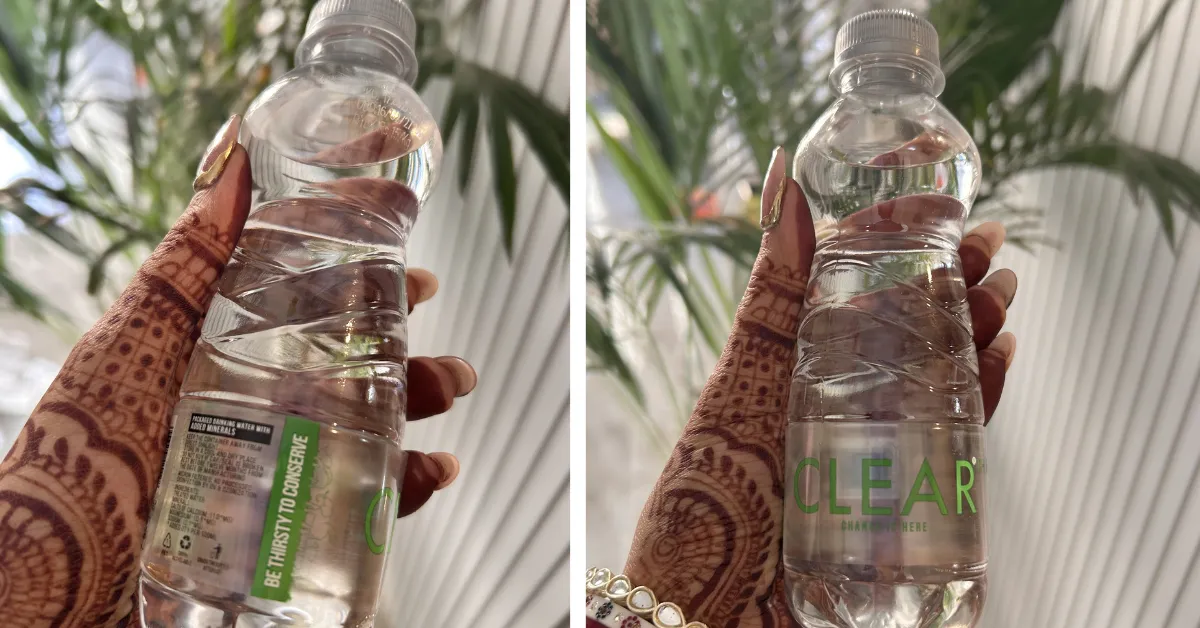
This is where Clear Pani came in.
Clear Pani supplies water in bottles made from recycled PET plastic rather than virgin plastic. Instead of producing new plastic from fossil fuel-based raw materials, the bottles are made using already used plastic that is processed and repurposed. The idea is basic but impactful, which is to reduce dependence on new plastic while keeping the system usable at scale.
“Our caterer actually connected us to them after we shared our intention to reduce waste, and he mentioned that he knew someone who could help us make that possible,” she explains.
Beyond supply, it added a layer of clarity to their decisions. “They helped us estimate how many bottles we would typically consume based on guest count and meals,” she says. “It was not a formal audit, but it gave us a baseline to work with.”
That estimation translated into a visible impact, including around 1,000 to 1,200 single-use plastic bottles avoided. “The key thing was visibility,” she adds. “Once you start counting, you stop treating things as invisible.”
Kunal admits, “Initially, everything feels normal, like it is just part of how weddings work, and no one really questions it. But when you start tracking even roughly what is being used or wasted, your perspective changes, and you begin to notice things you would otherwise completely overlook.”
The part of weddings no one talks about
Across three functions, around 450 meals were served. The couple kept food planning deliberately restrained.
“Food is where most weddings go wrong because there is almost always more prepared than what people can actually finish,” the bride says. They informed guests beforehand about the approach and kept reminders minimal and non-printed.
“We just used a whiteboard to help people understand the approach and what they should do, and avoided posters or any printed instructions altogether,” she says. They eventually shared the leftover food with the hotel staff when planned redistribution could not happen due to timing.
Nothing was built for one day
Decor was one of the most obvious areas where they made interventions, as they avoided fresh flowers, reused artificial decor across functions, and repurposed existing setups from previous events at the venue.
“We were very certain that nothing should be created only for us,” she says. “If it is going to be thrown away after one use, it does not belong in the wedding.” They kept invitations fully digital and printed only a minimal set for temple rituals.
Even seating, stages and basic structures came from the venue’s existing inventory. “It already exists,” she says. “So why remake it?”
The numbers they calculated
Damini also tried to understand the environmental impact of their choices, though she is careful to frame them as estimates.
She calculates that their choices helped avoid approximately 10 to 12 kg of textile production through rental outfits, saved around 80,000 to 1,00,000 litres of water through reduced food waste assumptions, avoided about 1,000 to 1,200 plastic bottles, and reduced over 20 kg of plastic waste through reuse systems.
“These are not the exact numbers,” she adds. “But they help you see scale in a way you otherwise do not.”
/filters:format(webp)/english-betterindia/media/media_files/2026/06/04/mumbai-low-waste-wedding-2026-06-04-16-20-29.png)
What stayed with the people who attended
For guests, the wedding did not feel restrictive or built around absence.
“It felt thoughtful, and nothing felt missing. It just felt more considered than the usual wedding experience,” says Manu Swal, a media producer and close friend.
He adds that what stayed with him was the emotional texture of the event.
“The presence of a female priest, Damini’s mother performing the kanyadaan, and other such choices made the wedding feel very personal and rooted in their own values; it felt lived in and not staged or performative,” he says.
What they would tell anyone planning a wedding like this
When asked what she would tell couples trying something similar, Damini does not begin with logistics.
“Start with your partner, because if you are not aligned on what you want, even the smallest decisions in wedding planning can start feeling unnecessarily complicated and stressful,” she says.
She adds, “Do not try to make it perfect. Just make it honest.”
Kunal agrees. “Talk more and be honest about what you actually want from the beginning, because you will be surprised how many things start falling into place and become possible when you are open about your intentions and communicate them clearly,” he says.
In the end, nothing about their wedding was designed to be a statement. But it became one anyway, not through intention to impress, but through consistency in small decisions.
/filters:format(webp)/english-betterindia/media/media_files/2026/06/04/mumbai-low-waste-wedding-2026-06-04-16-24-16.png)
A venue that already worked with nature rather than against it. A caterer who helped find alternatives instead of defaulting to excess. A supplier like Clear Pani, which helped turn assumptions into numbers. And a couple who kept returning to one simple question throughout, which is, does this need to exist at all? It was not a perfect low-waste wedding. It was something more grounded than that. Something more human.
It was a wedding where less was not absence. It was attention.
All pictures courtesy Damini Arora.
Disclaimer : This story is auto aggregated by a computer programme and has not been created or edited by DOWNTHENEWS. Publisher: thebetterindia.com



