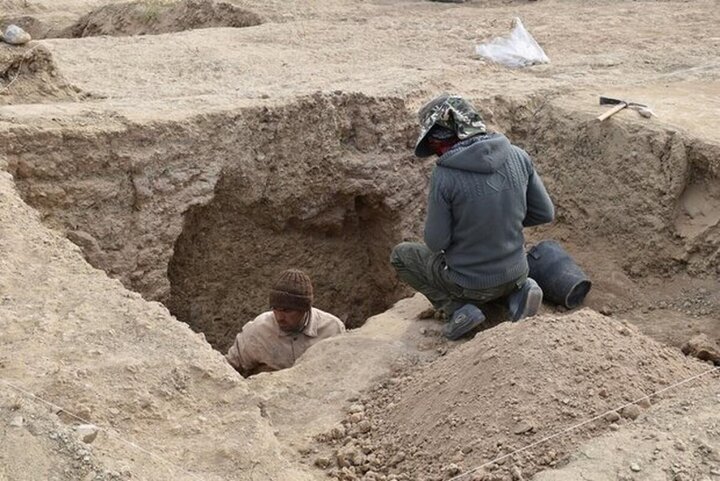
TEHRAN – Authorities in Iran’s western Ilam province have launched the fourth season of archaeological excavations at the prehistoric site of Chogha Golan, a provincial official said.
Raed Naserifar, deputy director for cultural heritage in Ilam province, said research and archaeological programs were continuing across the province, including the latest excavation campaign at Chogha Golan.
“The fourth season of excavations at the historic Chogha Golan mound is currently underway,” Naserifar told ISNA. He said the project aims to provide a more detailed understanding of the site, including the origins of sedentary life, continuity of settlement and other cultural and historical characteristics.
Chogha Golan, located about 30 kilometers north of Mehran near the Konjan Cham River in the foothills of the Zagros Mountains, is considered one of the earliest aceramic Neolithic sites discovered in Iran.
According to prehistoric archaeology specialist Habibollah Mahmoudian, the Chogha Golan region is regarded as one of the earliest centers of agriculture in Iran and West Asia.
Mahmoudian told ISNA that numerous archaeological remains representing different periods of human occupation have been identified in the area. He said the continuous flow of the Konjan Cham River contributed to long-term human settlement in the region.
He added that excavations at Chogha Golan have uncovered evidence of early plaster production and architectural remains.
Dating from approximately 12,000 to 9,500 years ago, the site is associated with some of the earliest evidence of agriculture and village life in Iran and beyond, according to Mahmoudian.
Previous archaeological investigations have revealed around eight meters of cultural deposits across 11 archaeological layers. Excavations uncovered red-painted plaster floors, mudbrick walls and clay animal figurines.
Research has also produced evidence of early domesticated emmer wheat dating to about 9,800 years before present, providing one of the earliest records of long-term plant management in Iran.
Chogha Golan was first excavated jointly by archaeologists from the University of Tübingen and the Iranian Center for Archaeological Research in 2009 and 2010. Archaeological work at the site has recently resumed under an Iranian team led by archaeologist Hojjat Darabi.
AM
Disclaimer : This story is auto aggregated by a computer programme and has not been created or edited by DOWNTHENEWS. Publisher: tehrantimes.com