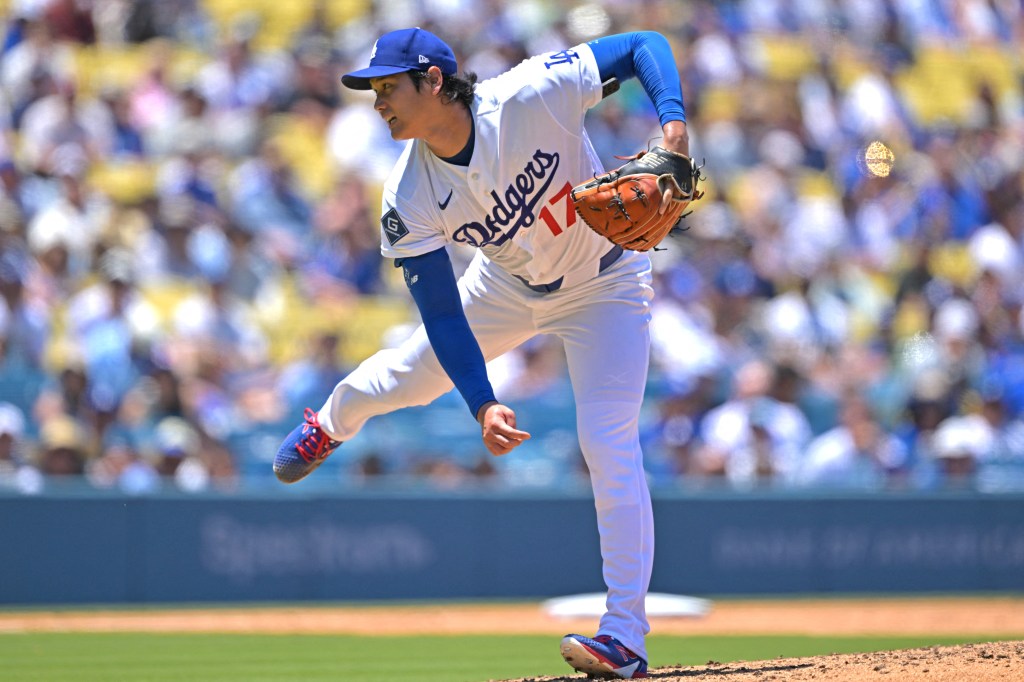
With Shohei Ohtani, the one question that never has to be asked is, “What if?”
What if Ohtani tried playing both ways? We don’t have to ask. We know.
What if Ohtani tried pitching and hitting in the same game? We don’t have to ask. We know.
What if Ohtani tried to take on the workload of a full-time pitcher as a soon-to-be 32-year-old? By the end of this season, we won’t have to ask. We’ll know.
His body could break down, his offensive production could decline, but the possibility of failure has never stopped Ohtani from attempting to do what no player before him has ever done.
And that’s not about to stop him now.
Ohtani emphasized this point in an interview published last week by the Japanese sports magazine Number.
“Inside, I’m assuming this is my last chance as a pitcher,” Ohtani told the publication in Japanese.
He said he couldn’t imagine ever wanting his time as a pitcher to be “thin and long” — in essence, he didn’t want to limit his effort for the sake of longevity.
“I’m not saying it’s OK for it to be short,” Ohtani said, “but what’s most important to me is for it to be as thick as possible.”
In other words, he intends to go all-out. He wants to be as good as he can be, and that can only happen if he doesn’t hold back. If he gets hurt, he gets hurt.
Which is why it makes sense that Ohtani won’t let swelling in his knee or a blister on his finger stop him from taking his next turn in the rotation. His wife recently gave birth to their second child, but Dodgers manager Dave Roberts said the plan is still for him to make his scheduled start Wednesday in Minnesota. He thinks he has more in him as a pitcher, and he wants to have a season that reflects that. Only once before has he pitched the required number of innings to qualify for the ERA title.
Ohtani has talked about how important pitching is to him. He’s demonstrated it with his actions. He explained why in greater detail to Number, with which he has a long-standing relationship.

The son of a former outfielder in Japan’s industrial league, Ohtani explained how he received expert guidance in hitting when he was a child.
“Because of that, I feel I can grasp the right answers [hitting],” he said. “But as a pitcher, I wasn’t taught much and learned on my own. That makes my feelings toward it that much stronger, but there’s a clumsiness I can’t get rid of. I think that contradiction is linked to my feelings about pitching.”
Ohtani acknowledged that he feels Ohtani the Pitcher has fallen behind Ohtani the Hitter, in part because of the time he’s missed recovering from two major elbow operations. The second procedure kept him from pitching in his first season with the Dodgers, in 2024. He resumed pitching in the middle of last year.
When Ohtani reported to spring training this year, he said it “would be wonderful” if he could win a Cy Young Award for the first time. His play this season has reflected that desire, as he has been better on the mound than in the batter’s box.
Asked by Number why he insisted on pitching as much as he has, Ohtani replied, “Because it’s fun. That’s why if I can do both, I’ll do both. I want to do it and I think I can do it. I also think doing both is advantageous to the team and for me personally it’s fun.
“A pitcher is the only one who is standing on higher ground. That alone makes it different. It means it’s that special of a position. There’s a lot that you have to do and the responsibility is big. How the game unfolds is up to you and that’s what makes it scary to be a pitcher and what makes it fun.”
When envisioning the kind of pitcher he wants to become, Ohtani said he pictures pitching to himself.
“Simply,” he said, “the pitcher version of me wants to throw pitches that the hitter version of me can’t hit.”
Ohtani said he felt validated by how Major League Baseball modified its rules for him.
“If we talk about what’s made me happiest up until now, it’s that MLB, which has a history of close to 150 years, created new rules — such as the two-way player designation, or that you can be inserted into the lineup as a DH when you’re pitching,” he said. “Because what I was doing was worthwhile, it was able to take a tangible form. It made me happy that people would think like that in the country that gave birth to baseball.”
So, Ohtani will continue pushing.
Pushing his body. Pushing boundaries.
He knows that doesn’t guarantee him anything. He’s been punished at times for his fearlessness. He blew out his elbow twice. He was rocked by the Blue Jays when he pitched Game 7 of the World Series last year on three days’ rest. If the Dodgers hadn’t come back to win, he would have been known as a different kind of goat.
Ohtani is daring to be great. He can deal with the consequences of that. By the sounds of it, what he can’t deal with is not trying. He doesn’t want to have to ask himself, “What if?”
Disclaimer : This story is auto aggregated by a computer programme and has not been created or edited by DOWNTHENEWS. Publisher: nypost.com