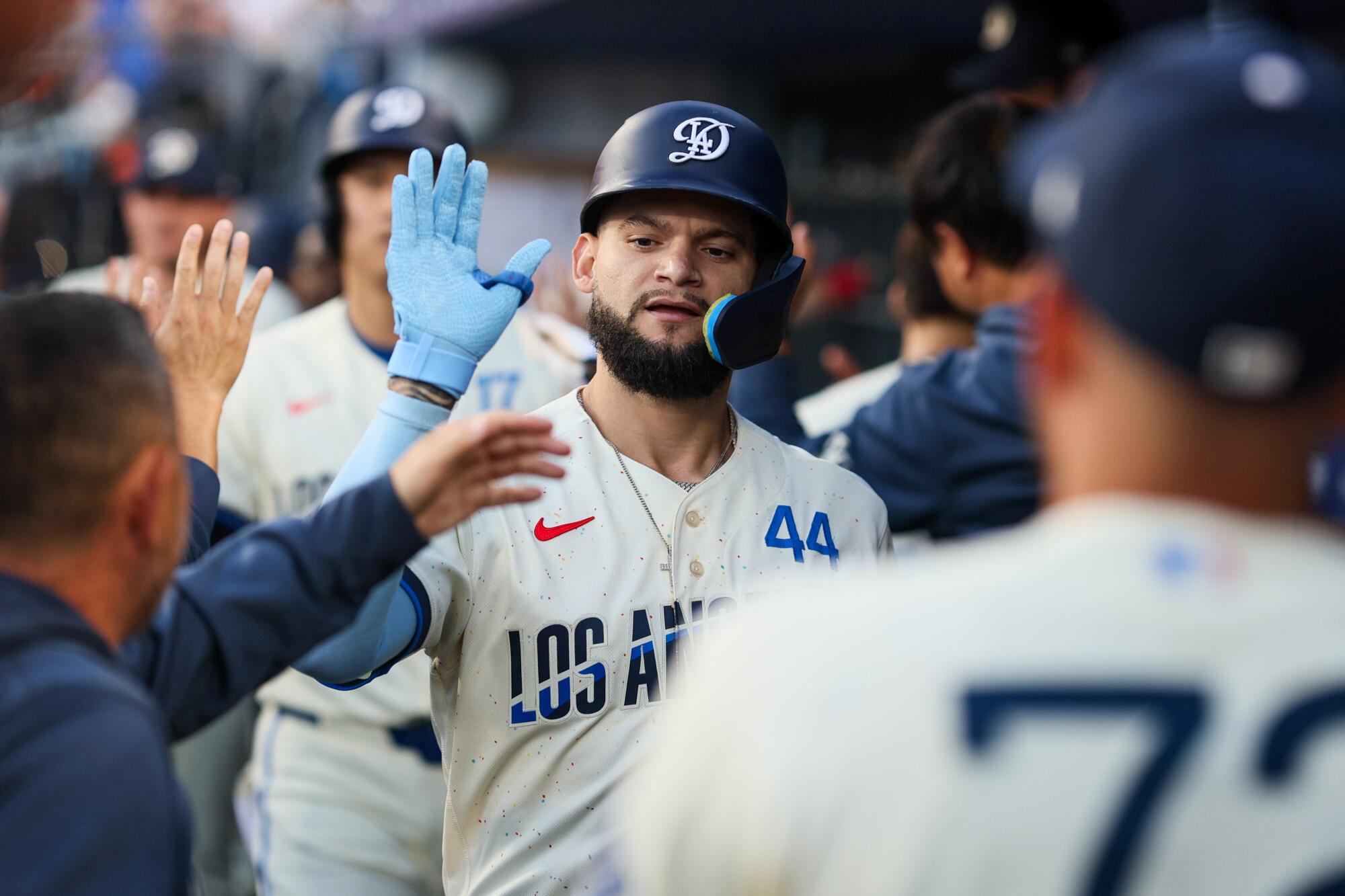
The Dodgers won the World Series last year, and the year before that. Their lead is the largest in any division this year. That success, and the money that nourishes it, has battalions of fans beyond Los Angeles all but marching outside ballparks with picket signs reading “SALARY CAP NOW.”
It’s a reasonable thought: The Dodgers can’t possibly keep winning if they can’t keep outspending the competition.
Or can they?
“There are a lot of little things that happen behind the scenes that people don’t see,” pitcher Will Klein said. “I understand where people are coming from. It’s easy to be a fan of a smaller team and get mad at other teams outspending you.
“But I think there’s a level of care here, and wanting to win, that exceeds other groups.”
The obvious disclaimer: Any team would be better with Shohei Ohtani and Freddie Freeman and Mookie Betts and Yoshinobu Yamamoto, at a combined price of $1.6 billion. The counter argument: The Angels had Ohtani and Mike Trout and, well, you know.
It takes a roster. In Klein and pitcher Eric Lauer, the Dodgers have done something they do well besides spend: develop valuable contributors out of players discarded by other teams.
The Dodgers grabbed Lauer last month, desperate to fill a hole in their starting rotation. The Toronto Blue Jays had cut him, and he would be joining his seventh major league organization. The logical thought: The Dodgers had found a healthy arm to eat up some innings until they could find someone better.
That still might happen. But Lauer, who is scheduled to start Monday, has put up a 3.22 earned-run average in four starts with the Dodgers. Four starts is a small sample size, but in that time, Lauer is a career league-average pitcher performing 28% above league average.
“They got me immediately,” Lauer said. “They figured me out right away, and they knew exactly what was going to help me.”
For Lauer, the changes affected his delivery, but the specifics were not as important as finding a kindred spirit in Connor McGuiness, the Dodgers’ assistant pitching coach.
“I’ve always had a really hard time explaining myself and what I do, because I think a little differently,” Lauer said.
“When I was with the Brewers, it was running joke that it was ‘the language of Lauer,’ because I would describe things so differently and feel things so differently that, if you weren’t close to me and you didn’t know how I operate, it was very hard to understand what I was trying to do.
“Connor just immediately got it. It was like he’s been speaking it forever.”
At one point in his career, Lauer said, he struggled to explain the sensation of catching his heel on the mound as he completed his delivery toward home plate.
“I would describe it as, ‘I was falling backwards and I would catch myself,’ and it’s a really weird concept to think somebody was falling backwards when it doesn’t look like you’re falling at all,” he said. “It looks like you’re just moving forward.
“So they were like, ‘That’s not what you’re doing’ and I was like, ‘That’s what I’m feeling.’ We have to make the connection between the feel and the real so that we can understand each other.”
“I have a hard time saying anybody has done a better or faster job of helping me than the Dodgers.”
— Eric Lauer, Dodgers pitcher, on his development with the team
Klein, who joined his fourth organization when the Dodgers acquired him in a minor league trade last June, is in his first full major league season. He has a 2.37 ERA, and his 0.7 wins above replacement is better than any Dodgers reliever besides veteran closer Tanner Scott.
Klein said other teams had made suggestions on how to improve his game, and with the Dodgers, he has added a sweeper and dumped a slider. But what he needed to do most was throw more strikes, trusting that his lively fastball and curve were good enough to beat the best players in the world.
In the minors, Klein issued 6.9 walks per nine innings. This season, he has issued 3.6 walks per nine innings.
The credit, he said, should be shared with the Dodgers’ mental skills coaches.
“It’s easy to see the guys in the batter’s box, especially when you come up watching baseball and being fans of these guys,” Klein said. “It’s easy to see them being above yourself.
“But you’re on the mound with them, so you have to see that too. There’s a lot on the mental side that’s helped me here.”
Dodgers pitcher Will Klein delivers against the Tampa Bay Rays at Dodger Stadium on June 16.
(Eric Thayer / Los Angeles Times)
The Dodgers did not include Klein on their postseason roster for the first three rounds last year, but he said coaches at all levels — in the majors, at triple-A and at the Arizona training complex — never stopped checking in on him, during the season and throughout October.
“When you’re down there, they don’t forget about you up here,” he said. “That kind of commitment and care was levels above what I had experienced.”
When the Dodgers added him to the World Series roster, Klein saved the season, with four scoreless innings to close out an 18-inning victory in Game 3.
Lauer called the communication in the Dodgers’ organization “miles ahead” of any other organization in which he has played.
“The training room, the weight room, the coaching staff, the players to each other,” he said. “Every form of communication is so seamless. Everybody knows what’s going on all the time. There’s no gray area.
“It’s all: ‘This is the plan, this is what we want to happen, this is how we’re going to make it happen,’ instead of: ‘This is the plan, this is what we want to happen, figure out a way to make it happen.’”
Klein raved about how the Dodgers treat player families, and about a high-tech pitching machine so lifelike that he could see what it would be like to bat against him. Lauer reflected on his experience as a first-round pick turned journeyman who went to South Korea to revive his career.
“I have a hard time saying anybody has done a better or faster job of helping me than the Dodgers,” Lauer said.
What Lauer and Klein say substantially echoes what Dodgers president of baseball operations Andrew Friedman said at last year’s World Series about turning the team into a preferred destination for players, and not just because the team wins and spends.
“Communication, being honest, having a really strong player development group in place at the major-league level, and how you treat families and treat the players,” Friedman said then, “I think matters a lot in that.”
To be clear: There is no indication the players’ union is willing to consider, let alone approve, a salary cap.
But, if that were to happen, Klein believes the Dodgers would be just fine.
“Our owners want to win, so they want to get the best product on the field, so they go and spend money,” he said, “and then everyone is mad that they want to win.
“I think they’ll find ways to win more if they can’t spend as much money. Friedman was with the Rays when they weren’t spending as much money and still had success there.
“I think they’re just better at wanting to win than some other people.”
Disclaimer : This story is auto aggregated by a computer programme and has not been created or edited by DOWNTHENEWS. Publisher: latimes.com