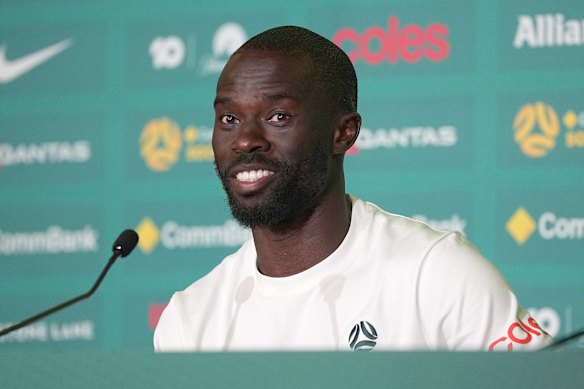
San Francisco: Riding high from a win over Turkey, Socceroo Jason Geria was not going to let an opportunity go to waste. On the phone with Anthony Albanese after Australia’s 2-0 victory, the defender told the prime minister it was time he gave the sport more money.
“We tried to give him a nudge in the direction of helping football a little bit more than he has been,” Geria said. “We made it a point to show what football has done for us and how big it is in the country, and the legacy that’s been built so far.”
Football Australia (FA) will receive $17.5 million in prize money from FIFA if the Socceroos progress out of the group stage and into the knockout round of 32. Add to that $2.15 million from FIFA to FA to help cover its expenses for the World Cup. But FA, whose financial woes were laid bare before the tournament, expects at the very best to break even from this tournament after costs.
That would improve if Australia makes it to the round of 16 – where the prizemoney of about $21.5 million would put the Socceroos World Cup in the black. At the same time, FA is using local interest in the team to ramp up its push for $50 million of federal funding to help establish a “Home of Football” in Australia – permanent high-performance facilities for the Socceroos, Matildas and youth sides.
A site has been earmarked at Sydney Olympic Park, and phone conversations between players and the prime minister will help that push, especially when no federal ministers have attended the tournament. Although Geria, who said Albanese was receptive to his plea, said his request was not just for money for elite facilities but for ensuring funding for grassroots and the next generation.
“The level of funding for football around the world has increased in such a large amount over the past decades,” he said. “I think we’re not keeping up in that sense. So more fighting in general, and being able to help out at a grassroots level as well, fees for these kids.”
“Football isn’t an elite sport, it’s a sport for everyone. I think the more access that people are allowed to have to it, the better it’s going to be and more talent is going to be found when there’s not that barrier of having to pay a few thousand dollars for registration.
“We can find these diamonds in the rough, and I think there are a lot of them out there.”
Australia’s main rivals in the Asian Football Confederation, including Japan, China, South Korea, Iran and Saudi Arabia, have well-established national facilities. Indonesia is building state-of-the-art operations for its sides in its capital, Nusantara, as part of a heavy investment in soccer.
Former Socceroo Josip Skoko said it was embarrassing FA had to ask for funding for such a facility, saying it was a necessity and not many other teams at the World Cup would be without such a venue.
“Australia’s qualified for six straight World Cups, the national team brings everyone together so well, and every, every time the World Cup finishes, everyone just forgets about it,” he told this masthead.
“Not enough money has been invested in football in Australia at any level. Not even close to some of the other sports.”
Skoko, who played 51 times for Australia and was part of the Golden Generation that qualified for the 2006 World Cup, said players often remarked how subpar training facilities were when they returned home from clubs in Europe for national duty. He warned it could lead to future players with dual nationalities opting not to play for Australia.
Get across our World Cup coverage
 Nick Ralston is the deputy editor and investigations editor for The Sydney Morning Herald. He has previously spent time as news editor, justice editor and world editor.Connect via X or email.
From our partners
Disclaimer : This story is auto aggregated by a computer programme and has not been created or edited by DOWNTHENEWS. Publisher: www.smh.com.au