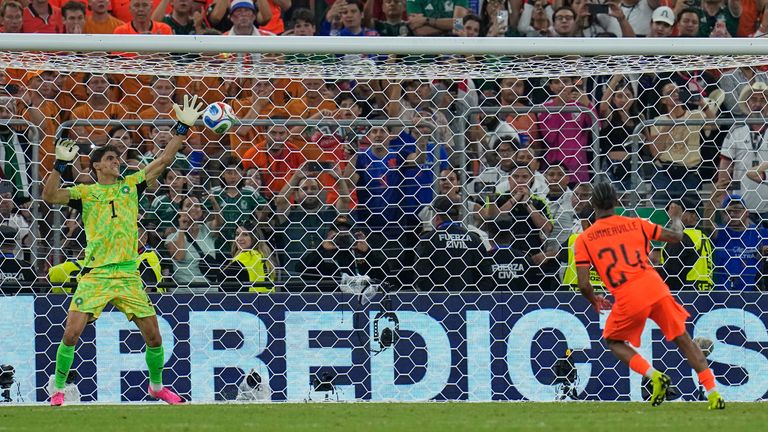
The stutter. Like it or loathe it, it’s a technique that has been increasingly adopted by penalty takers since the time of Pele in the 1960s. But after some faltering spot-kicks at this World Cup – might it be time up for one of football’s most polarising tricks?
Stutterers have enjoyed a boost of as much as 10 per cent compared to traditional run-ups according to analysis of five years’ worth of Premier League penalties by leading football psychology professor Geir Jordet.
The advantage of the stutter was deemed excessive enough to amend the laws of the game in 2016 to prevent players from making goalkeepers dive early by feinting with their final touch – though that did little to curtail its success.
It is difficult to fully define fans’ frustrations beyond a perceived unnecessary level of added theatrics. And when things go wrong, an acrobatic run-up presents an easy target.
Following high-profile shoot-out exits for Germany and Netherlands already, both including stutters from the losing side, that exasperation has potentially reached a peak. But there are signs of a growing justification behind those grievances.
Of the 11 stuttered penalty run-ups at this World Cup, six have resulted in missed spot-kicks, a hit rate already less than 50 per cent before you include Harry Kane’s retaken spot-kick against Croatia.
Goalkeepers have begun to fight back. And not before time.
“The majority of the top, top penalty takers in the world use the stutter,” Jordet tells Sky Sports. “And until quite recently, goalkeepers have struggled against this.
“It seems crazy to say it, but they haven’t had effective counter-measures. I’ve seen professional analysts for big clubs and national teams getting their analysis completely wrong by just reducing a penalty taker to direction.
“But with and without a stutter technique is a completely different technique, even with the same placement.”
Netherlands’ shoot-out loss presents a perfect case study because of the role of Morocco goalkeeper Bono, long admired for his hoodoo over penalties with eight of the previous 12 he had faced being missed.
He has refused to be coaxed into moving early, instead turning the uncertainty back onto the penalty taker by feinting to go one way in response to a stutter but diving the other – or in some cases, feinting twice. Arguably, he has deployed the goalkeeping equivalent of the same technique he has to face.
“He has this ability to get into penalty takers’ minds, and sow some doubt about themselves and their technique. That’s quite a feat as a goalkeeper,” says Jordet.
Bono’s bluffing planted enough doubt into Justin Kluivert’s mind for the Netherlands winger to miss the goal entirely after a stuttered spot-kick.
His high jinks during Crysencio Summerville’s penalty put the West Ham winger off too. But this is just the latest step on a wider goalkeeping redemption arc he has been leading for some time.
“I first noticed Bono when he faced a penalty from my countryman Erling Haaland in 2021,” adds Jordet. “Bono faked twice which way he was going to go up against Haaland’s stutter, and he saved the penalty.
“He had been just off his line and Haaland retook it, but he still almost saved that one too. After that, Haaland changed his approach completely.”
Bono has other impressive scalps. Ivan Toney, England’s penalty specialist at this World Cup, has been labelled the best spot-kick taker on the planet and prides himself on waiting for a goalkeeper to blink first before picking his spot.
But the Moroccan’s technique thwarted him when the two faced each other in a penalty shoot-out in the Saudi King’s Cup earlier this year, with Toney’s missed kick decisive in his side’s defeat.
The forward was so rattled by Bono’s technique that he, too, altered his style in response – and missed another in his next game.
“This is an arms race,” says Jordet. “It’s about staying ahead. We need a bigger sample size but from the start of this World Cup, the goalkeepers are winning.
“If you think what brought you success six months or a year ago is going to be enough today, you’re probably going to lose this race.
“I spoke to Robert Lewandowski a few years ago, who traditionally has been a huge spokesperson for the stuttered approach – and he had a good run of about 10 years in the Bundesliga where goalkeepers would just go down for him.
“But even when I spoke to him, he had a realisation he needed to adapt. He knew goalkeepers were about to catch up with him.”
So what more can penalty takers do? Sadly for critics of the stutter, it probably still has a future. Even the success rate of a good old-fashioned penalty into the corner drops to about 55 per cent if a goalkeeper guesses the right way. Little better than the flip of a coin.
Theoretically, there is always room for a whole new technique – the next Panenka, or an alternative to the stutter. But the laws of the game are so prescriptive that the prospect of creating something completely different is severely limited.
Realistically, the revolution comes back to what made the stutter so successful in the first place. Keeping goalkeepers guessing.
“It’s about being unpredictable, being difficult to read – so the goalkeepers don’t know what’s coming,” says Jordet.
“Mikel Oyarzabal is excellent at this. He has mastered finding the corner, he’s mastered the stuttered run-up, sometimes he just hits it high – sometimes he does a Panenka.
“It’s impossible to know what’s coming, he doesn’t give away any clues until he does his run-up.”
Kylian Mbappe is another bucking trends. The Frenchman has flown in the face of advice to avoid beginning his run-up too quickly after the referee’s whistle – generally associated with hurried penalties from nervous takers.
“He has a technique somewhere in between depending on the goalkeeper and not, as well,” adds Jordet. “His gaze is locked onto the goalkeeper as he runs up to say to him, I think, that he sees him and wants to keep him still as long as possible.
“When he gets to the ball, he’s decided where to shoot it. And he doesn’t make that decision based on anything the goalkeeper might do in the build-up.”
Whatever happens, this World Cup has likely not heard the end of the penalty stutter.
Not just because of its continued derision from the stands, but because of the role it will still play as penalty styles evolve – potentially, even as this tournament progresses.
“Information is travelling so fast now, there’s a velocity of adoption of it that we’ve never seen before in the world,” Jordet says.
“So we’re probably going to see a development within this World Cup, I expect. After all, that is what World Cups are for, right?”
Disclaimer : This story is auto aggregated by a computer programme and has not been created or edited by DOWNTHENEWS. Publisher: skynews.com