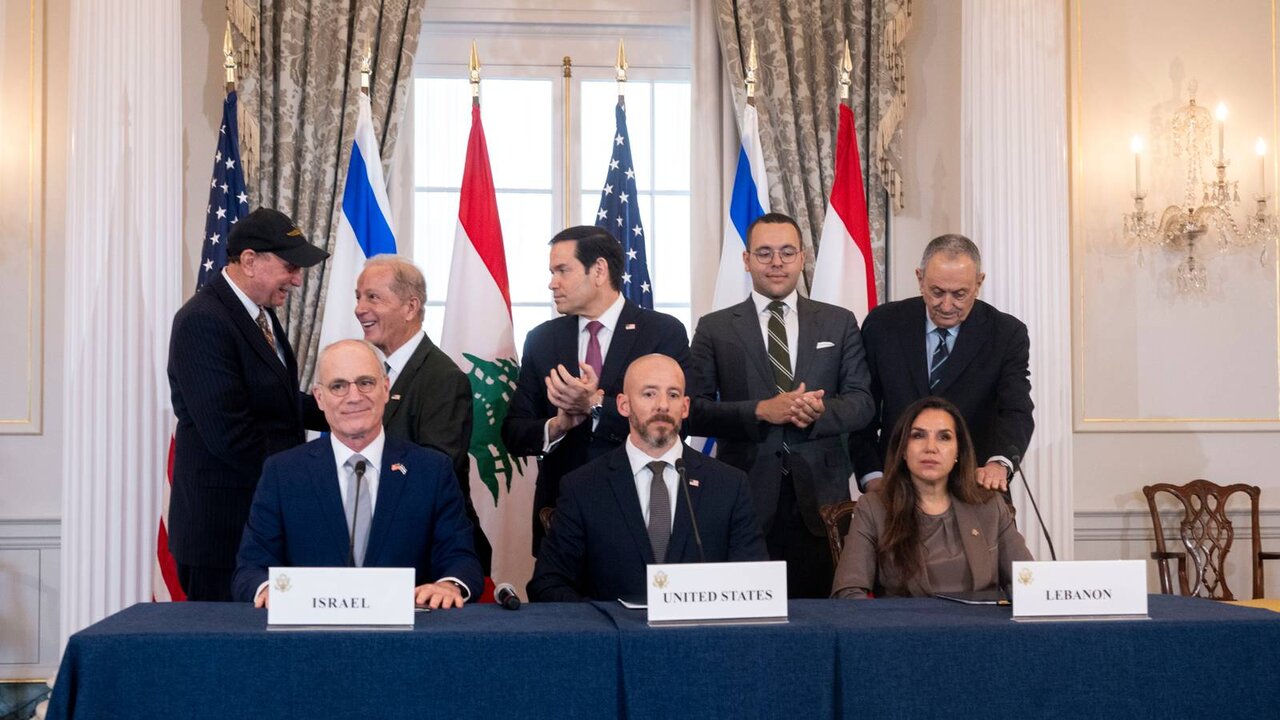
TEHRAN – The U.S.-brokered agreement between Lebanon and Israel appears to be far more than a deal governing the occupation regime’s withdrawal from southern Lebanon.
After the October 7 landscape, it reflects a deeper shift in the regime’s strategic thinking, marking the beginning of a transition away from the doctrine of military victory. In essence, the regime is shifting away from defeating Hezbollah militarily to reshaping the surrounding security and political scene in a bid to reduce Hezbollah’s ability to resist aggression.
This is being achieved by distributing responsibility among the Lebanese government and the United States.
It does not mean Israeli Occupation Forces (IOF) are abandoning aggression. Rather, it represents a redefinition of its role. Military power is no longer the sole means of eliminating resistance, but a tool for creating a new political and security environment, jointly managed by the Lebanese government and the U.S., while allowing the IOF to illegally intervene should that system fail.
Following the October 7 attack, the Israeli government’s rhetoric escalated toward eliminating the sources of resistance, whether in Gaza or along the northern front, under the banner of achieving “decisive victory.”
In Lebanon, the objective was no longer deterring Hezbollah or pushing it away from the Lebanese border. The stated aim became dismantling its military capabilities and eliminating the threat it posed once and for all.
When the November 2024 agreement was announced, it was presented within Israel as evidence that this approach had succeeded, with military pressure having imposed a new reality on both Hezbollah and the Lebanese state.
Yet the 15 months that followed demonstrated that even significant battlefield successes do not eliminate the Lebanese resistance. Hezbollah’s renewed engagement in resistance operations in March 2026, amid the illegal war on Iran, illustrated that resistance movements rooted in popular support and regional alliances cannot easily be removed permanently from the equation through military force alone.
Such organizations retain the capacity to regroup, reposition themselves, and capitalize on regional shifts, making the objective of “total victory” far more complicated than wartime Zionist political rhetoric had initially assumed. Against this backdrop, the new framework agreement is not an outright abandonment of the military victory doctrine, but rather an indication of growing recognition within Israel that military force alone is insufficient to achieve lasting political objectives.
The provisions of the agreement clearly reflect this shift. The objective is no longer for the regime alone to eliminate Hezbollah. Instead, the Lebanese government assumes the legal and security responsibility for maintaining a monopoly over arms, while the Lebanese Army is tasked with asserting control over border areas.
The United States oversees implementation, and reconstruction assistance is tied to progress along this path. In this way, the regime moves from trying to eliminate Hezbollah directly toward restructuring the security environment within which that threat operates.
This does not represent a retreat from the use of force. Under the agreement, the IOF retains its occupation, along with the right to resume aggression should it determine that Hezbollah is rebuilding its capabilities or that the Lebanese state has failed to meet its obligations.
It is a formula that combines military deterrence with political agreement, making military power an instrument for enforcing the agreement rather than a substitute for it.
The framework agreement grants the United States a role that extends well beyond traditional mediation. Washington becomes an active partner in redesigning the security environment, supervising implementation, verifying disarmament, leading security coordination mechanisms, and linking aid and reconstruction to compliance with the new arrangements.
This reflects a significant convergence between American and the Zionist regime’s interests.
Since the expansion of the Israeli aggression, the U.S. has publicly questioned whether the IOF alone could eliminate Hezbollah. Washington consistently advocated an approach that combined military pressure with strengthening state institutions, political agreements, and international oversight. Following its experience with the limitations of military victory, the regime appears increasingly willing to adopt this approach, without abandoning its aggression.
Viewed within its broader political context, the agreement does more than establish a new security framework. It also offers Netanyahu’s government an opportunity to address strategic dilemmas simultaneously at both domestic and international levels.
In recent months, Netanyahu faced a difficult choice: either clash with a U.S. administration pushing for new political and security arrangements or appear to be yielding to American pressure, which would have weakened him among his right-wing coalition partners.
The Lebanese government’s agreement offered a third option.
Netanyahu can present himself as a partner in crafting a joint American-Israeli vision for reengineering Lebanon’s security environment rather than as a leader who capitulated to U.S. demands. It also helps restore his image as the architect of the regime’s special relationship with Washington, a reputation that had come under strain.
Iran has sought to keep Lebanon integrated into its broader negotiations with Washington, linking Beirut’s fate to Tehran’s and making any IOF withdrawal from southern Lebanon dependent upon progress in the U.S.-Iranian talks.
The framework agreement offers the regime an olive branch to separate these two tracks. Any withdrawal, if it occurs, will be presented as the product of a direct agreement with the Lebanese state under American sponsorship, not as a concession to Iranian demands or the price of a U.S.-Iran memorandum of understanding.
The final dilemma concerns the Zionist regime’s stated objective since the beginning of the war: dismantling Hezbollah and disarming it.
Achieving that objective would require considerable time, enormous human and economic costs, and even success would remain uncertain if the regime alone bore responsibility for carrying it out.
The agreement changes this equation. Disarmament becomes the responsibility of Lebanon itself primarily, with the U.S. also assuming responsibility. This is while the regime transitions into the role of monitoring implementation and retaining the right to aggression should the process fail.
In doing so, the framework agreement redistributes the political, security, and economic burden of Hezbollah’s disarmament rather than leaving it solely on Israel’s shoulders.
Yet the success of this security architecture ultimately depends upon the Lebanese state’s actual ability to wrest the option of armed resistance from Hezbollah, something that cannot be achieved through legal texts and American guarantees alone. It also requires parallel regional and domestic transformations.
Regionally, concerning the future of the Axis of Resistance, and internally, through rebuilding Lebanese political consensus around the state’s exclusive right to bear arms. Without those developments, the agreement is nothing more than a temporary truce that offers the IOF some breathing space.
Despite transferring much of the responsibility to the Lebanese state and the U.S., Israel has not relinquished its core instruments of leverage. Withdrawal remains conditional. The so-called “pilot zones” allow the regime to monitor developments on the ground. On Tuesday, Netanyahu said the IOF won’t even withdraw from the first two “pilot zones”.
Essentially, the occupying regime also retains the final say in determining whether the new security framework has succeeded.
The timing of the framework agreement cannot be separated from Israel’s domestic political landscape. With Knesset elections approaching, Netanyahu needs to redefine what “decisive victory” means.
Having initially raised public expectations by equating victory with military defeat of the Lebanese resistance, it has become politically more realistic to present voters with a different achievement, not the complete destruction of Hezbollah, but the creation of a new security architecture. Netanyahu is therefore going to present the agreement not as a political compromise but as the direct outcome of military success. According to this narrative, the IOF did not withdraw under Hezbollah’s resistance operations that killed dozens of IOF troops and injured more than 1,000 others since March 2 in south Lebanon.
The agreement provides Netanyahu with a more defensible political narrative at home because it shifts the debate away from the question: Has Hezbollah been eliminated? Toward a different one: Has Israel’s surrounding security environment become safer?
If this agreement truly marks the beginning of the post-military victory era, then the real challenge will not lie in drafting security arrangements but in implementing them.
The success of this model will ultimately depend on the Lebanese state’s ability to establish a genuine monopoly over arms, despite growing public anger over its deal with Israel. It will also depend on the continued American commitment to overseeing the agreement, and Israel’s own willingness to adhere to a long-term strategy centered on managing the security environment.
That leaves the central question unanswered: does this framework agreement truly inaugurate a new Israeli security doctrine, or is it simply a temporary pause imposed by the limits of IOF power before yet another round of wide-scale Israeli regime aggression on Lebanon?
Disclaimer : This story is auto aggregated by a computer programme and has not been created or edited by DOWNTHENEWS. Publisher: tehrantimes.com