It was two days before Father’s Day, and Trisha Quinn was wondering how her six, 12 and 17-year-old nieces and nephews would handle the first of many without their dad.
Timothy Quinn, 39, worked at the Clairton Coke Works plant south of Pittsburgh, one of US Steel’s biggest production sites and the largest of its kind in the western hemisphere, for 18 years. Last August, he and colleague, Steven Menefee, were killed there in an explosion.
“His girlfriend called me and said they couldn’t find him,” Quinn recalls. “There was absolutely no communication [from the company]. We were calling all the local hospitals; I put myself on the news, to look for him. Then I got told to contact someone in the union. Then some ladies from the company came out to my mom’s house to share the news that he was deceased.”
Nippon Steel had acquired US Steel for $14.9bn just months before.
Quinn has since filed a wrongful death lawsuit against Nippon Steel and two other companies, alleging negligence.
US Steel says that during a cleaning operation, pressure that built inside a gas valve caused it to fail and created a series of explosions. According to the US Chemical Safety and Hazard Investigation Board, a federal agency, the cast iron valve that failed was manufactured in 1953.
US Steel has an annual revenue of more than $15bn.
“He was in there when the explosion occurred,” says Trisha. “It isn’t right, you’re at work, it’s not supposed to happen.”
Despite pledging $11bn to upgrade the steel plants it acquired last year, Nippon Steel has made no effort to develop clean-fuel production at its three facilities in western Pennsylvania’s Mon Valley, one of the most polluted regions in the US for sulfur dioxide and hydrogen sulfide. Instead, Nippon only plans to open a coal-free, integrated steel mill in Arkansas.
US Steel says it plans to reach net zero by 2050.
A 14-mile drive down the Monongahela River in Braddock is where US Steel announced with fanfare this month that the massive, 150-year-old Edgar Thomson Works is set to get a new hot strip mill that, for locals, would increase air pollution.
“They promised investment, it was supposed to be better. Us and Clairton have the worst air quality,” says Nathan Mallory, a local resident and council member.
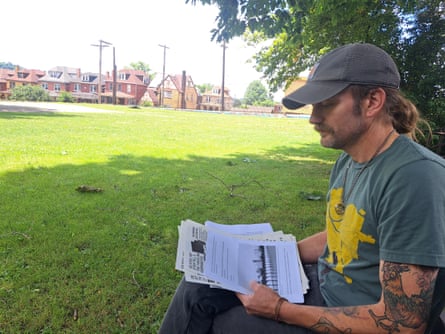
He and other councilmembers claim they’ve been pressured by US Steel to vote on a resolution that would allow for a new sewer connector for the plant. Locals are concerned that they haven’t been informed of the full extent of the new mill project.
Mallory lives within earshot of the plant. More than 70% of Braddock’s population is Black while the town’s per capita income is just $15,500. Thousands of people live within a two-mile radius of the plant.
“There has been years and years of citations [for pollution and other issues] under US Steel; there is this notion that it’s cheaper for US Steel to pay the health department citations … than it is to put containment equipment, a technology that does exist, on the existing blast furnaces or to replace them with something cleaner,” says Mallory.
“We’re just fodder to the industry. It’s all corporation and government agreements. When you try to advocate [for the community], it’s all convoluted on purpose; it protects the industry over the people.”
Steelmaking involves burning coal to make coke, which has a higher carbon content and thus can burn at a higher temperature. Coal is burned and converted into coke at the Clairton Coke Works, which is then moved to the Edgar Thomson Works plant, where the steelmaking occurs.
US Steel says its equipment is consistently refurbished and maintained.
“We have strengthened several safety protocols based on the investigation results. Multi-disciplinary teams collaborated to establish standardized best practices for industrial valve cleaning to provide operational safety, prevent hazardous leaks, and maintain a controlled work environment,” a spokesperson wrote.
“Employees have completed comprehensive training on these new program elements and procedural changes.”
Researchers, however, claim that failing to invest in green-energy steel production facilities in the Mon Valley, the heartbeat of US steel manufacturing for over a century, would cost the region thousands of future jobs, and that Nippon’s planned $2.5bn investment in coal-fuel facilities there risks the health of thousands of residents and workers for years to come.
“The responsibility for worker deaths, and the deaths of many community residents every year from pollution-related cancer, heart disease, and lung disease is rooted in US Steel’s dependence on coal-based technology, combined with a ‘drive it til the wheels fall off’ approach to managing this [Clairton Coke Works] facility,” says Matthew Mehalik, executive director of the Breathe Project.
“The only way to ensure a long-term, safer, cleaner future for Mon Valley workers and fenceline community members is to replace coal-based steelmaking equipment with clean, coal-free, next-generation technology in well-maintained, new processes.”
All the while, asthma rates among children who live close to the plants are triple the national rate. Environmentalists say that US Steel’s own reporting shows that a new hot strip mill would increase particle pollution in the area by up to 40%.
Nor was the explosion that killed Tim Quinn and Steven Menefee the only one to occur at Clairton Coke Works last year. In February 2025, two workers were injured following an explosion at a smokestack.
Years earlier, a maintenance worker was killed at the plant following a gas leak in September 2009. Less than a year later, 15 workers suffered severe burns in another explosion at a coke oven. Following a fire in 2018, US Steel promised to spend $1bn across its three Mon Valley Works facilities to curb pollution.
But within two years, that plan was shelved.
In February, the US labor department cited US Steel and MPW Industrial Services Inc, fining them $118,214 and $61,473 respectively for exposing their workers to unsafe conditions in the explosion that killed Quinn and Menefee. It found: “United States Steel Corp. failed to use required safety management and energy control practices for hazardous work involving flammable gas.”
Menefee’s family has also filed a lawsuit alleging negligence against Nippon Steel, MPW Industrial Services Inc, and Valves Incorporated. The latter two companies were contracted in the work that was tied to the explosion.
US. Steel wouldn’t comment on if it is compensating the families of the two victims but noted: “We continue to cooperate with relevant government agencies and hold the employees who were injured or lost during the August 11th incident in our thoughts.”
Today, what steel making means for the Quinn family, whose fathers and sons worked for more than 60 years in the industry, has changed.
“[Tim was] a second-generation steel worker. My dad worked there for 42 years. My brother enjoyed his work a lot,” says Trisha Quinn. Tim worked as a heater, which meant monitoring the temperature at coke oven batteries, which can reach 2,300F.
“His son wanted to be a steel worker, but we said, ‘No, that’s not an option.’”
“I don’t want to jeopardize his life.”
Disclaimer : This story is auto aggregated by a computer programme and has not been created or edited by DOWNTHENEWS. Publisher: theguardian.com