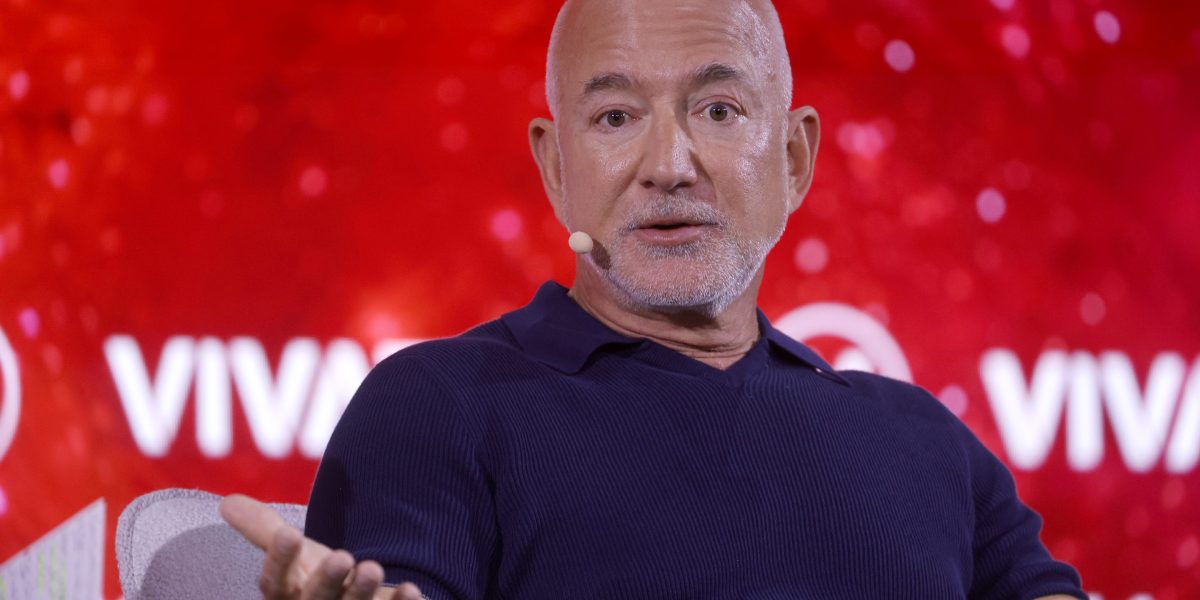
Blue Origin, Jeff Bezos’s rocket company that fiercely competes with SpaceX over NASA contracts, is now seeking money outside of the Amazon billionaire’s pocketbook for the first time—$10 billion at a $130 billion valuation, according to DealBook.
DealBook reports that Bezos himself will contribute $2 billion and global asset manager Coatue Management will contribute $4 billion, with the remainder expected from institutional investors. Historically, Bezos had funded the company by selling his personal Amazon stock.
“Another way to think about it is Jeff Bezos doesn’t want to put any more of his own money into the business,” Nicolas Owens, an equity analyst who covers SpaceX for Morningstar, told Fortune. “He has observed that institutional investors were interested in investing in SpaceX, and so maybe he should ask them if they also want to invest in him.”
The move marks a turning point for Bezos’ space company. After decades as a privately bankrolled moonshot, it’s now seeking institutional firepower just as Musk’s SpaceX is being tested by public markets. Shares in SpaceX have surrendered nearly all of the gains from their blockbuster stock market debut, cratering 16% in a single day on June 22 and closing at $149.47 on July 7—a 29% retreat from its $211.39 closing peak on June 16 and roughly back to where it opened.
But Blue Origin branching out also ramps up the the two-decades-long Bezos-Musk rivalry further away from a mere billionaire duel and into a capital-heavy race for space dominance that institutional investors can help fund.
“SpaceX is far ahead of Blue Origin and it’s an expensive business to create, and so Blue Origin asking for money is a way for them to fund future competition,” Owens told Fortune.
The rivalry over space—and NASA contracts
The Bezos-Musk space race predates either billionaire’s rocket company becoming a reliable orbital operator.
Bezos founded Blue Origin in 2000, a year and a half before Musk founded SpaceX. However,Musk’s company reached orbit first with Falcon 1 in 2008 and has since dominated orbital launch.
Federal spending data show the same imbalance, with SpaceX far ahead of Blue Origin in government space contracts, but with some nuance. Since 2008, the federal government has actually paid SpaceX about $15.7 billion for contract work—more than five times the $2.9 billion paid to Blue Origin. But Blue Origin’s contracts could eventually be worth close to $30 billion if NASA exercises all its options, nosing ahead of the roughly $27.6 billion SpaceX’s contracts could max out at, according to a Fortune analysis of federal spending data.
NASA has spent the past three years trying to make sure SpaceX isn’t its only space partner. After first selecting SpaceX’s Starship-based lander, the agency awarded Blue Origin a $3.4 billion Artemis contract in 2023 to develop a second human landing system, saying a second provider would increase competition and lower taxpayers’ burden.
The pattern has echoed in satellite broadband and launch.
Formerly known as Project Kuiper, Amazon’s Leo network is widely seen as a direct Starlink competitor, but it lags behind SpaceX’s 10,000-plus-satellite constellation. For comparison, Amazon reported more than 375 Leo satellites launched as of early July 2026. Blue Origin’s New Glenn rocket—central to its effort to challenge SpaceX’s reusable-launch dominance and support Amazon’s satellite deployment—suffered a May 28 explosion that destroyed the test vehicle, though Blue Origin stated it’s still targeting a return to flight this year.
Blue Origin and SpaceX did not respond to Fortune’s request for comment.
Disclaimer : This story is auto aggregated by a computer programme and has not been created or edited by DOWNTHENEWS. Publisher: fortune.com