- India strengthens security, fosters J&K development for stability.
Pakistan-Occupied Kashmir (PoK) is witnessing one of its most turbulent phases in recent years. Growing public anger over inflation, unemployment, governance failures and shrinking economic opportunities has intensified unrest across the region, raising concerns that Islamabad could once again seek to divert domestic attention by escalating tensions along the Line of Control (LoC) or encouraging cross-border instability.
The political and economic situation in PoK has deteriorated rapidly over the past few years. Rising electricity tariffs, soaring food prices, unemployment and prolonged power shortages have triggered repeated protests across Muzaffarabad, Mirpur, Kotli and other towns. Demonstrators are not asking for the moon- all they want is lower electricity bills, subsidised wheat, better governance and greater economic autonomy.
Movement Born from Public Frustration
The ongoing protests are being spearheaded by the Jammu Kashmir Joint Awami Action Committee (JKJAAC), a grassroots civil rights movement formed in 2023, comprising members from all sections of society. This movement has gained widespread public support since it has no political or ideological agenda and is fighting for the basic rights of PoK citizens.
The popularity of JKJAAC can be gauged by the fact that its 2024 protests forced the government to announce subsidy packages after widespread demonstrations that resulted in clashes with security forces. Several protesters and police personnel were injured during the unrest, highlighting the growing disconnect between the administration and the local population.
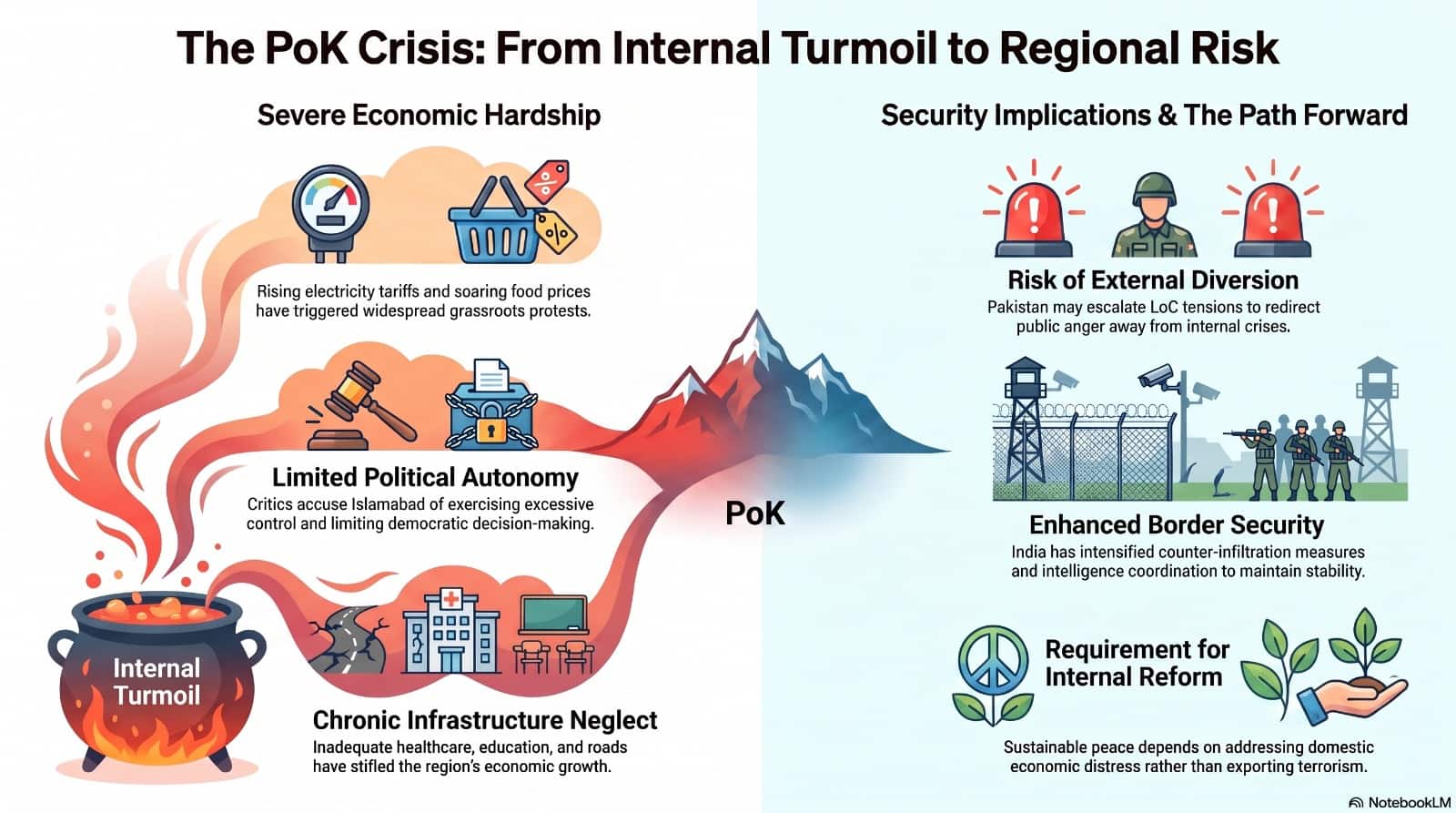
Beyond economic grievances, political discontent has also intensified. Many local leaders and civil society groups rightly accuse Islamabad of exercising excessive control over the region while limiting democratic decision-making through political manipulation. Critics argue that despite being projected internationally as a self-governing territory, PoK has limited autonomy, with key decisions invariably being taken by the federal government in Islamabad without considering the will of the people.
The region faces chronic infrastructure deficits. Healthcare facilities remain inadequate, educational institutions lack resources and investment in roads, industries and tourism clearly indicates official apathy and neglect. Due to this, the region has lagged behind and has been unable to exploit its true potential. These issues have fuelled frustration, particularly among young people facing limited employment opportunities.
Risk Of Escalation Along The LoC
Security analysts are watching the situation closely because whenever Pakistan experiences mounting domestic political or economic pressure, it attempts to divert public opinion by internationalising the Kashmir issue through diplomatic campaigns and heightened military rhetoric. It also attempts to create tension along the Line of Control (LoC) by resorting to unprovoked cross-border firing as well as attempts to infiltrate terrorists into J&K.
It’s no secret that despite repeated calls by the international community to dismantle terror infrastructure operating from its soil, Pakistan continues to sponsor cross-border terrorism. Hence, New Delhi’s stance that terrorism and dialogue cannot go hand in hand makes perfect sense. Similarly, by exercising its legal right to target terrorist infrastructure and assets in PoK and Pakistan, India has demonstrated to the world that it will do all to protect its citizens.
Following the Pahalgam terror attack in J&K, Indian security agencies have further strengthened counter-infiltration measures along the LoC and intensified intelligence-based operations within the Union Territory. Security forces remain on high alert to prevent any attempts by terrorist groups to exploit the prevailing situation.
Analysts caution that while Pakistan’s internal challenges are genuine and increasingly severe, any attempt to redirect public attention through external confrontation would carry significant risks for regional stability. India and Pakistan are both nuclear-armed neighbours, making restraint and responsible statecraft essential to avoiding unnecessary escalation.
For India, the priority remains maintaining robust border security, strengthening intelligence coordination and continuing development initiatives in J&K. Improved infrastructure, expanding tourism, higher investment and better governance have become central pillars of New Delhi’s strategy to counter instability through economic progress and public participation.
Ultimately, Pakistan’s internal crisis is rooted in economic distress, governance deficits and political instability. Addressing those structural challenges requires domestic reforms rather than external confrontation. Sustainable peace in the region depends not on exporting terrorism across borders but on promoting stability, development and constructive engagement.
(The author is Editor of Brighter Kashmir, author, TV commentator, political analyst, and columnist. Views expressed in the above piece are personal and solely those of the author.)
Disclaimer: The opinions, beliefs, and views expressed by the various authors and forum participants on this website are personal and do not reflect the opinions, beliefs, and views of ABP Network Pvt. Ltd.
Disclaimer : This story is auto aggregated by a computer programme and has not been created or edited by DOWNTHENEWS. Publisher: abplive.com