The Ken does not rush like the Himalayan rivers, nor does it meander lazily across wide floodplains.
It is one of central India’s last free-flowing rivers, still allowed to follow its natural course without dams, diversions or concrete embankments interrupting its flow. It shapes the landscape as much as the landscape shapes it, sustaining forests, wildlife and communities along the way.
Today, however, the Ken is also at the centre of one of India’s most ambitious infrastructure projects.
The Rs 44,605-crore Ken-Betwa Link Project, the country’s first major river interlinking initiative, aims to transfer water from the Ken basin in Madhya Pradesh to the water-scarce Betwa basin in Uttar Pradesh’s Bundelkhand region.
Through the proposed Daudhan Dam, along with a network of canals and tunnels, the project aims to irrigate 10.62 lakh hectares, provide drinking water to nearly 62 lakh people, and generate 130 MW of hydropower.
The project has drawn national attention. In the process, it has also raised an important question: what makes the Ken unlike almost any other river in central India?
A river that still flows naturally
Stretching 427 kilometres from the Kaimur Hills in Madhya Pradesh to its confluence with the Yamuna near Fatehpur in Uttar Pradesh, the Ken is the last major tributary to join the Yamuna before it meets the Ganga.
Its journey tells the story of central India’s ancient geology.
As the river cuts through the Bijawar-Panna hills, it carves a dramatic 60-kilometre gorge that reaches depths of nearly 180 metres. Seasonal streams tumble into these rocky valleys, creating waterfalls and deep pools that support a remarkable mix of habitats.
Unlike many rivers that are heavily regulated, the Ken still follows its natural rhythm.
During the monsoon, floodwaters replenish floodplains, carry nutrient-rich sediments downstream and reshape riverbanks. In summer, deep pools become vital refuges for fish and other aquatic life. Together, these seasonal cycles sustain an entire ecosystem.
The river also flows through the UNESCO-recognised Panna Biosphere Reserve.
The river that keeps Panna alive
Few protected areas in India are as closely linked to a river as the Panna Tiger Reserve is to the Ken.
The reserve, known globally for its successful tiger reintroduction programme launched in 2009, depends on the river throughout the year. During Bundelkhand’s harsh summers, when much of the landscape dries up, the Ken becomes the primary water source for tigers, leopards, sloth bears, sambar, chital and many other wild animals.
/filters:format(webp)/english-betterindia/media/media_files/2026/07/17/ken-betwa-1-2026-07-17-18-43-03.png)
The surrounding basin supports tropical dry deciduous forests dominated by species such as palash, Boswellia, acacia and albizia. Patches of moist deciduous and subtropical forests appear in areas that receive higher rainfall.
Researchers have documented at least 81 plant species across the Ken riverscape.
A refuge for species disappearing elsewhere
The Ken is home to the Critically Endangered gharial, one of the world’s rarest crocodilians, as well as the Vulnerable mugger crocodile.
Researchers have also recorded the Endangered Gangetic river dolphin in parts of the basin. More than 110 species of freshwater fish have been documented here, including the Endangered magur catfish and the Near Threatened Indian mottled eel.
The rocky cliffs surrounding the river also provide one of central India’s most important nesting landscapes for vultures.
White-rumped vultures, Indian vultures and red-headed vultures — all now Critically Endangered after devastating population declines across the subcontinent — continue to breed and roost here.
The river’s skies are also shared by kingfishers, river terns, birds of prey and migratory species. Surveys have recorded at least 41 bird species along the Ken, nearly a quarter of them winter migrants.
More than a river
Rivers are often measured by their length, storage capacity or the amount of water they carry.
But the Ken performs ecological work that cannot easily be captured in numbers.
Every monsoon, it transports sediments that replenish downstream habitats. Seasonal flooding nourishes riparian forests, which stabilise riverbanks while providing food and shelter for wildlife. Its uninterrupted stretches also allow fish and other aquatic species to move between breeding and feeding grounds, while connecting forests that help animals disperse across the wider landscape.
The river has shaped human history too.
Known locally as Karnavati, it features in regional folklore and flows past the scenic Pandav Falls, which are associated with legends from the Mahabharata. Nearby hills also preserve prehistoric cave paintings, offering evidence that people have lived alongside the Ken for thousands of years.
A landscape under national attention
As work on the Ken-Betwa Link Project progresses, the river has become the focus of both development planning and ecological debate.
Scientific assessments, including studies by the Wildlife Institute of India and the National Centre for River Research, have noted that the proposed reservoir could submerge around 258 square kilometres of habitat within the Panna Tiger Reserve, including areas used by tigers and nesting vultures.
/filters:format(webp)/english-betterindia/media/media_files/2026/07/17/ken-betwa-2-2026-07-17-18-45-14.png)
Researchers have also observed that altering the river’s natural flow through dams and barrages could affect aquatic habitats and disrupt ecological processes that support biodiversity.
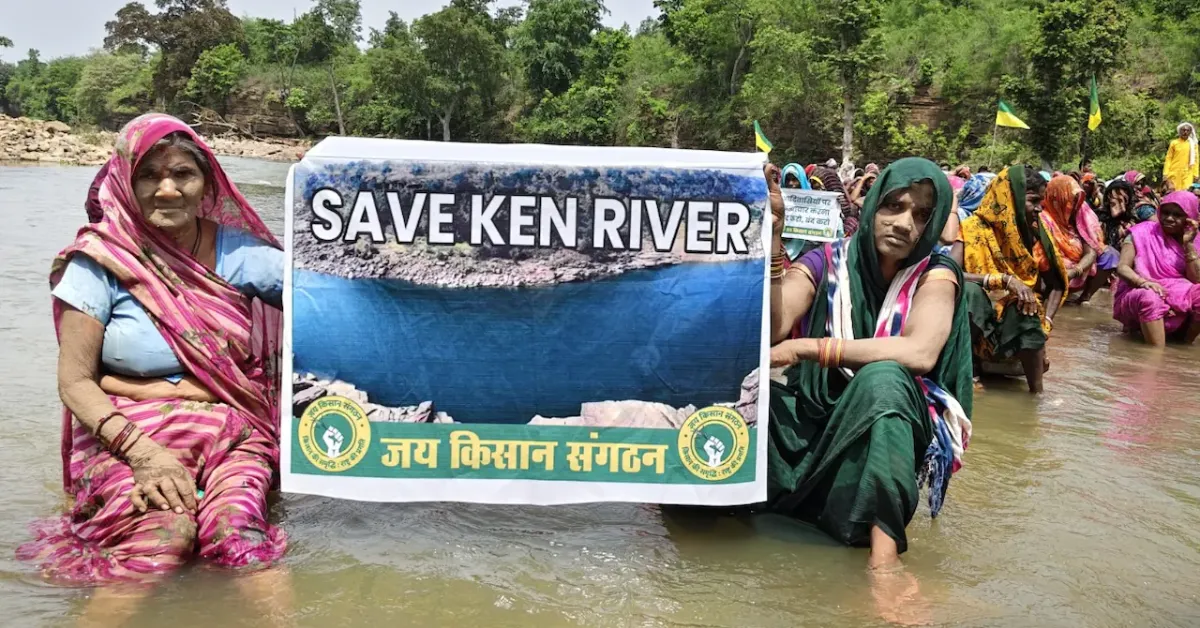
At the same time, the project has prompted protests from tribal communities and farmers in parts of Madhya Pradesh. They have sought transparent land surveys, adequate compensation and fair rehabilitation before any relocation takes place.
The Ken has never been just a river.
It is a lifeline for wildlife, forests and people — a living corridor that has shaped central India’s landscapes for centuries. Whatever its future holds, its story is a reminder that rivers are far more than channels of water. They are ecosystems that keep entire landscapes alive.
Sources:
‘Protests over Ken-Betwa river link project resume in Madhya Pradesh’: by Mehul Malpani, Published on 11 July 2026
‘Ken River’: by Ganga Aqualife Conservation Monitoring Centre/ National Centre for River Research, Wildlife Institute of India
Disclaimer : This story is auto aggregated by a computer programme and has not been created or edited by DOWNTHENEWS. Publisher: thebetterindia.com