‘Phantom of the Opera’
Where: Hollywood Pantages Theatre, 6233 Hollywood Blvd., L.A.
When: 7:30 p.m. Tuesdays-Thursdays; 8 p.m. Fridays; 2 and 8 p.m. Saturdays; 1 and 6:30 p.m. Sundays. (Check schedule for exceptions.) Ends Aug. 9.
Tickets: Start at $47 (subject to change)
Contact: BroadwayInHollywood.com or Ticketmaster.com
Running time: 2 hours, 30 minutes (including one intermission)
The production also runs Aug. 12-Aug. 30, Segerstrom Center for the Arts, 300 Town Center Drive, Costa Mesa. scfta.org
It’s over 8 feet tall, nearly 11 feet wide and travels by 53-foot semitrailer. It’s covered in more than 20,000 beads and weighs almost 1 ton — or about 2,000 pounds. And eight times a week, it’s dropped atop the heads of people who pay for the privilege — just a few feet short of actually hitting anyone.
Meet “Gillian,” the stunning chandelier traveling with “The Phantom of the Opera” on its current North American Tour. Playing at the Hollywood Pantages Theatre through Aug. 9 before heading to Segerstrom Center for the Arts, the show is a “replica” of the original 1980s West End and Broadway extravaganzas , maintaining director Hal Prince’s staging, Gillian Lynne’s choreography and Maria Björnson’s iconic production design while incorporating modern technology.
As a result, the production — and the chandelier at its center — are laden with history. But the creative team is careful not to let the show become a “museum piece.” When the chandelier falls, Production Stage Manager Jovon E. Shuck wants audiences to feel a fresh thrill of terror.
“I hope you poop a little bit,” he joked. “We want the audience in the back of the house to be glad that they’re not sitting under it, and the folks sitting under it to be thrilled that they [did].”
Far from a stagnant set piece, the “Phantom” chandelier is considered a character in its own right. The show opens by foreshadowing a past disaster involving the lighting fixture at the Paris Opéra House, which comes to fruition at the end of Act 1 when the titular Phantom sends it crashing in a climactic fit of rage.
A section of the 2,000-pound chandelier set piece for “Phantom of the Opera” hangs in the Hollywood Pantages Theatre.
(Ariana Drehsler / For The Times)
So beloved is the chandelier that each model is named after one of the show’s pioneering creatives. The original Broadway production featured a chandelier named “Ruthie 2,” a successor to an early London chandelier reportedly named “Ruthie” after Hal Prince’s longtime assistant Ruth Mitchell (alternate stories suggest the first chandelier was just called “the Chandi”).
Both the chandelier in the current London production and the one built for the 25th anniversary concert at the Royal Albert Hall are named “Maria” after Björnson, the show’s original designer, and the chandelier on the current World Tour is named “Hal,” in honor of Prince. On the North American Tour, we have “Gillian,” namesake of Lynne.
In addition to the new name, Gillian is distinguished by a revamped design and capabilities.
Forty years ago, Björnson initially modeled her chandelier design after the one in the Palais Garnier (Paris Opera House), but ended up “squishing” it into a more oblong, elliptical shape to accommodate the staging. In the original productions, the chandelier started onstage and traveled diagonally to a point above the audience, before traveling down again to “crash” onto the stage and collapse. Critically, the oval shape allowed it to occupy less stage depth.

Maria Björnson’s original 1986 “Phantom” model and chandelier design.
(Maria Björnson Archives)
“Over the years, as the oval became the iconic look of the phantom chandelier, replica productions both in America and then internationally in Vienna, and onwards from there across Europe and Asia and Australia all just held on to the original design,” said Seth Sklar-Heyn, “Phantom’s” director and executive producer.
Later tours reconfigured the chandelier’s choreography, hanging it on one fixed point to lower and lift up and down without the sideways travel — a much easier installation for touring.
In 2020, a new United Kingdom tour led designers to revisit and adapt Björnson’s original spherical design with added bells and whistles. As a result of the COVID-19 pandemic, that production was short-lived, but the design was re-appropriated when the musical reopened in London in 2021. The current West End production includes the massive, ornate spherical chandelier and the stage-to-ceiling travel — “a happy medium between the two worlds,” said Sklar-Heyn.
Though Gillian — the biggest working “Phantom” chandelier in the world — only travels vertically and doesn’t start onstage, the production team makes sure it’s still a spectacle.

1991 chandelier schematic for the 1993 North American “Music Box” tour of “Phantom of the Opera.”
(Maria Björnson Archives)
“We are spherical. We have the harps. We have the swags of beads. We have the globes. We have the fluted glass lanterns. We’ve got all these little elements that recall Maria’s original design, because we have the space to create an element that doesn’t have to go to the stage,” said Sklar-Heyn.
“We can do certain things in the air in L.A., on tour, with swinging and pyrotechnics, and there’s certain elements we can’t do in London because it moves from the stage,” he continued. “So you try to make the best of whichever version you’re working with.”
Different productions have required different chandeliers. According to Lighting Designer Andrew Bridge, for the 2000s-era Las Vegas iteration of the show, “everything had to be bigger and more spectacular.” That chandelier started in four separate pieces, flying through the auditorium to come together and form the complete fixture at the overture’s climax.
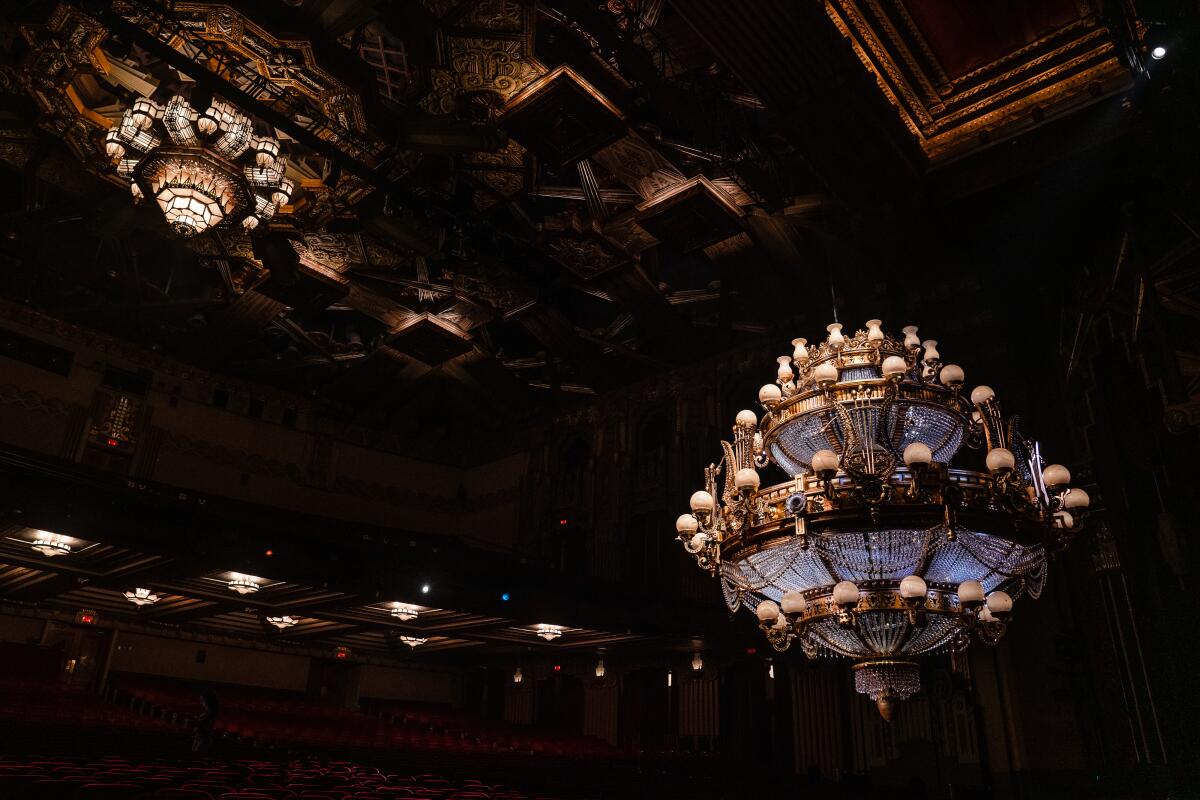
“Phantom of the Opera” plays at the Hollywood Pantages Theatre through Aug. 9.
(Ariana Drehsler / For The Times)
For the 25th anniversary performance at London’s Royal Albert Hall, the production team planned to borrow one of the chandeliers that Swarovski had made for the 2004 “Phantom” film.
“For some reason, we couldn’t get it,” recalled Set Design Adapter Matt Kinley. Instead, Kinley and his team had to call upon lighting designer and prop maker Howard Eaton, whose company Howard Eaton Lighting Ltd. has constructed virtually every “Phantom” chandelier, and ask him to make a “giant” one from scratch in just two weeks.
“He’s a real maverick,” Kinley said. “There’s no one really like him in [the U.K.], and he’s able to take on these insane projects and take an artistic brief and turn it into something hugely technical. They’re kind of works of art in themselves.”
In his role, Kinley draws from Björnson’s archive of sketches, photos and models to maintain a “DNA link” between her original concept and every piece of the design.
“She was a hard task master, you know, she was tough, but she was brilliant and ‘Phantom’ is her masterpiece,” he said.
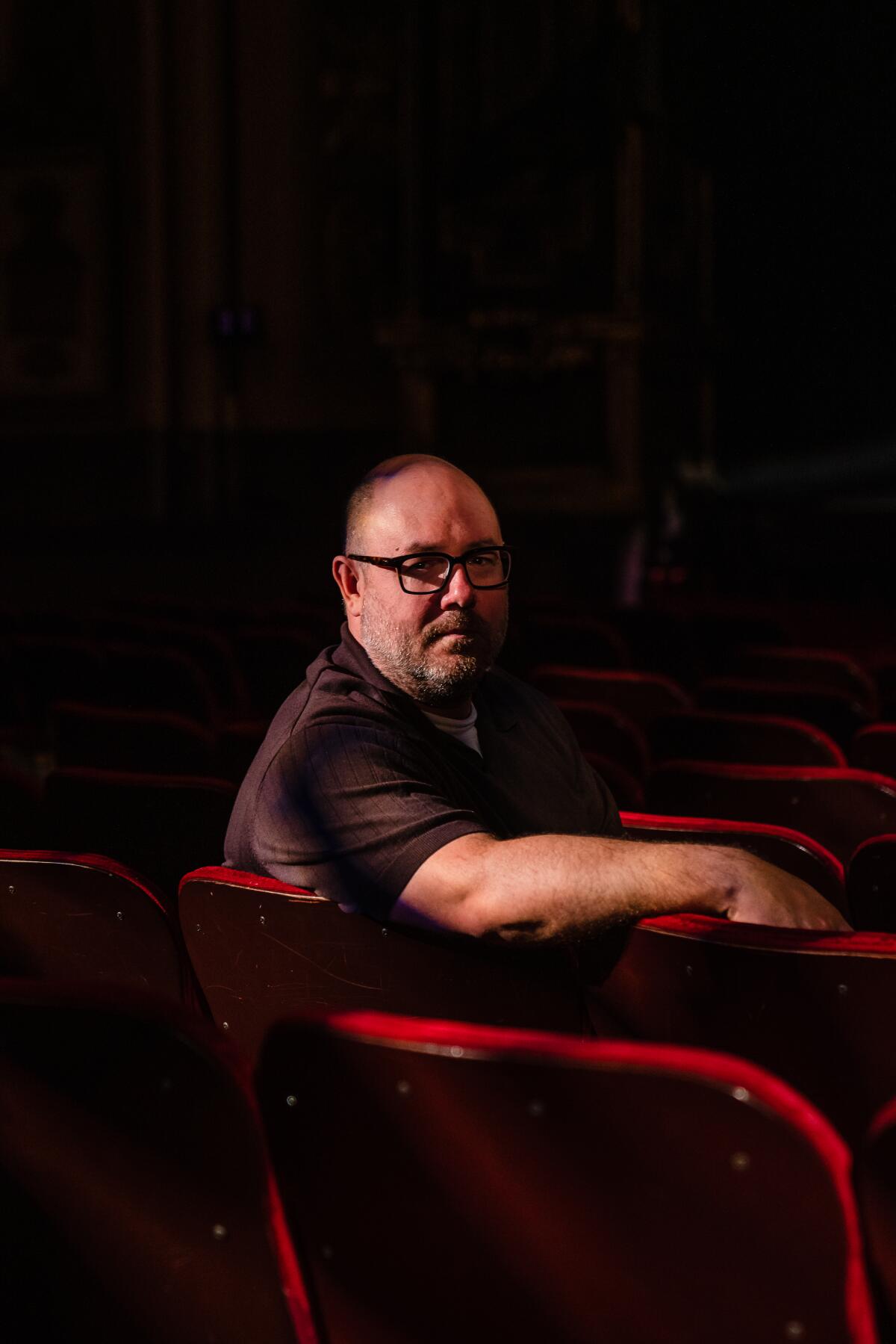
“Phantom” Production Stage Manager Jovon Shuck sits in the Hollywood Pantages Theatre. The North American tour of the musical kicked off last November.
(Ariana Drehsler / For The Times)
Bringing Gillian on tour is another feat. It takes up one-third of a 53-foot tractor trailer—one of 17 trailers “Phantom” travels with, and the team anticipates about 38 hours to load into a venue. Six months before every tour stop, someone from Shuck’s team visits to survey the theater building and meet with structural engineers to ensure the structural steel mount can support its weight and dynamic force.
“We want that moment at the end of act one to be terrifying and completely safe,” Shuck said.
When the “phans” — that’s “Phantom” fans — come to the theater, whether they’ve seen every production or are just seeing it for the first time, Shuck, Sklar-Heyn and the whole team want their experience to be as close to the original Broadway spectacular as possible.
If that involves a massive chandelier falling above their heads in a pyrotechnic explosion, even better.
More to Read
Disclaimer : This story is auto aggregated by a computer programme and has not been created or edited by DOWNTHENEWS. Publisher: latimes.com