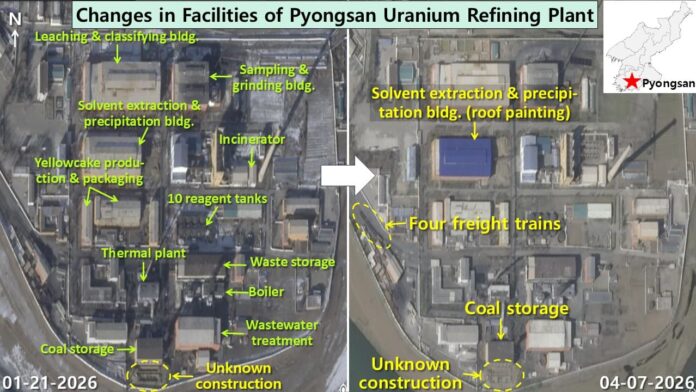
North Korean authorities have sealed off a cluster of villages near a uranium refining plant in North Hwanghae province. The lockdown follows an outbreak of unexplained illness that has left many people suffering hair loss, vomiting and skin lesions, fueling fears of radioactive contamination.
A source in North Hwanghae province spoke to Daily NK on Friday, saying an illness of unknown origin broke out simultaneously among people living in villages along a river near the Pyongsan uranium refining plant, causing considerable alarm. Those affected report sudden hair loss, uncontrollable vomiting, skin blotches and severe lethargy.
Local health authorities have been unable to respond. Doctors say they have no medicine to prescribe. The number of people showing similar symptoms is growing quickly.
Suspicion is mounting that the illness may stem from radiation exposure rather than a simple infectious disease, and anxiety among the population has reached a fever pitch. The source said talk has spread that the root of the problem lies in the state’s aggressive push to boost nuclear material production. Officials framed the push as a way to strengthen national defense. As a result, the Pyongsan uranium refining plant has been running around the clock.
The Pyongsan Uranium Concentrate Plant is North Korea’s only known facility producing uranium yellowcake. Outside monitoring groups say the material feeds directly into the country’s nuclear weapons program.
Some people have used river water near the plant for drinking and daily use. They suspect that radioactive waste and contaminated wastewater discharged from the facility are behind the outbreak.
Lockdown and travel ban
Authorities recognized the severity of the situation, and rather than launching an epidemiological investigation, they chose to cover up the outbreak and seal off the region instead.
North Hwanghae’s provincial party committee, people’s committee and the local bureau of the Ministry of Social Security, North Korea’s police agency, reportedly received an urgent internal directive. The joint order was issued by the Workers’ Party of Korea and the Cabinet. It banned all travel to Pyongyang for people in the affected area, except for those with special business needs.
Blockade walls have gone up along the county boundaries near the plant since dawn on July 13. The walls span Pyongsan and Sohung counties, sealing off every route into Pyongyang.
Checkpoints on the roads leading to Pyongyang have tightened their inspections several times over. Safety officers turn away anyone carrying identification issued in North Hwanghae province, and only a duty travel permit stamped with special authorization allows a person to cross the cordon, the source said.
Safety officers from Pyongsan county have reportedly been deployed to the river valley villages where the outbreak occurred. Their job is to tightly control people’s movement there.
Public sentiment in the area has grown volatile in response to the crackdown. Fear and resentment are spreading, the source said. Some people compare the outbreak to what they call the “ghost disease,” once linked to the area around North Korea’s nuclear test site. Others accuse the state of discarding them after forcing them to work in weapons production that made them sick.
Reporting from inside North Korea
Daily NK operates networks of sources inside North Korea who document events in real-time and transmit information through secure channels. Unlike reporting based on state media, satellite imagery, or defector accounts from years past, our journalism comes directly from people currently living under the regime. We verify reports through multiple independent sources and cross-reference details before publication.
Our sources remain anonymous because contact with foreign media is treated as a capital offense in North Korea — discovery means imprisonment or execution. This network-based approach allows Daily NK to report on developments other outlets cannot access: market trends, policy implementation, public sentiment, and daily realities that never appear in official narratives.
Maintaining these secure communication channels and protecting source identities requires specialized protocols and constant vigilance. Daily NK serves as a bridge between North Koreans and the outside world, documenting what’s happening inside one of the world’s most closed societies.
Disclaimer : This story is auto aggregated by a computer programme and has not been created or edited by DOWNTHENEWS. Publisher: dailynk.com