
Negotiations over a fresh pay deal between the state government and public school teachers are at a stalemate following high-profile industrial action which saw some 20,000 striking teachers take to the streets on Thursday.
With no meetings scheduled to resolve the deadlocked dispute, the prospect of further strikes as well as bans on teachers responding to department emails, working unpaid overtime and hosting Labor MPs at schools remain in place.
Both the Australian Education Union and the government told The Age they were open to meeting but, as of late Friday, neither had approached the other.
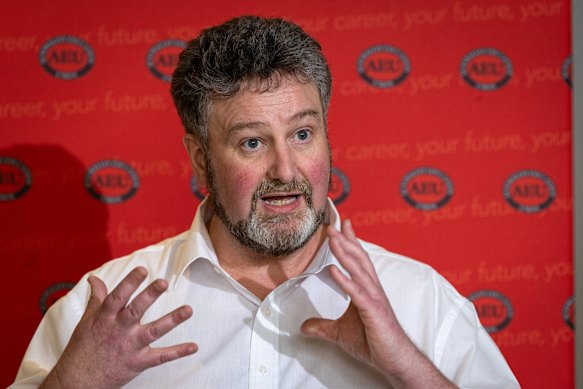
The union’s Victorian branch president Justin Mullaly is juggling a range of competing expectations from within the union membership.
The union’s Left faction is sticking to its demand of a 35 per cent pay increase over three years, backdated to January, and flagging rolling industrial action and a third strike on August 4.
Union state councillor and Fight the Crisis president Lucy Honan told The Age on Friday that a further four schools had resolved to strike next month, taking the total number of schools facing a stop-work to 42.
The Maribyrnong region, representing about 50 schools, has also voted to strike, she said, while another two regions are set to vote on whether to take industrial action next week.
Honan said the faction remained firm on its insistence that class sizes be capped at 25, that there be a reduction in teaching time, and conditions improved for education support staff.
“It’s a knot of problems that need to be solved together, and we’re sticking to these demands,” she said.
The union’s leadership has presented a shopping list of conditions to the government including more time for planning and preparation, improved pay recognition for employees at the top of their salary range, increased pay if inflation exceeds annual pay rises, reduced class sizes, and the ability to work from home when possible.
Public school advocate Trevor Cobbold said teacher pay should be a priority if the sector was going to attract and retain staff in a competitive environment amplified by a national teacher shortage.
“Student outcomes are suffering because of the lack of funding in Victoria,” he said.
“Teachers don’t strike lightly. It is indicative of the state of crisis Victorian schools are in, in terms of their funding.”
Cobbold, the Save Our Schools national convenor, backed the push for more teachers in schools which, he said, would allow for a reduction in class sizes.
However, he said that disadvantaged schools should have smaller classes which would close the achievement gaps between rich and poor in the public education system.
Last week, the union membership narrowly rejected a proposed 28.3 per cent wage rise over four years, which came with improved conditions for education support staff.
Union members had previously dismissed another state government offer despite the leadership reaching an in-principle agreement that would have increased teachers’ wages between 28 and 32 per cent over four years.
The government has been immovable in offering a four-year deal, while the union has consistently pushed for an agreement spanning three years.
Thursday’s stop-work drew 20,000 educators from across the state to the CBD, down on the estimated 35,000 who attended the rally in March.
However, consensus over the government’s latest proposal could be close, after a ballot of 50,000 union members who voted on the revised offer of 28.3 per cent pay rise over four years rejected the offer 51.18 per cent to 48.82 per cent.
A government spokesperson said Thursday’s strike action was disappointing, repeating Education Minister Ben Carroll’s comments that the current offer would make Victorian teachers and education support staff the best paid in the country together with the best conditions.
“Families are already juggling a lot, and yesterday’s disruption was disappointing,” she said.
“The AEU members’ ballot was a close vote and our door is always open to continue working with the AEU leadership to resolve this matter.”
Start the day with a summary of the day’s most important and interesting stories, analysis and insights. Sign up for our Morning Edition newsletter.
 Bridie Smith is an education reporter at The Age. A former desk editor, she has also reported on science and consumer affairs.Connect via X, Facebook or email.
From our partners
Disclaimer : This story is auto aggregated by a computer programme and has not been created or edited by DOWNTHENEWS. Publisher: www.smh.com.au