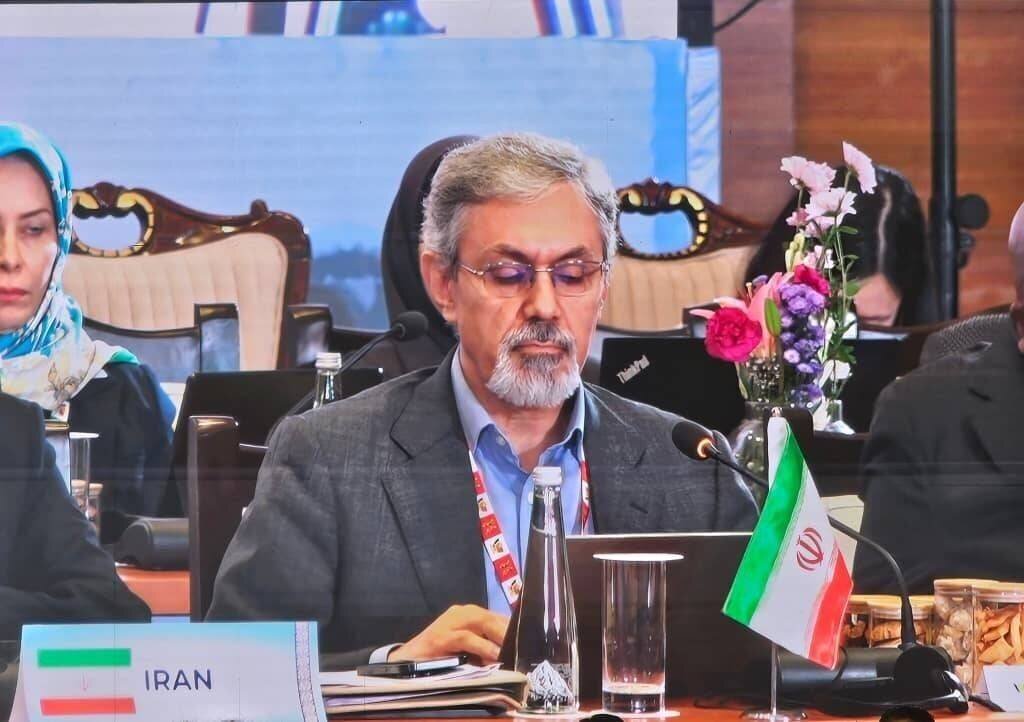
TEHRAN – Attending the 16th BRICS Health Ministerial Meeting, being held in Chandigarh, India, from July 21 to 25, the Iranian delegation has so far actively participated in drafting a declaration and putting forward technical and legal proposals to strengthen health cooperation among BRICS member states.
Iran’s position fundamentally prioritized the pursuit of consensus while safeguarding national interests, preserving the authority of regulatory bodies, expanding production and research capacities, ensuring equitable access to medicines, vaccines, and health technologies, and fostering cooperation in traditional medicine and mental health, IRNA reported.
The Iranian delegation emphasized that BRICS cooperation must advance beyond declarations and develop into joint, actionable initiatives yielding measurable outcomes; they also underscored that access to health products and technologies should not be hindered by obstacles that disrupt supply chains, technology transfer, joint production, or patients’ timely access to care.
Elaborating on the health achievements of the country during crises, Ali Jafarian, the senior advisor to the health minister, put forward three key priorities for the development of the ‘BRICS Action Plan’.
The first proposal highlighted strengthening joint preparedness, which includes developing early warning systems, emergency response networks, combating antimicrobial resistance and environmental threats, while respecting national sovereignty.
Developing pharmaceutical innovations was the second proposal, entailing a shift from one-way technology transfer toward collaborative research, local manufacturing, and resilient supply chains.
The third suggestion focused on enhancing regulatory cooperation. Announcing Iran’s readiness to participate in BRICS GxP initiatives, the official highlighted the importance of sharing experiences and reducing duplication of efforts to accelerate access to safe, high-quality medicines.
He went on to say that despite intense pressures caused by the recent illegal US-Israeli attacks against the country, particularly hospitals, health staff, and the pharmaceutical supply chain, the provision of essential health services in Iran never came to a halt, defining the true resilience. For instance, in just one noteworthy initiative in Tehran during the 40-day wartime crisis in March, 15 complex liver transplant surgeries were successfully performed, IRNA quoted Jafarian as saying.
Iran is willing to expand cooperation in different fields including tuberculosis research, new vaccines, and advanced diagnostics, he added.
Referring to Persian and complementary medicine, Jafarian said the country has taken great steps to integrate these services into the national health system, and it welcomes the establishment of a BRICS expert working group on traditional, complementary, and integrative medicine.
He also underlined the necessity of digital transformation in healthcare grounded in the equitable and intelligent use of artificial intelligence. Highlighting the immense potential of BRICS member states, he said BRICS can transform solidarity into tangible action.
The official also proposed health cooperation mechanisms to present at least one joint pilot project, one operational protocol, and one measurable outcome by the next meeting, to help mark a turning point in BRICS transition from declarations to practical implementation and sustainable health security.
Regarding regulatory cooperation, Iran supported information exchange, capacity building, reliance on credible assessments, and the reduction of duplicative processes. However, it explicitly stated that such cooperation must not lead to the automatic recognition of licenses or the undermining of national decision-making authority.
Focusing on tuberculosis, Mohammad-Mehdi Nasehi, head of the Iranian Health Insurance Organization, highlighted the implementation of joint operational studies and programs, the continuity of services for migrants and vulnerable populations, and the strengthening of cross-border cooperation.
Furthermore, the proposal by Mohammad-Reza Shalbafan, an official with the health ministry, regarding the inclusion of psychosocial support during crises, particularly for children and adolescents, was accepted by the consensus of the members.
Iran also supported the development of the BRICS vaccine research and development center, cooperation in nuclear medicine, and the radiopharmaceutical supply chain, provided that such cooperation is voluntary, based on scientific evidence, and aligned with the countries’ national laws and priorities.
The meeting to establish an Expert Working Group on Traditional, Complementary and Integrative Medicine (TCIM) was held on the very first day of the 16th meeting.
Thanks to the efforts of Arman Zargaran, international advisor to the health ministry’s traditional medicine office, the historical and cultural significance of traditional medicines in safeguarding the cultural heritage and identity of nations was recognized, and Iran supported the establishment of a working group of experts in traditional, complementary, and integrative medicine.
Highlighting the country’s rich health heritage, Zargaran stated that Persian medicine, far from being merely a traditional practice, is a scientific, regulated, and evidence-based discipline that has been successfully institutionalized and integrated into the national health system.
Moreover, the official outlined Iran’s strategic achievements in the development of traditional medicine across five key areas: expanding higher education through specialized academic majors at postgraduate levels; advancing research and technology through scientific innovation and the preservation of cultural heritage; establishing a standardization and regulatory framework for natural medicines; integrating traditional medicine into clinical services and primary healthcare; and achieving health equity through comprehensive insurance coverage to ensure citizens’ equitable access to the full range of quality health services.
On the sidelines of the 16th BRICS Health Ministerial Meeting, Zargaran held a meeting with Monalisa Dash, the director general of the international relations office at the Indian Ministry of Ayush.
The two sides also discussed avenues for the enhancement of cooperation between the two countries on a bilateral basis as well as within the BRICS framework through conducting research and educational projects, exchanging students and professors, and joint research grants, highlighting the need to develop a roadmap to help implement the reached agreements in traditional medicine in line with existing memoranda of understanding.
The 16th BRICS Health Ministerial Meeting is bringing together BRICS nations to deepen cooperation, exchange best practices, and shape the future of resilient, innovative, and sustainable healthcare.
It serves as a great opportunity to strengthen ties with BRICS member states and explore the potential to expand cooperation, particularly in pharmaceutical raw materials, health technologies, and medical equipment, IRNA quoted Ali Jafarian, an official with the health ministry, as saying.
The Iranian delegation represents different health sectors including Persian medicine, mental health, communicable diseases, and international affairs.
The delegation is scheduled to hold meetings with its counterparts from member states, such as India, Russia, and China.
Given the illegal sanctions imposed on the country, Iran intends to leverage BRICS member states’ capacity to facilitate access to essential healthcare supplies.
Chandigarh is hosting the BRICS health ministerial meeting and the BRICS meeting on Traditional, Complementary and Integrative Medicine (TCIM), the Times of India reported.
The five-day program, from July 21 to 25, is being held under the theme “Building for Resilience, Innovation, Cooperation and Sustainability.”
A major highlight will be the high-level ‘Health Without Borders’ conference, featuring 26 technical sessions involving ministers, policymakers, public health experts and researchers from participating countries.
Traditional, complementary and integrative medicine is being held at the center of the Chandigarh deliberations. The Ministry of Ayush is leading discussions on integrating traditional medicine into mainstream healthcare and strengthening international cooperation through evidence-based practices.
Participating countries are expected to finalize the Terms of Reference for a BRICS expert working group on TCIM, paving the way for collaboration in research, clinical validation, digital knowledge-sharing, regulatory harmonization, and protection of traditional medical knowledge.
Boosting health ties with BRICS counterparts
In May, Health Minister Mohammad-Reza Zafarqandi explored avenues to expand cooperation with his counterparts from BRICS member states in different fields of the health sector.
Zafarqandi held several meetings on the sidelines of the 79th World Health Assembly (WHA), which was held from May 18 to June 23 in Geneva, Switzerland, IRNA reported.
Holding a meeting with the Indian Minister of Health and Family Welfare, Jagat Prakash Nadda, Zafarqandi highlighted the role of India in the pharmaceutical industry and emphasized the need for the enhancement of ties in the field of health.
For his part, Prakash Nadda expounded on India’s capacity in the health sector and announced the country’s readiness to maintain and promote cooperation with Iran.
The two sides agreed to form a joint committee to follow up on the development of academic, medical, and pharmaceutical ties.
Also, Zafarqandi held meetings with his Russian, Brazilian, Chinese, South African, Egyptian, and Ethiopian counterparts, elaborating on the impacts of the US-Israeli war on the country’s civilian and health infrastructures, while discussing ways to enhance collaboration among the BRICS member states in the health sector.
MT/MG
Disclaimer : This story is auto aggregated by a computer programme and has not been created or edited by DOWNTHENEWS. Publisher: tehrantimes.com