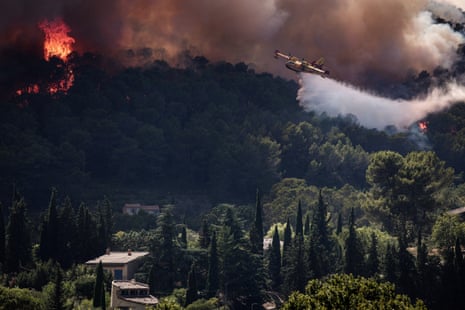
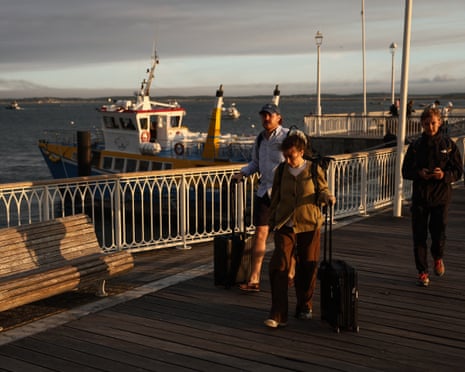
Thousands of people have been forced to flee parts of south-west France amid worsening wildfires that prompted the authorities to order people to evacuate from the Cap Ferret peninsula along the Atlantic coast.
Evacuees have been told to leave the area before 10am, using hundreds of mobilised boats or the only road linking the area with the mainland.
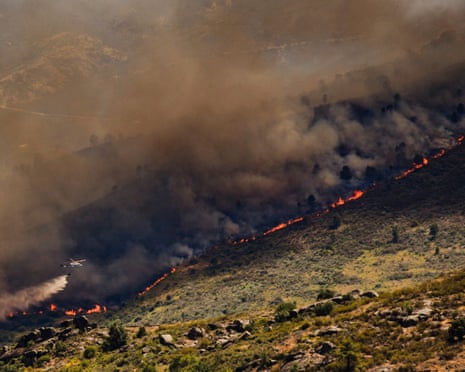
More than 10,000 hectares are affected by the two concurrent wildfires, which last night crossed the firebreak established by firefighters.
The French authorities formally requested the activation of the European Union’s Civil Protection Mechanism to tap into the bloc’s resources as they battle the fires, with Emmanuel Macron saying the situation remained “very intense.”
The EU’s crisis commissioner, Hadja Lahbib, confirmed that “following France’s activation of the EU’s civil protection mechanism, the EU is providing assistance and deploying 3 water bomber aircraft.”
Dangerous situation is also unfolding in Spain, with the Spanish government declaring a national emergency over wildfires near Madrid and Avila, forcing more than 10,000 people to evacuate.
I will bring you all the updates here.
It’s Friday, 24 July 2026, it’s Jakub Krupa here, and this is Europe Live.
Good morning.
And, on that note, we will be closing the blog for today.
-
More than 80,000 people have fled huge wildfires in Spain and France as Madrid declared a national emergency and French authorities ordered the total evacuation, by land and sea, of one of the country’s best-known holiday spots.
-
Both countries have triggered the EU’s Civil Protection Mechanism to get help with battling the blaze (9:48, 10:53, 13:24).
-
Spain’s prime minister Pedro Sánchez warned the country faced “a dramatic situation,” after a rare decision to declare a rare state of national emergency (11:03, 11:31), and satellite pictures showing the scale of devastation (13:59).
In other news,
-
A Romanian F-16 fighter jet shot down a drone that had entered its airspace on Friday, president Nicușor Dan said, with authorities investigating its origin (16:30).
-
Germany’s embattled and deeply unpopular chancellor, Friedrich Merz, sought to turn a scandal into an opportunity with a mini cabinet reshuffle (16:08), as he desperately hopes to turn his rock-bottom poll ratings around.
-
Poland’s main opposition Law and Justice (PiS) party has split, after former prime minister Mateusz Morawiecki and his allies said they were forced out (16:21) over factional disagreements on policy direction ahead of next year’s parliamentary election.
If you have any tips, comments or suggestions, email me at jakub.krupa@theguardian.com.
I am also on Bluesky at @jakubkrupa.bsky.social and on X at @jakubkrupa.
in Madrid
Spanish authorities are also worried about the prospect of the blazes in Madrid and Ávila coming together to form a single fire.
On Friday afternoon, Nicanor Sen, the central government’s delegate to the Castilla y León region – which lies to the northwest of Madrid – said there was “very little time left” before the fires could merge.
in Madrid
Spain’s far-right Vox party is adamant that the current wildfires have nothing to do with the climate emergency and everything to do with a failure to clear rural areas of excess vegetation and to invest in firefighting services.
In a post on X, they have said:
“It’s not climate change, it’s the lack of clearing of the woodlands and the means to combat the fires.”
But as Spanish wildfire experts have pointed out, the reality is a little more complicated than that.
Here’s some detail from one of our stories yesterday:
“Spanish wildfire scientists said they were not surprised by the extreme figures as the abandonment of rural land had left more overgrown vegetation and the rise in temperatures from climate breakdown made it easier for such plant matter to dry out and burn.
Víctor Resco de Dios, a professor of forestry engineering and global change at the University of Lleida, said:
‘Although it’s difficult to predict how far things might go, we will soon be unable to rule out Dantesque scenarios like those seen in California or Australia, with fires or fire complexes reaching hundreds of thousands of hectares or even a million hectares.’”
Spain’s socialist prime minister, Pedro Sánchez, has been blunt in highlighting the deadly role played by the climate emergency. He has also repeatedly urged other parties to agree a “state pact” to tackle the changing climate.
“It’s not just about reacting when these fires hit; it’s also about preventing them, building perimeters, and about teaching people how to react when a fire – or any of the civil emergencies that are unfortunately becoming more common – hits,” he said in the aftermath of this month’s deadly fires in Almería.
He added:
“I’ve said it many times before, but the climate emergency kills. We’re seeing that across Europe and we’re seeing that in Spain.”
It’s also worth reading this piece by our colleague Ajit Niranjan on the causes of Spain’s growing wildfires:
Back to the wildfires in France and Spain…
A Russian ballistic missile strike on Friday in Ukraine’s Kyiv region killed 10 people and injured close to 100 others at a site where a defence industry event was being held, Ukrainian officials and industry representatives said.
A Russian aerial bomb also killed five people in the frontline city of Sloviansk and damaged Latvia’s honorary consulate there.
Latvia’s president Edgars Rinkēvičs said the attack on the consulate was “yet another Russian war crime.” “We will continue to support the work of our honorary consul Oleksandr Pavenko, and all who remain on the frontlines helping their people,” he added.
European Council president António Costa said the strike was “a grave and unacceptable act.” “I strongly condemn this strike, which claimed lives and left many injured,” he said.
The latest strikes comes as the White House confirmed that US president Donald Trump and Ukrainian president Volodymyr Zelenskyy are scheduled to meet in Washington on Tuesday, as first revealed by the rightwing US influencer Laura Loomer, who has previously minimised Russia’s invasion of Ukraine and amplified Kremlin propaganda to her nearly 2 million followers on social media, but is now in Kyiv and supports Ukraine.
A Romanian F-16 fighter jet shot down a drone that had entered its airspace on Friday, president Nicușor Dan said.
Dan did not specify the origin of the drone and said an investigation was under way.
The army’s chief of staff, Gheorghiță Vlad, said the drone visually “looked to be a Shahed type,” but warned it was too early to draw conclusions.
Fragments of the drone fell on a wheat field but caused no damage or injuries, the prefect of Buzau County told reporters.
An army source told Reuters: “There is an ongoing investigation to determine the origin of the drone. But in this part of the world it is Russia that is the attacker.”
Reuters pointed out that Romania has reported multiple breaches of its airspace by Russian drones since Moscow began attacking Ukrainian ports across the Danube River following its full-scale invasion in 2022.
In late May, a drone crashed into an apartment building in the town of Galati, injuring two people.
Earlier today I said I would keep an eye on the drone incident in Romania and the latest Russian attacks on Kyiv.
Let’s update you on both then.
Poland’s main opposition Law and Justice (PiS) party has split, after former prime minister Mateusz Morawiecki and his allies said they were forced out over factional disagreements on policy direction ahead of next year’s parliamentary election.
Speaking at a press conference, the party’s longtime leader, Jarosław Kaczyński, said dozens of members of parliament effectively left the party after refusing to sign a loyalty oath.
All those who refused to sign the pledge were deemed by Kaczyński to have effectively resigned from the party. The rebel MPs insisted they did not intend to leave, but conceded they may be formally expelled at a party meeting on Tuesday.
“Everyone knew what they were signing, and at the same time everyone knew what the consequences of not signing would be … It’s all done,” Kaczyński said, adding that the decision will be formally processed during the party’s leadership meeting on Tuesday.
Law and Justice is one of Poland’s two most successful political parties since 1989, having ruled the country for 10 years in 2005-2007 and 2015-2023, with its candidates winning four out of eight presidential elections.
Despite losing to a coalition of pro-European parties led by former European Council president Donald Tusk and going into opposition at the last election in 2023, PiS remained the largest party in the Polish parliament – a status it could lose as a result of the split.
The resignations come after months of increasingly bitter disagreements in Poland’s main opposition party as it lost its grip on the Polish right.
in Berlin
Germany’s embattled and deeply unpopular chancellor, Friedrich Merz, sought to turn a scandal into an opportunity with a mini cabinet reshuffle on Friday.
Health minister Nina Warken, who recently spearheaded a tricky cost-cutting drive in what Merz called the biggest sector of the German economy, will become his chief of staff. That will bring a rare woman into Merz’s political inner circle and make her the first female to manage affairs at the chancellery in the history of the federal republic.
This round of musical chairs in Berlin will see the former chief of staff, Thorsten Frei, become head of the parliamentary group of Merz’s conservative Christian Democrats (CDU). The party’s general secretary Carsten Linnemann, will replace Warken at the health ministry, leaving him to implement the reforms she boxed through parliament this month.
Merz said he’d announce more changes in the coming days, with widespread speculation transport minister Patrick Schnieder will be out given disappointment with his efforts to modernize the rail network and other crucial infrastructure despite a big public funding injection.
Philipp Amthor, a media-savvy former regional head of the CDU’s youth wing, was tapped as new state minister responsible for managing the federal government’s relations with Germany’s 16 states.
Merz said his new lineup “follows a clear trajectory”.
“We want a government that works with great vigour and pleasure and reflects the diversity of our society and politics. We are a reform government and we want to keep demonstrating that.”
The whole chapter, which in the terms of German politics went off at lightning speed, began just over a week ago. The ambitious head of the CDU parliamentary group, Jens Spahn, announced that he and his husband had welcomed a baby born to a surrogate in the United States.
The news drew immediate accusations of hypocrisy given Spahn’s outspoken opposition to surrogacy, which is illegal in Germany. He initially indicated his desire to ride out the storm but by last Saturday, Merz withdrew his support and Spahn resigned.
Many in Berlin saw the chance for Merz to reorder his personnel as an opportunity given his rock-bottom poll ratings and the surge of the far-right Alternative für Deutschland party ahead of three key state elections in September.
Merz, who has a rash streak coupled with uneven communication skills, is the most disliked federal chancellor in postwar history.
Coupled with an economic reform drive that he recently unveiled, Merz is using the reshuffle to signal a fresh start to German voters who, polls show, have lost confidence in his government’s ability to jumpstart the ailing economy and map a return to strength for the EU’s biggest nation.
Let’s take a quick look at other news from across Europe.
More areas in the Nouvelle-Aquitaine region of south-western France see evacuation orders, with the local authorities telling residents of Arès, Andernos, Le Temple and Saumos to leave as a precautionary measure.
As wildfires are burning in parts of the UK and Europe, forcing people to leave their homes, disrupting travel and affecting communities, we would like to hear how the fires have impacted you.
Have you had to evacuate your home? How are you coping? Are you living with smoke, poor air quality or the threat of evacuation? We would like to hear about your experiences.
“The smoke was incredibly thick. You couldn’t breathe,” José Cobos, who fled his home west of Madrid with his wife and three dogs, told Spanish private broadcaster Antena 3.
Only emergency vehicles were allowed on roads near the blaze, while police set up checkpoints to prevent unauthorised access, according to an AFP reporter at the scene.
From the Temple of Debod park, on the western edge of central Madrid overlooking the city’s outskirts, a thick plume of grey smoke could be seen rising above the horizon as wildfires burnt about 60 kilometres (40 miles) away.
Dora Fernandez, a 57-year-old nurse walking her dog in the park, said she was not worried despite the scale of the blaze.
“It’s far from here,” she said, adding firefighters “know how to stop it”.
in Madrid
“This is the worst fire in the history of the Madrid region,” according to Isabel Díaz Ayuso, the regional president. Speaking at an emergency command post in the southwestern municipality of Cenicientos on Friday, Ayuso said the area was experiencing “a perfect storm, with extremely high temperatures, a relentless wind and the misfortune of having several fire fronts join together”.
She described the situation and the merging of different blazes as “completely unusual and catastrophic”, and said 19,000 people had been evacuated or ordered to remain confined to their homes in the region. She added: “The priority now is saving lives and saving the homes of thousands of people who are caught up in this catastrophe.”
Ayuso said the coordination with the central government was going well and defended her decision to ask it to step in, declare a national emergency and take overall control.
“I think it’s absolutely necessary for several reasons,” she said. “First, because we’re talking about a mechanism established by law; stipulated by the law itself. We’re talking about three autonomous regions and a risk to life. And when there’s this volume of people confined or displaced – there are nursing homes and health centres that have had to be evacuated – and that’s precisely when the central government needs to be present.”
Disclaimer : This story is auto aggregated by a computer programme and has not been created or edited by DOWNTHENEWS. Publisher: theguardian.com