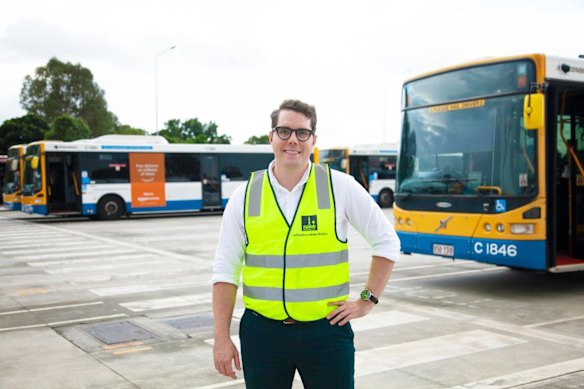
Welcome to Brisbane Times’ CityChats interview series. This week, Ryan Murphy, the chair of infrastructure at Brisbane City Council, tells us about his cancer journey, as well as April Fools’ Day, and that Glee guy.
We meet Murphy at North Quay ferry terminal, a short walk from his office at Brisbane City Hall. Having previously served as the council’s chair for transport, he’s all too familiar with CityCats.
What got you into politics?
I thought I could do a better job than the guy who was doing it [then]. He’d been the councillor for 30 years and I put my hand up to run against him. I won that election by just 2000 votes, so it was very close, and then I won the next one by more. I’m still here about 14 years later.
I’m here because I love the job. I think serving the people and being very close to the people in local government and their problems is one of the most rewarding and gratifying levels of government to work at.
I see state and federal politicians, they’re often caught up in parliament or just writing letters to ministers … local government councils actually get to effectively act sometimes as middle managers in their community, actually connecting the problem with the solution and the needs. It’s a very, very good and gratifying role.
You’re known as a councillor for your sense of humour, including your posts on April Fools’ Day. How do you come up with those?
That’s really all in my tortured brain. I think we should take our jobs seriously as politicians, but not ourselves, and I think too many politicians take themselves too seriously.
I think April Fools’ Day is like our Hunger Games Day – it’s our one day to have a crack at each other over things. Not many people do it, but I like to do it. We can get a little bit too caught up in ourselves.
Have any of your prank posts come true?
Not that I can think of. We haven’t annexed the Redlands yet.
No itty bitty cats?
We had the KittyCats. We were looking for a name for these little small catamarans we were bringing up after the wooden ferries. We had to take them off the water and it was like an episode of Utopia, we were up there in the building trying to pick the name for these things, and I can’t remember who it was, but someone came up with the name CityKitties, and we were like, “oh, it’s just not right”.
And then we flipped it. We didn’t have a focus group or do any research, we just knew then and there in the transport team that that was going to be the name.
On a more serious note, you’ve been open about your cancer diagnosis. Has that changed how you approach your job at all?
It has, actually. After you win that first election and you’re elected, you’re very much worried that you might never get re-elected and so a lot of politicians get caught up in this election-cycle trap where they don’t want to do things too boldly because they’re worried that maybe they won’t get re-elected in the future or people won’t support them.
For me, the cancer scare really made me wonder. It might not be losing an election, it might be just losing my life or something else. I might get hit by a bus or a car and life’s over the next day.
It’s really, I suppose, hastened my timeline to make a real impact in the time that I’ve got in the role that I have.
And so we are doing a lot of things very fast in my portfolio at the moment, whether that’s how we surface the roads, how we trim the trees, how we fix potholes, our works management system, our ability to communicate with our customers – the residents of the city of Brisbane – about how and what we’re doing, the use of AI and operational efficiencies.
We are building a team here that is getting the city ready to host the Olympic Games in 2032 and there’s no time to waste.
If there was a pipe dream you had for infrastructure in the city, what would it be?
It’d be all of our Metro extensions delivered on time and on budget before 2032. We’ve seen the ability of just a large electric bus to make a massive difference in the quality of public transport in this city. And we know how to do it now, there’s really no R&D left to do.
Now it’s about rolling it out, and we know that it has a really strong benefit-cost ratio to the city. We could be talking about light rail and heavy rail for another 100 years, but we could get Metro done in the next six years if we’re really careful about putting together a strong case.
We’re going to need to work with the state government and our federal funding partners to make it happen. It’s going to require a bit of vision.
You said that when you got diagnosed, you weren’t scheduled for a test for 14 years. Do you think that’s something that needs to change?
I do, and I understand that the federal government is about to release the new testing guidelines, but we haven’t seen them yet. I’m very hopeful that they will bring the age down to 45, and 50, but the big challenge is that a lot of men don’t even know about this test and they don’t even know that prostate cancer is something that affects one in five men.
It’s a slow-growing cancer for most people – it could be growing slowly for years, so if they know about the test, the GP tells them about the test, they can potentially get onto it early like I did. It saved my life, absolutely.
Most men aren’t that interested in their health, and it might be years between GP visits for them and they certainly won’t be thinking of prostate cancer, but the reality is really stark.
Do you think a lot of men maybe think it’s an “old man disease”?
Absolutely. It has a marketing problem, this disease. As long as we think of it as a cancer that you die with, not of, and that it’s an old man’s disease, we’ll have unfortunately more and more young men, men that I’ve met in the prime of their life, who are stage four and there’s not a lot of hope for them and they’re just hoping that a cure comes around in time to save them.
What we want is for men to detect this disease early when it’s treatable. That’s why I came forward and that’s why I talked about my diagnosis. I’m very gratified to have so many men that I know, that are in my life, go and get tested after seeing that.
What kind of response did you receive after talking about it?
I think that we don’t like to think about cancer because we just put it in the back of our mind that it’s never going to happen to us and, you know, the stats say that I think one in four people will be touched by cancer at some point in their lives.
Those stats don’t lie, but for prostate cancer, it kills 11 men in this country every single day. It’s the single greatest cause of death of men, specifically, and so we need to do a lot more when it comes to awareness of this disease.
But the good news is it’s so treatable, like the survival rate in Australia is 95 per cent plus. It was only 70 per cent 20 to 30 years ago, so it has improved massively. But still not enough people know about that test. And it’s a $30 test. It’s free if you have a family history.
On a lighter note, do you ever get mistaken for Ryan Murphy, the creator of Glee?
No, never. You know who I do get mistaken for? Sam O’Connor. People say, “oh mate, I saw you, that great housing thing you did the other day, that was great”, and I just nod, I go, “yeah”.
I can see that he’s a lot more attractive than I am, so I’ll take whatever I can get.
Start the day with a summary of the day’s most important and interesting stories, analysis and insights. Sign up for our Morning Edition newsletter.
From our partners
Disclaimer : This story is auto aggregated by a computer programme and has not been created or edited by DOWNTHENEWS. Publisher: www.smh.com.au