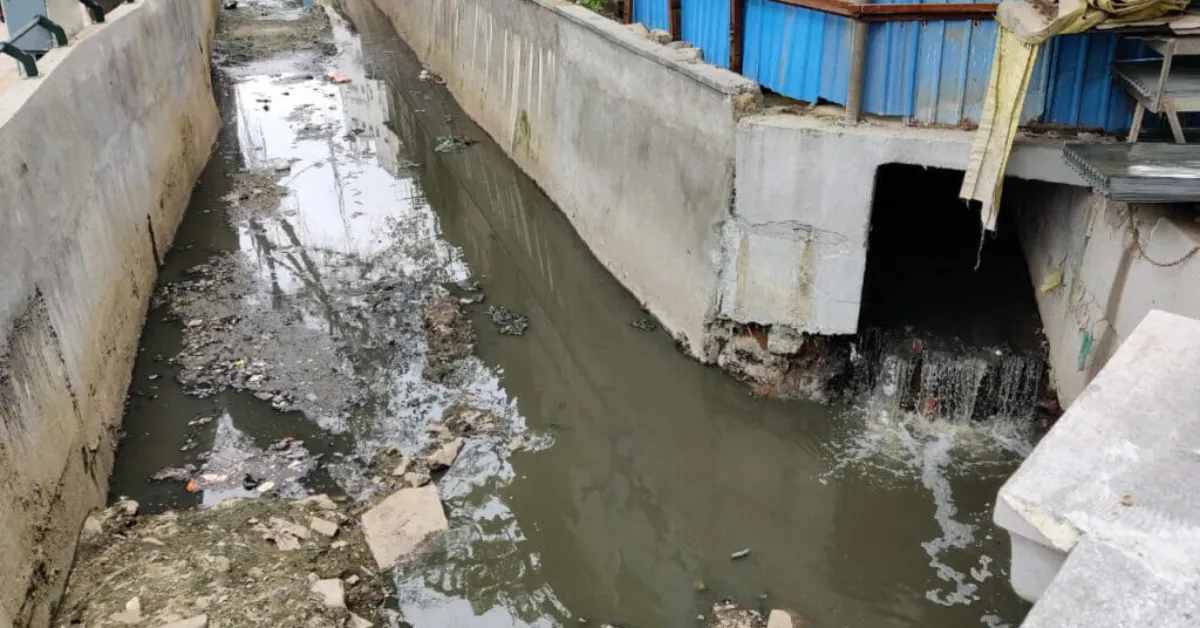
What happens when rain can no longer find the path it has followed for centuries? In Bengaluru, it floods roads instead of filling lakes.
Every monsoon, cars stall in waterlogged streets, homes flood, and the city slows after a few hours of heavy rain. Yet several lakes remain dry.
For retired Army officer Captain Santosh Kumar, the contradiction demanded an answer. If the city received enough rain to flood entire neighbourhoods, why was that water failing to reach its lakes?
The answer lay beneath roads, buildings and decades of urban expansion, inside Bengaluru’s forgotten network of Raja Kaluves. These ancient channels carried rainwater from one lake to another, protecting the city from floods while replenishing its water bodies.
Using British-era maps from 1923, Captain Santosh began tracing the waterways Bengaluru had buried.
Why Bengaluru’s rain stopped reaching its lakes
Captain Santosh retired from the Army in 2008 and returned to Muthanallur in Anekal Taluk, on Bengaluru’s outskirts.
His search first revealed that water was being illegally extracted from lakes in Anekal for commercial tanker supply. The extraction explained only part of their decline.
Between 2017 and 2019, he documented lakes and stormwater drains across the taluk. A pattern emerged. The lakes were drying because the channels that fed them had been encroached upon, built over or buried beneath concrete.
For centuries, Bengaluru’s lakes had worked as an interconnected system. More than 500 years ago, under Kempe Gowda’s city planning, Raja Kaluves guided rainwater through the city’s natural valleys. Water moved from one lake to another, slowing runoff, recharging groundwater and reducing floods.
As those links disappeared, rainwater began collecting on roads and in neighbourhoods.
The century-old maps that revealed a lost network
Captain Santosh searched historical records and found detailed British-era maps prepared in 1923.
Guided by the maps, he walked through villages and neighbourhoods, comparing old waterways with today’s landscape. He traced forgotten channels and documented stretches blocked by construction and encroachment.
While studying the link between Muthanallur Lake and Bidaraguppe Lake, he identified four historic Raja Kaluves. One had lost all visible signs of its original purpose and had become an encroached stretch of land.
Captain Santosh worked with local residents to gather evidence and secure approvals from the Minor Irrigation Department and the Deputy Commissioner of Bengaluru Urban district. Together, they restored nearly four kilometres of the channel, reconnecting it to Battalakere Lake, a key link in the chain.
The monsoon that put the restoration to the test
The next monsoon brought proof.
Neighbouring areas flooded again. Muthanallur escaped the flooding.
The revived Raja Kaluve carried rainwater along its original course, directing it into interconnected lakes instead of roads and homes.
/filters:format(webp)/english-betterindia/media/media_files/2026/07/29/blr-3-2026-07-29-19-00-15.png)
The result strengthened Captain Santosh’s belief that Bengaluru could recover much of its resilience by restoring the system it had inherited.
He expanded the effort across Anekal Taluk, helping revive 14 ancient lakes. Many are believed to be nearly 1,000 years old, with several dating to the reign of Rajaraja Chola I.
What a city can learn from its water
Bengaluru has an estimated 800 kilometres of stormwater drains, many altered by rapid urbanisation. Roads and buildings have expanded across natural drainage paths, leaving rainwater with fewer routes to move safely.
Speaking to The Indian Express in 2022, Captain Santosh said, “In natural settings, rainwater either gets soaked into the soil or makes its way to rain streams, lakes and rivers. If these are maintained efficiently, we will never face floods and calamities.”
His work points to a simple truth: a city’s resilience can begin by remembering the pathways its water once knew.
Sources:
‘Bengaluru: Restore connectivity between lakes to prevent flooding, says activist’: by Aksheev Thakur, Published on 21 September 2022
‘One-Man Army’s Resolve Against the Devastating Flood in Bangalore’: by Keerthana Kantharaj
Disclaimer : This story is auto aggregated by a computer programme and has not been created or edited by DOWNTHENEWS. Publisher: thebetterindia.com