As dozens of forest wildfires burned across France this week amid the summer’s fourth brutal heatwave and increasing air pollution, some wondered whether voters’ first-hand experience of the climate emergency would change the political debate ahead of next year’s presidential election.
The Green leader, Marine Tondelier, who cut short a tour of France on medical advice that at seven months pregnant she should avoid breathing smoke-filled air in the south-west near a huge wildfire in Gironde, said the political class still had its head in the sand.
She said the government had ignored her plea for cross-party crisis talks to declare a national state of emergency on the climate this summer. She called for a new “climate welfare state” in France to help those whose lives were being affected as about 260,000 people were evacuated because of wildfires across the country.
But French politicians focused instead this week on arguments over budgets, crisis planning and criticisms over the levels of state funding for emergency services and equipment to fight fires, including water-bombing planes. The more complex longer-term issues of cutting emissions and structural societal changes to address climate heating were largely left aside.
The president, Emmanuel Macron, said it was not the time to analyse lessons to be learned while France was still in “full battle” against fires.
Macron, whose decade as president comes to an end next spring, returned to his war vocabulary of the 2020 Covid pandemic. As the Gironde wildfire burned an area four times the size of Paris, Macron flew to the crisis operations centre in Bordeaux, saying France was facing its “hardest situation since the second world war”.
He also said the situation was “totally atypical”, suggesting the wildfire was out of the ordinary. Climate experts said growing numbers of forest fires had been predictable amid rising temperatures.
Most political parties will not clarify their full election manifestos – and positions on the climate crisis – until this winter, and some climate campaigners worry that by then the fires and heatwaves may be less present in the media and people’s minds.
Marine Le Pen, who leads the far-right anti-immigration National Rally (RN), is seen as having a good chance of reaching the final round vote in the presidential race. During the second round of the last contest, in 2022, Le Pen said: “I have never been a climate sceptic”. But the following year she said the UN’s Intergovernmental Panel on Climate Change was “alarmist”, and some RN politicians have in the past questioned the role of human activity in climate heating.
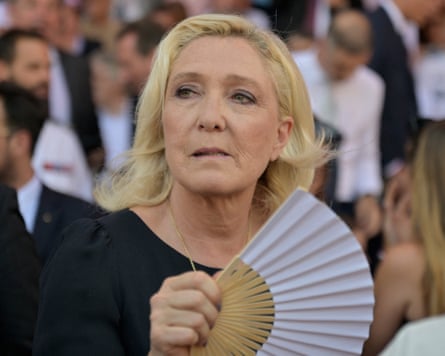
The RN has also opposed the workings of the EU’s green deal, which is designed to make the EU carbon neutral by 2050. But since the heatwaves of the start of the summer, key figures in Le Pen’s party have sought to stress that the RN is not a climate crisis denier. This week, the RN focused more on the heroism of firefighters and alleged underfunding of fire services by the state than on long-term environmental action.
The radical left candidate Jean-Luc Mélenchon earlier in July proposed reorganising French regions into “eco-regions” to ensure water supply and deal with the climate crisis.
Rémi Lefebvre, a professor of political science at the University of Lille, said of the current wildfires’ impact on the presidential campaign: “Ecology will probably be talked about more during the election campaign, but I’m not convinced that it will reconfigure French political life.” He said serious wildfires in previous years had not forced a change of direction and French politics had shown itself to be “too short-termist” to dig deep into changing models of society.
Lefebvre said Le Pen did not take a stance of denying climate change “because that is no longer possible … we’ve passed that point”. But he said the broader issue was political inaction on climate challenges. He said a lot of French people felt those in charge were powerless to react.
Disclaimer : This story is auto aggregated by a computer programme and has not been created or edited by DOWNTHENEWS. Publisher: theguardian.com