Tens of thousands of Moroccans broke into Ceuta, a Spanish territory that neighbours Morocco. By the following evening, most of them had left, hungry and disappointed.
Ceuta, Spain: Like so many others in Morocco, Mohammed Ahmidho saw on his social media feeds early Thursday that the heavily guarded border his country shared with the Spanish territory of Ceuta was open.
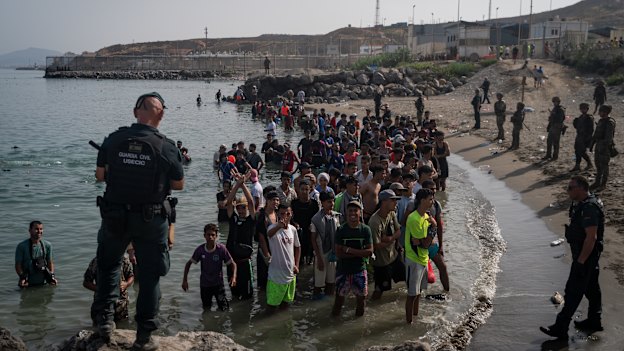
Soon enough, he joined a crowd in the tens of thousands, many of whom were astonished to see Moroccan police urge them, as he recalled, to “come to Spain.” Some climbed over the fence, as he did, or dove through holes in the chain-link, or swam across the maritime border. Some wore wet-suits, sometimes kicking with flippers, or floated to the Spanish coast in orange life preservers, pink inflatable doughnuts around their waists. At least 60 people died in the mayhem.
“A lot of people came,” said Ahmidho, 37. “A lot.”
He was among roughly 50,000 people who crossed the border into a Spanish town of only 84,000 residents on Thursday and early Friday, local time, according to the Spanish interior ministry. That was a more intense surge than in any equivalent period during the peak of the European migration crisis in 2015.
By Friday morning, the city looked like the emergency that Europe has been trying to avoid since that era of mass migration 11 years ago, the last time so many non-Europeans surged into European-held territory, upended the continent’s politics and spurred the rise of its anti-immigrant right.
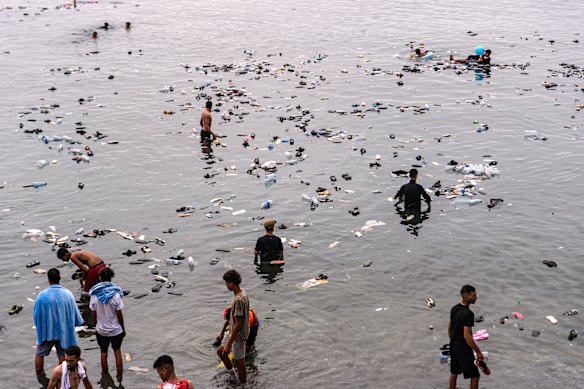
As the city’s residents hunkered down and shuttered their stores, groups of mostly young men with nowhere to go filled squares and avenues, condominium courtyards, hilltop overlooks and bridge underpasses. Some took dips in waters patrolled by a Spanish naval ship or waded through a band of floating detritus – plastic bags and water bottles – caught in the current. Others marched across a beach littered with the things their fellow arrivals had carried: single shoes, a shed wet-suit, mobile phone cases, an ID card from Casablanca.
Spanish soldiers, many of whom had been mobilised on Thursday to deal with the crisis, stood on nearby tanks. They watched the migrants drink water from beach showers, each shaped like vertical surfboards and branded with the slogan, “Ceuta, where you feel the emotions.”
Nearby, young teens laughed under the whirl of patrol helicopters as they tried out the exercise equipment at a beach playground. Ahmidho wore a pink bathing suit and stood bare-chested, his black T-shirt slung over his shoulder. The soles of his feet were cut, he said, from clambering over rocks near the border.
His voyage had been a disappointment, he said. Like so many, he had come to find work, only to find soldiers and policemen harrying him to leave. “There’s no water, there’s no food, there’s no place to sleep,” he said. “There’s nothing.”
As the migrants took over the streets, residents mostly stayed hidden in their homes, keeping their shops and businesses closed.
Emerging briefly, Francisco Pérez, 68, rushed his grandchildren into car seats as the migrants walked around him. He said his granddaughter had asked why they couldn’t go to the beach, and why there were “so many Moroccans.” The locals, he said, were “scared” and furious with the Spanish government, which, he said, had abandoned them.
Pedro Sánchez, the Spanish prime minister, tried to avert such reactions by rushing to Ceuta on Friday morning to show his support for its citizens and also to condemn the influx as a “violation of Spain’s territorial integrity.”
For Sánchez’s right-wing critics – both at home, around Europe and throughout the world, including at the White House – the surge of migrants was an indictment of his pro-immigration policies. His government allowed more than 1 million migrants illegally living in Spain to apply for legal residency this year – a move that his opponents said had helped to entice the migrants this week.
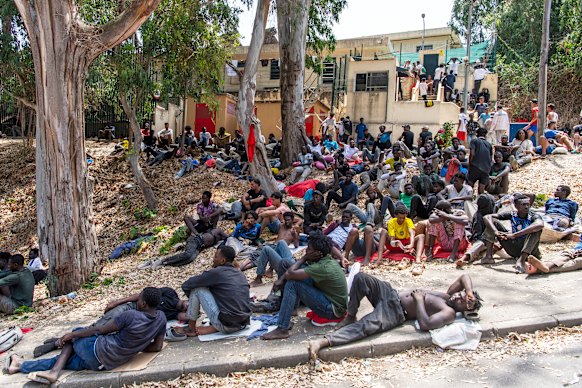
To opponents of immigration, the footage of migrants sweeping into the tiny Spanish territory amounted to Exhibit A for their case. Ceuta, all of a sudden, became an international emblem for the perils of unchecked illegal immigration.
In response, Sánchez blamed human traffickers for misleading the migrants about how easy it would be to claim asylum in Spain – and noted that, despite his migrant-friendly policies, Spain has attracted fewer migrants trying to enter illegally in recent years than some European neighbours.
It is still unclear why so many people came to Ceuta. Many of the Moroccans who wandered around Ceuta on Friday wondered if the doors hadn’t opened because of some unknown plan by Morocco, which has been accused of using immigrant flows in the past for political pressure.
“I don’t know why they let us through,” said Ajoub el-Arrot, 24, who said he heard about the open border on social media. “Maybe they had some political reason. They opened the border and let everyone go by.”
He added, “When there are political problems, Morocco opens the doors and tells us to go.”
Douae Tabit, 19, who also said she heard about the unchecked crossing on social media, said it went “viral” and passed by word-of-mouth, attracting people from all around Morocco. Fluent in English, French and Spanish, she said she worked as a nurse and photographer and spontaneously decided to take advantage of the opportunity.
She climbed over a fence and swam to the Spanish shore, she said, but she had expected something more welcoming: No one had food, water or a place to sleep. Still, she said, “I’m not going back.”
Many seemed not to know exactly what they were doing there.
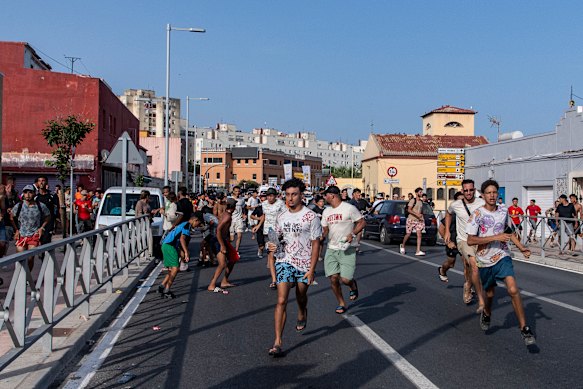
Young men, shirtless or in soccer jerseys, marched barefoot or sometimes in a single sandal, as if in an aimless parade. One teenager gently knocked on the grate of a closed food market while others hovered longingly around the city’s locked supermarkets.
As morning turned to afternoon and the harsh sun burned away the clouds, men sought shade wherever they could. One group gathered under a hulking statue of Hercules near the port terminal. Others leaned against gas station pumps or reclined under the tents of abandoned stalls that had been raised for a local food fair. Still more looked in trash bins for food, or begged passersby for water. One woman fainted by a Zara store.
Sulayman Ahmed, 15, a resident of Ceuta who is of Moroccan descent, said he couldn’t believe that Morocco was letting so many people through.
“They have to put more resources to stop people from coming,” he said, complaining that the appearances of politicians at the border, including that of Sánchez, amounted to “theatre.”
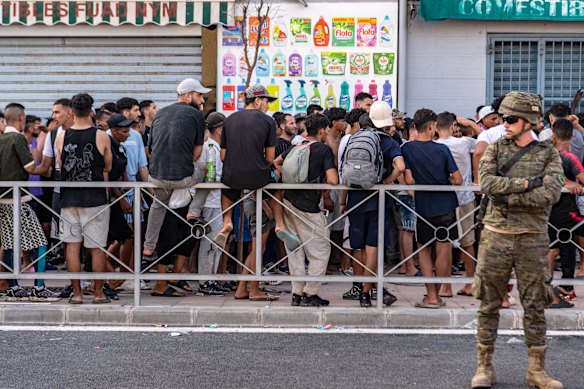
As the day progressed, it became clear many of the migrants were leaving. By the boardwalk, they hovered around Spanish soldiers who had hooked a mobile phone to stereos that played messages in Arabic telling them to go home. Other Spanish soldiers and police officers threatened the migrants, waving their sticks to push them back to the border. In town, a roving band of young Spanish men chased down and intimidated Moroccan stragglers.
Even as a sprinkling of late arrivals waded through the water, a mass return was underway.
By 6pm, 48,300 people had gone back across the border, according to Spain’s interior ministry. They crossed into a small beach between the countries’ border fences, its sands strewed with clothes and plastic bags, as Spanish soldiers yelled for migrants to keep moving out of Ceuta. Then they walked past iron gates topped with barbed wire and floodlights, back into Morocco.
Ahmidho moved in the long line, deeply disappointed with his adventure across the border.
“They had nothing for us,” he said. “They were screaming, ‘Get out of Spain.’”
This article originally appeared in The New York Times.
Get a note directly from our foreign correspondents on what’s making headlines around the world. Sign up for our weekly What in the World newsletter.
Disclaimer : This story is auto aggregated by a computer programme and has not been created or edited by DOWNTHENEWS. Publisher: www.smh.com.au