The last century was fueled by oil and gas. Turner Caldwell is betting the next century runs on metals.
“We’re entering a metals-driven economy,” said Caldwell, CEO and cofounder at Mariana Minerals, a software-focused mining startup. “Lithium and copper are going to be core, but our mandate needs to be broader than that. We’re starting to chase aluminum, which goes into lightweight alloys and plays a major part in the electrification of the economy. We’re looking at magnesium, nickel, cobalt, manganese, uranium, and rare earths. The beauty of the software backbone we’re building is that we’re architecting it to be as generalizable as possible for all the metals the modern economy depends on.”
Metals are the unseen but ubiquitous foundation of our economy (and our world) as we understand it. Power grids and motors guzzle copper. EV batteries don’t exist without lithium. Aluminum builds power lines, planes, and cars. The list goes on: steel is the skeleton of the building you’re sitting in right now, and even metals you never think about—like germanium—are irreplaceable in the chip powering the phone in your hand.
And now, the supply chain powering our phones, transportation, and electricity is endangered: China dominates global mining and controls as much as 90% of critical minerals processing worldwide (this number for rare earth magnets manufacturing—essential for smartphones and defense applications—goes up to 92%). The U.S. is locked in what’s been widely described as a critical minerals chokehold, developed through decades of price-cutting Chinese industrial policy and American industrial decline. So, the supply chain is high-risk, and even high-volume essential minerals like copper and lithium can get wildly expensive.
“Our goal is to reduce the cost of these core inputs to the modern economy over time,” said Caldwell. “That enables us to ensure that everything downstream can move as fast as humanly possible, so we can unlock all the industries [like AI] that everyone is super excited about.”
Mariana—which Caldwell in 2024 cofounded with Baker Tilney and Juan Lozano after nine years working on factory design and construction at Tesla—has been one of a few buzzy startups trying to make waves in the centuries-old mining sector, at a pivotal geopolitical moment. The company, which is based in San Francisco, has just secured a new round of notable funding: Mariana raised a $310 million for its Series B, led by Khosla Ventures, Fortune has exclusively learned. Andreessen Horowitz, a longtime backer, participated in the round, along with Breakthrough Energy Ventures, Greenoaks, Halo Fund, Pax Ventures, StepStone Group, BHP Ventures, Washington Harbour Partners, Greycroft, Mitsubishi Corporation, and others. Mariana has now raised $400 million total and is valued at $1.5 billion.
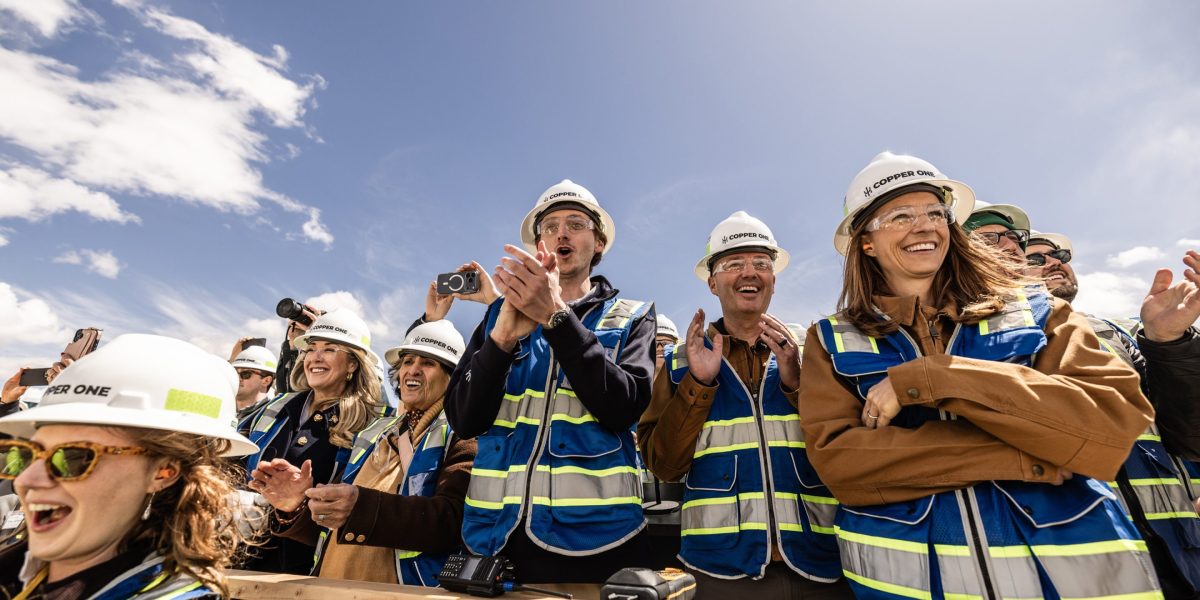
That $400 million includes capital that goes to the mines that Mariana runs: Copper One in Utah and Lithium One in Texas. The names are descriptive: Copper One is a previously idled copper mine that Mariana acquired in 2025 and restarted over four months with autonomous software—the company says the site is moving toward producing 50,000 metric tons of refined copper each year. Lithium One, which broke ground in 2025, is expected to enter commercial production in 2027.
Mariana stands to compete with the massive incumbent miners, from Standard Lithium to BHP Group. But the startup’s betting that there’s not only an opening for Mariana, but that the rising metals demands forced by the AI boom make an efficient, software-based miner existential and essential.
“The AI revolution, physically speaking, depends on the mining of a huge amount of minerals and metals,” Travis Kalanick, former Uber’s founder who now runs physical AI and robotics company Atoms, said via email. “Data centers, chips, the grid, robots, EVs, defense systems: it all starts with copper and other critical minerals. So how existential is it? You cannot lead in the AI century without a domestic supply chain.”
To Kalanick’s point, consider copper, a chokepoint for electrification, as AI-built data centers are placing more demands than ever on America’s outdated electrical grid.
“If you look at the modern economy, it’s basically an electrification story,” said Caldwell. “That’s true whether it’s AI infrastructure, renewables and energy storage applications, the reindustrialization initiative, or the electrification of transport—land, air, and sea. All of that is going to be tied to how much electricity we can generate as a country and as the human race.”
Electricity needs copper. So, volatile copper prices alone stall America’s fragile industrial future.
“If copper prices start to get crazy—and we’ve already seen them increase—all the downstream customers of those metals are going to face cost pressures,” Caldwell said, “which will slow the rate at which we modernize the global economy.”
And copper is just one of dozens of metals that matter to our collective, complicated future.
See you tomorrow,
Allie Garfinkle
X: @agarfinks
Email: alexandra.garfinkle@fortune.com
Submit a deal for the Term Sheet newsletter here.
Joey Abrams curated the deals section of today’s newsletter. Subscribe here.
VENTURE CAPITAL
– Balance Theory, a Columbia, Md.-based AI platform that helps companies manage cybersecurity spending, raised $19 million in Series A funding. SYN Ventures led the round and was joined by DataTribe and TEDCO.
– Smallest.ai, a San Francisco-based AI lab focused on voice AI infrastructure for enterprises, raised $13 million in Series A funding. Seligman Ventures led the round and was joined by Sierra Ventures and 3one4 Capital.
PRIVATE EQUITY
– Charterhouse Capital Partners acquired Animalcare Group, a York, U.K.-based animal health care company, for £235.2 million ($317.3 million).
– Haudecoeur, backed by Apheon, acquired Natur Food, a Giessen, Germany-based Turkish product wholesaler, and Heliadis, a Vilvoorde, Belgium-based food manufacturing company. Financial terms were not disclosed.
IPOs
– Braveheart Bio, a San Francisco-based biopharmaceutical company developing therapies for hypertrophic cardiomyopathy and other serious cardiovascular diseases, plans to raise up to $319.6 million in an offering of 18.8 million shares priced between $15 and $17 on the Nasdaq. AH Bio, Forbion, Jiangsu Hengrui Pharmaceuticals, Orbimed, ES Braveheart Aggregator, and Frazier Life Sciences back the company.
– Apnimed, a Cambridge, Mass.-based drug developer focused on sleep-related breathing diseases, raised $192 million in an offering of 12 million shares priced at $16 on the Nasdaq.
FUNDS + FUNDS OF FUNDS
– Index Ventures, a London, U.K.-based venture capital firm, raised $3.5 billion across multiple funds focused on seed, venture, and growth-stage technology investments.
Correction: The July 31 edition of Term Sheet incorrectly stated that $3.1 billion across its two funds. The amount raised was instead $4 billion. We regret the error.
Disclaimer : This story is auto aggregated by a computer programme and has not been created or edited by DOWNTHENEWS. Publisher: fortune.com