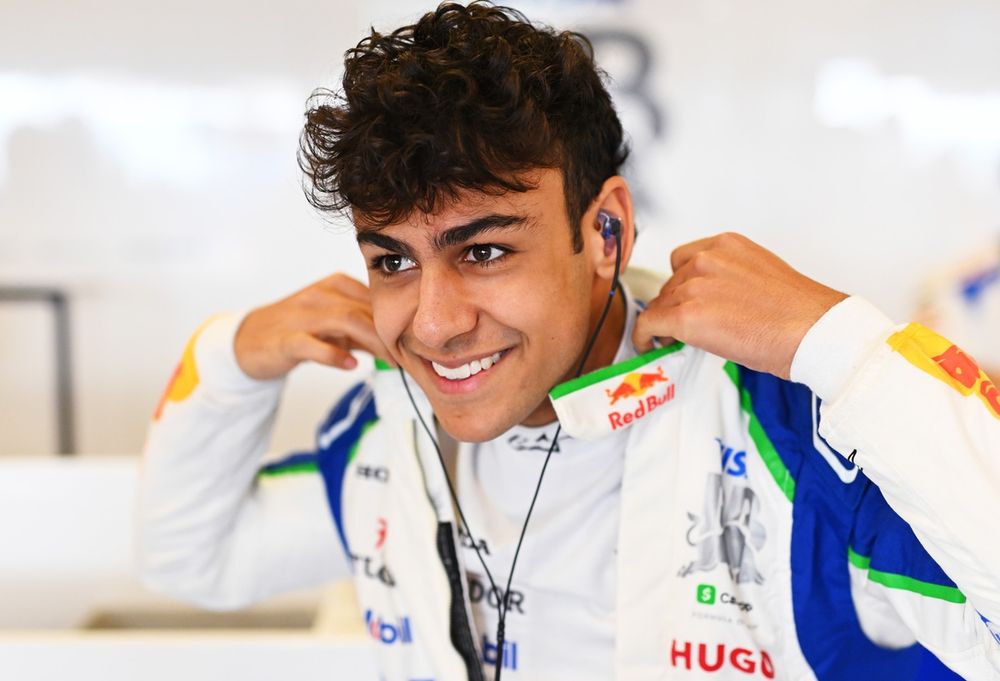
Some conversations stay with you. They remind you that, even in today’s Formula 1, it is still possible to be yourself – to speak openly, without filters, carefully rehearsed answers or media-trained soundbites.
The fact that this interview was conducted with the youngest driver currently on the F1 grid makes it even more remarkable. Arvid Lindblad will celebrate his 19th birthday next Saturday.
Behind the racing driver is already a young man with remarkable maturity. At just 18, he carries himself with unusual composure. Beneath the helmet, gloves and race suit lies a story of hardship, determination and an exceptional level of self-awareness that shines through in every answer.
Three years ago, during the 2023 Belgian Grand Prix, Helmut Marko was enjoying a coffee in the Red Bull hospitality when the conversation turned to the team’s junior programme. Lindblad’s name came up, despite the fact that he had yet to win a single title in single-seater racing. “Within three years he’ll be in Formula 1,” the former Red Bull advisor declared.
On 2 December last year, Racing Bulls confirmed exactly that, announcing Lindblad as one of its race drivers for the 2026 F1 season.
“Why was he so convinced?” Lindblad recalls today. “I’ve asked myself the same question. I think a lot of it came down to my mentality. I joined the Red Bull Junior Team at the end of 2020. I was 12 or 13 when I first met Helmut. My father came with me, but throughout the meeting it was basically Helmut and I doing all the talking.
“My dad later told me that one of the things that impressed Helmut most was seeing a young kid who already knew exactly what he wanted and was completely focused on achieving it.”
Arvid Lindblad, Racing Bulls
Photo by: Rudy Carezzevoli / Getty Images
Let’s start there. Many drivers describe F1 as a childhood dream. You have always spoken about it as a concrete objective. You were still a child when you told your mother: “I’m not going to university. I’m going to be a Formula 1 driver.” When did that certainty first appear?
AL: “It was simply what I wanted to do. From as early as I can remember, my goal was Formula 1. But it wasn’t just about getting there. Even when I was six or seven years old, I didn’t dream of just racing in Formula 1 – I wanted to be competitive. I wanted to fight for wins.
“I can’t really explain why I thought differently from other kids. That’s just how my mind worked. Of course, I played other sports. I played football at school, I went swimming like everyone else. But I never once thought any of those could become my future. For me, there was only Formula 1.”
When you started racing in the junior formulas, was there ever a moment when you seriously considered having a plan B?
AL: “No. Never. Because in my mind, plan A was always going to work. Even when I was five or six years old, I simply couldn’t picture a future where I wasn’t a Formula 1 driver.
“It wasn’t even a possibility in my head. Maybe that’s also why I never felt intimidated by expectations. A lot of people are frightened by such a huge ambition. I honestly never was.”
Looking back, is there one person who made the biggest difference in your career?
AL: “Oliver Rowland, without a doubt – apart from my family. He’s probably the person who has helped me more than anyone else. I met him when I was seven. At first we just did a few kart test days together, but our relationship kept growing.
“After I won the British Karting Championship we started working much more closely. He taught me so much – not only as a driver but also as a person. I genuinely believe my career would have been very different without Oliver.
“Of course, I also have to mention Helmut Marko. He gave me an incredible opportunity. He believed in me even when others didn’t, and if I’m here today it’s largely thanks to him. I’ll always be grateful. Those are the two people who have had the biggest impact on my journey.”

2024-25 Formula E champion Oliver Rowland
Photo by: Simon Galloway / LAT Images via Getty Images
How are you experiencing this stage of your career? Has it matched what you imagined?
AL: “Everything is completely different compared to previous years. My life has changed a lot, but I’m enjoying it. Racing in Formula 1 is what I’ve dreamed about since I was a little kid, so I’m trying to enjoy every moment and really appreciate what’s happening to me.
“I’m someone who adapts quite easily to new situations, so I tend to take things as they come. But every now and then I stop and remind myself that, for so many years, all I wanted was to be in this paddock and drive these cars. That’s why I try to enjoy every single moment.”
You’ve come through the entire Red Bull Junior programme. A Red Bull insider once told me you were the perfect fit for that system. How did your journey begin?
AL: “It all started in karting. Helmut had a lot of contacts in the paddock and would regularly ask about the most promising young drivers. At some point, my name started coming up more and more often.
“I remember exactly when everything changed. My dad and I were in Portimao preparing for the Karting World Championship. We were having breakfast when he received a phone call from Graz, Austria. He answered, and when he hung up he told me Helmut Marko wanted to meet us to discuss a contract.
“I remember that moment very clearly. We met on the Sunday morning of the 2020 Portuguese Grand Prix, before he headed to the circuit. I can’t remember if we actually signed the agreement that day, but that’s when he told us we’d be joining the programme. That’s where everything really began.”
The Red Bull programme is often described as ruthless: if you don’t deliver, you’re out. Was that how you experienced it?
AL: “I know that’s how people see it, but I never experienced it that way. To me, it was simply a huge opportunity. I thought: ‘These people believe in me. They’re helping me reach Formula 1.’
“I never felt the pressure everyone talks about because, in my mind, it was always very straightforward. If I wasn’t fast enough, I’d be disappointed in myself. That wouldn’t be Red Bull’s fault – it would simply mean I hadn’t been good enough. So I never really felt under pressure. The first time I saw the Red Bull helmet, my only thought was: ‘Wow, that looks so cool.’ That was it.

Arvid Lindblad, Prema Racing
Photo by: Red Bull Content Pool
“The same applies now that I’m in Formula 1. Before I arrived, everyone kept telling me the pressure would be enormous. I’m sure there will be a moment when I’ll feel it too, but honestly, I haven’t so far.
“Being here is what I’ve wanted since I was five years old. I’ve spent my whole life working towards this. I’m grateful to everyone who helped me along the way, but at the end of the day, this is my dream. I’m living it for myself. So why should I feel pressure?”
What’s the strongest emotion you’ve experienced in motorsport?
AL: “There are two moments that stand out. The first was definitely Silverstone in Formula 3 [in 2024], when I won both races. It was actually a very strange weekend because everything had started badly. As a team, we made a mistake in qualifying. We went out too early while the track was constantly evolving as it dried, and I was one of the first drivers to start a flying lap. The lap itself was good, but the timing wasn’t. I ended up 11th and I remember being furious.
“Up until then I’d always been fighting near the front. Yes, 11th meant pole position for the reverse-grid sprint race, but honestly, I didn’t care. What mattered to me was Sunday’s feature race. I won on Saturday, but starting from pole made it a fairly straightforward race. On Sunday, though, I was talking to Oliver Rowland before the start and we agreed that finishing fifth or sixth would already be an excellent result.
“Then the rain arrived. The race turned into complete chaos, and somehow I ended up winning. It was the first time in my life I’d been so overwhelmed with emotion that I almost lost control of myself. I was screaming over the radio. I couldn’t believe what had just happened. I was just unbelievably happy. The feeling was even better than anything I’d ever imagined. Usually reality never lives up to your dreams, but that day it actually surpassed them. It was something I couldn’t even have imagined.”
And the second?
AL: “The Formula 3 sprint race in Bahrain. That victory lifted an enormous weight off my shoulders. Going straight from Formula 4 to Formula 3 was considered almost impossible. Nobody had done just one season in Formula 4 and then immediately been competitive in Formula 3. It was probably the biggest step of my career.”
Even bigger than Formula 2 to Formula 1?
AL: “Yes, probably. I knew that season could define my career. If I performed well, people would say I really was a special talent. If I didn’t, I’d probably have to lower my expectations. Considering how my Formula 4 season had ended, I had a lot of doubts about myself. Winning at the very first opportunity made all of that pressure disappear.”

Arvid Lindblad, Racing Bulls
Photo by: Mario Renzi / Formula 1 via Getty Images
You didn’t mention Formula 1 among your greatest emotions…
AL: “Those moments will come. But there was one experience I’ll never forget. It was in Melbourne, at the opening race this March. Until then, I still hadn’t fully processed the fact that I was actually a Formula 1 driver. I knew it, of course, but I hadn’t truly taken it in.
“The first time it really hit me was on the starting grid. After the national anthem, I was walking back towards the car. I’d qualified ninth and was just about to put my helmet on when Oliver Rowland gave me a hug and said something very simple: ‘All those years of hard work were for this moment.’
“Something happened inside me that I’d never experienced before. For one or two seconds, my whole life flashed before my eyes. I saw myself at seven years old. Then eight. I remembered dreaming about Formula 1. I remembered every difficult moment, every year I wondered whether I’d ever make it.
“I started crying. Then I stopped almost immediately because I had a race to do, but it was an emotion completely unlike anything I’d ever felt before. That was the moment I truly realised: ‘I’ve made it. I’m a Formula 1 driver.'”
It’s not just about trophies or results. There’s also a deeply personal journey behind it.
AL: “Exactly. What Oliver said — ‘all those years of hard work were for this’ — summed up everything. It represented 13 years of my life. There were so many difficult moments. So many times I thought about giving up. So many times I doubted myself.
“It’s hard to even explain what that felt like. But I honestly don’t think I’ll ever experience an emotion that intense again.”
Do you believe there’s such a thing as the perfect lap?
AL: “That’s an interesting question. When I was younger, I was convinced the perfect lap didn’t exist. It was like an impossible ideal – you could only try to get as close to it as possible.

Arvid Lindblad, Racing Bulls
Photo by: Andy Hone/ LAT Images via Getty Images
“Today I think about it a little differently. I believe there are extremely rare moments when you’re capable of performing beyond what you normally can. I imagine it happens when you’re fighting for a world championship or something truly significant. In those moments, a driver can enter a completely different mental state. It’s almost as if someone is sitting on your shoulder helping you.
“You’re no longer consciously thinking about what you’re doing. Everything happens automatically. You just drive, instinctively, and suddenly you produce a lap that almost doesn’t feel real. I don’t think it’s something you can force. If you try to manufacture it, it won’t happen. It simply has to come naturally. And it probably only happens once or twice in an entire career.
“Ironically, it often comes when you’re going through a difficult period – when you’re under pressure, when you’re struggling, when you need something extra. Sometimes that’s when you’re able to reach a very special place.”
You’ve said several times that you have no intention of moving to Monaco. Why?
AL: “There are a few reasons. The first is very simple. The Formula 1 season is so intense that, when I want to switch off, I really want to disconnect completely from racing. Monaco is Formula 1 even when you’re not at the circuit. The drivers are there, the teams are there, everyone talks about racing all the time. I don’t want to live in that environment.
“I’d rather live somewhere by the sea, somewhere quiet, where nobody recognises me. Somewhere I can go to the cinema, take a walk, meet my friends or simply live like any other young guy. That’s really important to me.
“Since I was a child, my life has been completely different from that of my friends. When I’m at the track, I want to be a Formula 1 driver. But when I go home, I just want to be an 18-year-old. I want a normal life. And where I live now, that’s exactly what I have.”
And the second reason?
AL: “It has to do with my family. I come from a family that worked incredibly hard for everything it has. My father raced a little when he was younger, but certainly not because we had money. Quite the opposite.

Arvid Lindblad, Racing Bulls
Photo by: Bryn Lennon / Formula 1 via Getty Images
“My grandparents had nothing. There were periods when my dad struggled to even eat three meals a day. By the time he was 11 or 12, he was already working.
“My mother’s side of the family has a remarkable story as well. My grandparents came from Pakistan. At one point they lost everything. Literally everything. Overnight they were left with nothing except the clothes they were wearing and whatever they could carry with them. They came to the United Kingdom and had to rebuild their lives from scratch. They worked incredibly hard as doctors to create a future for themselves.
“I grew up surrounded by people who earned everything through hard work. I think that’s one of the reasons I’ve always been so driven. That’s simply how I was raised. For me, settling for an ordinary life was never an option. I’ve always wanted to do something special.”
And does that also explain why you don’t want to live in Monaco?
AL: “Exactly. I know many people who live there tell me that, in the end, it’s actually a fairly normal life. But in my mind, I still struggle with the idea of living in a place that represents the ultimate symbol of wealth.
“When I think about my father struggling just to have three meals a day when he was young, and my grandparents losing everything, it feels almost wrong to me. It’s a personal feeling. I’m not saying Monaco is a bad place. It’s simply that, right now, I don’t feel comfortable with that idea.
“Of course, I’m still just a normal guy. Sometimes I like buying something nice. Maybe, in that sense, I’m a little contradictory. But that’s how I see things today.”
Is it true that you still don’t have a driving licence?
AL: “[Laughs] Yes, it’s true! I’ve simply been so busy that I’ve never found the time. And, to be honest, part of me also liked the idea of reaching Formula 1 without even having a driving licence. I thought it was a funny story.

Arvid Lindblad, Racing Bulls
Photo by: Andy Hone/ LAT Images via Getty Images
“But now it’s becoming a problem. My mum still has to drive me around, or I have to take an Uber. Until recently, I genuinely didn’t need a licence. My life was organised in a way that allowed me to manage without one. Now, though, I’ve found an incredible training facility with a gym, swimming pool, athletics track and everything I need. The only problem is that it’s about 20 minutes from home. I can’t keep asking my dad to take me everywhere. So I’m finally working on getting my licence. The difference is that now, for the first time, I actually need it. So I’ll get it done.”
You’re 18 years old and already a Formula 1 driver. What is your relationship with money? Is it a symbol of success, independence, or something you simply don’t think about?
AL: “Honestly, I don’t think about it much. My approach is very simple. I have sporting goals. If I achieve those goals, the money will naturally follow. That’s why it doesn’t occupy my thoughts.
“What interests me more is building my personal brand. Not just my image, but how I want to develop my career away from the track as well. I like fashion. I like music. I’m interested in understanding which companies I want to work with, which partnerships make sense and how I can grow in that area too. Those are the things I think about. Not because I want to earn more money, but because I want to do things properly and build something that lasts.”
Is there anything else you dream of doing outside Formula 1?
AL: “There is something that really fascinates me when I look at Max Verstappen. I like the fact that he doesn’t just love Formula 1 – he loves racing. There’s a big difference. That’s why he created a GT team, why he wants to compete in the 24 Hours of Le Mans and why he continues looking beyond Formula 1.
“When I think about my own future, I realise I’m quite similar. Of course, I want a long Formula 1 career. I’d like to stay here for 10 or 15 years. But once that chapter is over, I’d like to try completely different experiences. I’d love to race in IndyCar for a few seasons. I’d like to try the Australian Supercars championship and explore other forms of motorsport that interest me. The world of racing is huge.”
We want your opinion!
What would you like to see on Motorsport.com?
– The Motorsport.com Team
Disclaimer : This story is auto aggregated by a computer programme and has not been created or edited by DOWNTHENEWS. Publisher: motorsport.com