Other Good Gaming Mice to Consider
Corsair Sabre V2 Pro Ultralight for $130: When I first reviewed the new 36-gram Sabre, I was wowed by its weight but critical of its overly thin shell and flimsy construction. However, I accepted these as being a part of its innate nature as the lightest-possible mouse, and I’m incredibly glad that it exists. It’s a great option if you’re willing to sacrifice everything in the name of “simplifying and adding lightness,” as car designer Colin Chapman put it. But it’s probably not the right choice if you want something that feels substantial or meaningful beyond that.
Corsair Sabre V2 Carbon Fiber and Magnesium for $170: While neither of these carry the same groundbreaking lightness of their predecessor (they both hover just below the 60-gram mark), they offer a much more refined design with premium materials and rigidity that’s unmatched by Corsair’s mainstream competitors. While they lag a bit behind in performance, they both feel fantastic to fling around a desk while providing a much more sturdy chassis that gives the impression they can withstand some serious use. Unless you really love the looks or science of carbon fiber, the less-expensive magnesium chassis is definitely the way to go in terms of both sturdiness and on-desk appeal.
Logitech Pro X Superlight 2 Dex for $160: This sculpted mouse predates the Deathadder V4 Pro by over a year and, because of this, the specs lag slightly behind it. However, the shape is just as comfortable, and the internals are still fantastic for anyone except the absolute most-discerning. The best part of this mouse is that, these days, it can easily be found on a significant discount. If you don’t want to shell out the extra cash for Razer’s latest model, or if you prefer Logitech’s software and styling, this is the mouse for you.
Corsair Scimitar Elite Wireless SE for $80: While MMO-focused mice aren’t finding themselves in the spotlight anymore (much like many of the MMOs that required numpads, and even numpads themselves, for that matter), there are still a few new models kicking around. The Scimitar is one of the most modern ones, adding adjustability to the classic numpad-on-the-side formula with a sliding rail to accommodate different grip styles and hand sizes. While this mouse obviously doesn’t compete with other models on this list in terms of technical specs or weight, it’s a really great mouse for the kinds of games that still necessitate having swathes of macros at your fingertips.
Steelseries Aerox 3 for $100: While it doesn’t have nearly the same weight or speed advantages as offerings from Razer and Logitech, the Aerox 3 is still a great mouse in its own special way. Weighing in at only 66 grams and being one of the only waterproof mice on this list (I literally ran it under a sink for a couple minutes to test this), this mouse is great for multi-user gaming computers, accident-prone individuals, and/or the poolside gaming setup of your dreams. Plus, built-in Bluetooth connectivity means you aren’t stuck with a dongle! However, 1000 Hz polling and 18,000 DPI do mean that, if you aren’t looking for something that’s more durable than average, you may be able to get a good bit more performance for a comparable price.
Logitech G203 for $27: Budget gaming mice often forgo a lot of the conveniences and performance you get out of nicer models, but the Logitech G203 never feels like it’s lacking. The sensor has a lower maximum sensitivity than you’ll get out of a more expensive offering—8,000 dots per inch—so if you need that top-end sensitivity, you’ll want to look elsewhere, but it features six buttons, compatibility with Logitech’s G Hub software, and, most importantly, has RGB lighting. Those are all things you’d typically expect to pay more for.
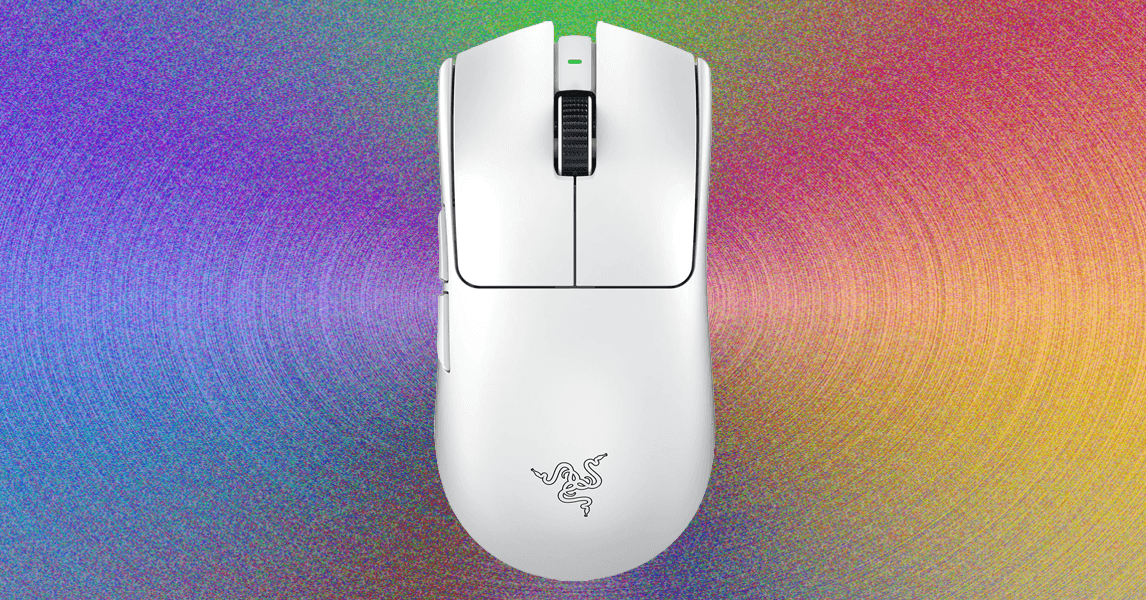
Razer Viper V3 Pro for $100: The previous-gen Viper V3 Pro remains a solid choice, especially since it’s selling for much less than the newer model. It remains an uncompromising mouse for lightweight, high-speed gaming performance. Despite being a couple of years old at this point, it still has competitive specs, the same great symmetrical shape, and some of the best-feeling buttons on the market. The battery lasts an incredibly long time (it’s rated for over 95 hours, and I didn’t need to charge it once during my testing). And with the included HyperPolling dongle, the mouse is capable of up to 8,000-Hz polling.
Sony Inzone Mouse-A for $148: Sony’s Inzone line is meant for a relatively upmarket audience, as evidenced by the price and build quality of both this mouse and its companion KBD-H75 keyboard. They are both incredibly well-made, with premium build quality and competitive specs. The Mouse-A is one of the lightest on this list, weighing only 48 grams. Despite this, it feels far more premium than other mice of comparable weight, using soft-touch plastics and feeling incredibly rigid during use. The mouse buttons feel good, with a subtle click, and the overall shape is simple and non-sculpted, comfortable for both left- and right-handed use (although it only has side buttons for right-handed users). This mouse has issues with wireless connectivity and battery life (between tests, I found it drained the entire battery life while disconnected), and I didn’t like the mouse wheel—there was a lot of space between each “bump” on the wheel, and I regularly found myself getting stuck between bumps when trying to scroll, resulting in a missed input. Like anything using a soft-touch coating, there is a concern that it will wear away and leave unsightly spots of exposed plastic with continuous use.
Disclaimer : This story is auto aggregated by a computer programme and has not been created or edited by DOWNTHENEWS. Publisher: wired.com