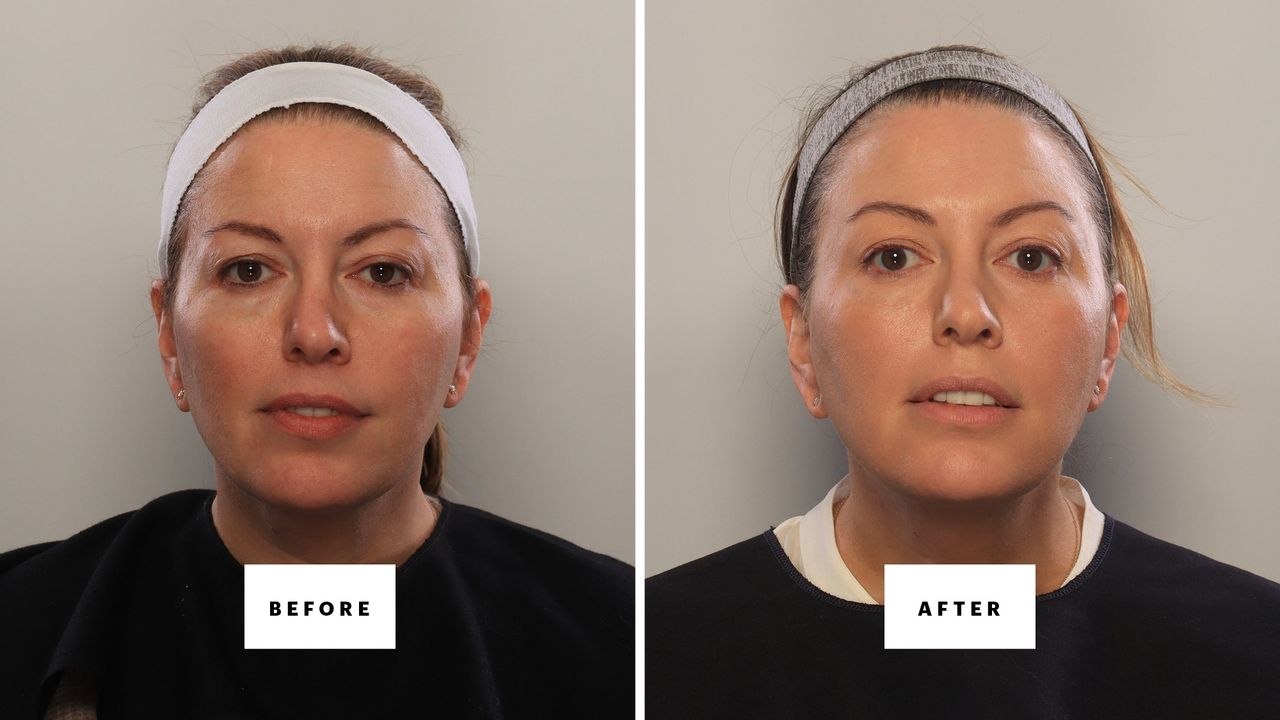
My shift in perspective landed me in the office of Ava Shamban, MD, a board-certified dermatologist in Los Angeles. She was on the same page as Dr. Diamond: “For you, we don’t want to erase the hooding. We want to tighten and support it.” Her strategy involved a series of non-surgical treatments done both in-office and at home that would target multiple factors: muscle, collagen, surface texture, and ligaments.
Over the next eight months, I worked through the following protocol in phases. Treatments aimed at improving structural support and skin laxity came first, followed by procedures targeting texture and skin quality. Sometimes I was just getting one treatment per appointment; other times, we’d do two in the same session. The sequencing allowed Dr. Shamban to assess how my face responded at each stage and build results gradually rather than chasing a dramatic one-time transformation.
One note: The downtime and side effects described throughout this story—many of which were minimal or non-existent—reflect my personal experience. All of these treatments come with some level of risk, and individual results and recovery time may vary based on the treatment, provider, settings, and the patient’s skin.
1. Muscle Support: EmFace
EmFace is a 30-minute treatment that combines radiofrequency to stimulate collagen with high-intensity electromagnetic stimulation to contract muscle. We started here because Dr. Shamban thinks muscle tone and structural support were the main cause of my issue; after a few weeks of EmFace-only appointments, she added more of the treatments below.
At each appointment, a grounding pad went on my stomach, and two adhesive strips were placed across my forehead and undereyes. When the machine was turned on, my brows and undereye areas would start twitching in rhythmic pulses. “The brow elevators are muscles,” says Dr. Shamban. “If we strengthen the lifters without over-relaxing the depressors, we create upward support.” Translation: Train the muscles that pull up, don’t just freeze the ones that tug down (which is what a neuromodulator like Botox does).
What it feels like: An involuntary eyebrow workout. Not painful, just quiver-y spasms, like your face is doing Pilates without asking you.
Downtime: I experienced no downtime or side effects, though temporary redness, warmth, and mild swelling can occur.
My results: Subtle but real. My brows felt more supported, with a slight visible lift in the outer corners that made my eyes look more open by the end of the series.
Series: 4 treatments, 1 week apart. Full results at 3-4 months
Lasts: 6 months
Devil’s Advocate: Studies are promising, but many are manufacturer-funded. If you’re expecting browlift-level results, temper expectations… a lot.
Price: $1,800 for series of four
2. Collagen Remodeling: Sofwave
If EmFace is about muscle training, Sofwave is about collagen building. About four weeks later, after EmFace had strengthened the muscles supporting my brow, Dr. Shamban layered in Sofwave to target the skin itself. In a Sofwave treatment, focused ultrasound energy penetrates the mid-dermis, deep enough to trigger increased collagen and elastin production, but not so deep that it melts the fat layer underneath. Around the eyes, that distinction is everything. You cannot afford to lose volume here. Instead, the goal is to make the skin that’s already there thicker, denser, and more supportive over time. “If you tighten along the brow, you can get a visible lift,” Dr. Shamban says.
Disclaimer : This story is auto aggregated by a computer programme and has not been created or edited by DOWNTHENEWS. Publisher: www.allure.com